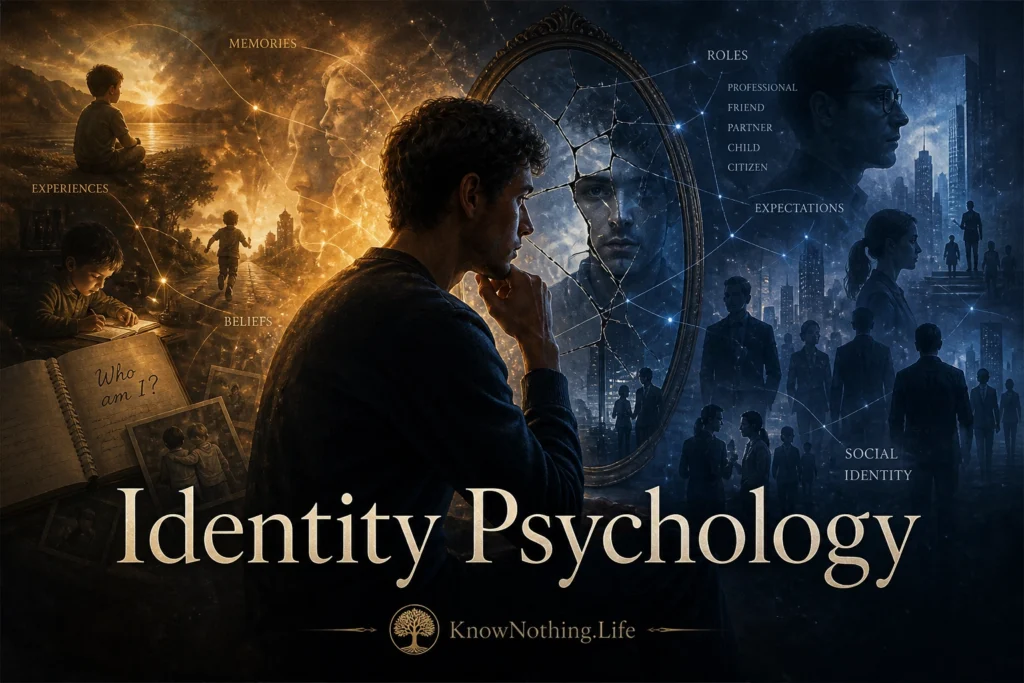
Identity psychology is the study of how human beings develop, maintain, question, revise, and defend a sense of who they are. Identity is not simply a name, personality type, job title, nationality, or private feeling. It is the organized meaning a person gives to their life across time: “This is who I have been, this is who I am, and this is who I am trying to become.” It includes memory, values, social roles, relationships, culture, body image, moral commitments, group belonging, and personal narrative. Identity answers practical questions as much as philosophical ones. What kind of person am I? Where do I belong? What do I owe others? Which parts of me are chosen, inherited, discovered, or imposed?
The psychology of identity has roots in philosophy, psychoanalysis, developmental psychology, sociology, and social psychology. William James, in The Principles of Psychology, made a famous distinction between the “I” as the knowing subject and the “Me” as the self that can be observed, described, and evaluated. Erik Erikson later placed identity at the center of human development, especially in adolescence, writing in Identity: Youth and Crisis that identity involves “a subjective sense of an invigorating sameness and continuity.” Modern identity psychology builds on these insights while recognizing that identity is not formed once and then finished. It is continuously shaped by memory, social feedback, trauma, culture, aspiration, conflict, and change.
The Self and the Structure of Identity
Identity begins with the self, but the self is not a single simple thing. William James divided the empirical self into material, social, and spiritual dimensions. The material self includes the body, possessions, and physical extensions of personhood. The social self includes the versions of oneself recognized by others. The spiritual self includes inner capacities, values, conscience, and subjective continuity. This framework remains powerful because it shows that identity is layered. A person may feel attached to their body, their family role, their reputation, their beliefs, their memories, and their private inner life, but these layers do not always align.
Charles Horton Cooley’s concept of the “looking-glass self,” developed in Human Nature and the Social Order, added an important social dimension. Cooley argued that people develop self-feelings by imagining how they appear to others, imagining others’ judgments, and experiencing pride or shame in response. Identity is therefore partly reflected back to us. We learn who we are not only by introspection but through recognition, rejection, praise, labeling, exclusion, and belonging. George Herbert Mead expanded this social view in Mind, Self, and Society, arguing that the self develops through taking the role of the other. In this tradition, identity is not a private object hidden inside the mind; it emerges through social life.
Erikson and the Development of Identity
Erik Erikson is one of the central figures in identity psychology. In Childhood and Society and Identity: Youth and Crisis, he described development as a series of psychosocial conflicts, with adolescence centered on “identity versus role confusion.” For Erikson, adolescence is the period when young people begin asking who they are beyond childhood dependence. They experiment with roles, beliefs, friendships, ideals, occupations, and forms of belonging. A stable identity allows the individual to move into adulthood with direction and continuity. Role confusion, by contrast, can leave a person feeling fragmented, uncertain, or overly dependent on external approval.
Erikson’s theory remains influential because it treats identity as both personal and historical. A young person does not form identity in a vacuum. They inherit a society’s available roles, ideals, conflicts, prejudices, and opportunities. Erikson’s work on figures such as Martin Luther and Mahatma Gandhi showed his belief that identity crises can also have historical significance. Some people resolve inner conflict by creating new forms of public meaning. Identity is therefore not merely adjustment to society; it can involve transformation of society. A person asks, “Who am I?” but also, “What kind of world am I entering, and what role can I play in it?”
Identity Status and Exploration
Psychologist James Marcia expanded Erikson’s theory by identifying four identity statuses: diffusion, foreclosure, moratorium, and achievement. These statuses are based on two processes: exploration and commitment. Identity diffusion occurs when a person has neither explored nor committed. Foreclosure occurs when a person commits to an identity without serious exploration, often by accepting family or cultural expectations. Moratorium describes active exploration without final commitment. Identity achievement occurs when a person has explored meaningful alternatives and made commitments that feel personally owned.
Marcia’s model is useful because it shows that a confident identity is not always a mature identity. Someone may seem certain because they have never questioned what they were given. Another person may seem uncertain because they are honestly exploring. Identity development often requires a period of discomfort, ambiguity, and experimentation. The goal is not permanent certainty, but commitments that are reflective enough to withstand pressure and flexible enough to grow. This is why identity psychology treats crisis not merely as failure, but as a potential stage of development. Confusion can become the doorway to deeper self-knowledge.
Narrative Identity and the Story of the Self
One of the most influential modern approaches is narrative identity theory, especially associated with Dan P. McAdams. In The Stories We Live By, McAdams argues that people create internalized life stories that give unity, meaning, and purpose to their lives. These stories connect past events, present identity, and imagined future. A person does not simply remember facts; they organize experience into themes such as redemption, contamination, struggle, calling, betrayal, survival, or growth. Identity becomes a story the person tells about why their life has taken its shape.
Narrative identity explains why two people can live through similar events but understand themselves differently. One person may interpret hardship as proof of failure, while another sees it as evidence of resilience. One may remember a turning point as humiliation, another as awakening. This does not mean identity is fictional in the sense of being false. Rather, it means human beings need narrative structure to make life intelligible. Philosopher Paul Ricoeur, in Oneself as Another, argued that selfhood involves narrative continuity, because the person remains the same not by being unchanged but by being able to integrate change into a meaningful life story.
Social Identity and Group Belonging
Identity is also collective. Henri Tajfel and John Turner’s social identity theory showed that people derive part of their self-concept from membership in groups. Nationality, religion, political affiliation, profession, gender, ethnicity, fandom, class, and community can all become sources of identity. Group belonging offers meaning, pride, loyalty, protection, and orientation. It tells people who “we” are, what “we” value, and how “we” differ from “them.” This helps explain why attacks on a group can feel like attacks on the self.
Social identity can produce solidarity, courage, and shared purpose, but it can also create prejudice and conflict. Tajfel’s minimal group experiments showed that even arbitrary group divisions can produce in-group favoritism. People may prefer their own group not because it is objectively superior, but because group identity becomes tied to self-esteem. This makes identity psychologically powerful and socially dangerous. When identity is organized around threat, humiliation, or purity, people may defend the group with irrational intensity. Identity psychology therefore helps explain both community and tribalism.
Culture, Recognition, and the Formation of the Self
Culture provides the symbols, roles, stories, and moral frameworks through which identity becomes thinkable. Hazel Markus and Shinobu Kitayama’s influential work on independent and interdependent self-construals showed that people in different cultural contexts may understand the self differently. In more individualistic settings, identity is often framed around autonomy, uniqueness, and personal achievement. In more collectivist settings, identity may be understood through relationship, duty, harmony, and role fulfillment. Neither model is simply natural or universal; both are culturally patterned ways of being a self.
Recognition is central to identity because people need their self-understanding to be acknowledged by others. Philosopher Charles Taylor, in “The Politics of Recognition,” argued that identity is partly shaped by recognition or its absence, and that misrecognition can inflict real harm. This insight matters psychologically. When people are repeatedly unseen, stereotyped, mocked, erased, or reduced to one trait, identity can become defensive or wounded. Healthy identity formation requires more than personal confidence. It requires social conditions in which people can be known with dignity and complexity.
Identity, Memory, and Continuity
Memory gives identity its temporal structure. Without memory, the self would be a series of disconnected moments. Yet memory is not a perfect recording device; it is reconstructive. People remember in light of current needs, beliefs, emotions, and narratives. Autobiographical memory helps a person maintain continuity, but it also allows revision. A person may reinterpret childhood, reevaluate a relationship, forgive an earlier self, or discover that an old story no longer fits. Identity changes when memory is reorganized.
John Locke’s philosophical theory of personal identity, developed in An Essay Concerning Human Understanding, tied identity to consciousness and memory. Though modern psychology complicates Locke’s view, his basic intuition remains important: to be a person is to have some continuity of awareness across time. Contemporary research on autobiographical memory supports the idea that identity depends on remembered episodes, emotional themes, and self-defining memories. These memories act like anchors. They tell a person, “This mattered. This changed me. This is part of who I am.”
Identity Conflict and Fragmentation
Identity becomes difficult when different parts of the self come into conflict. A person may feel torn between family expectations and personal desire, private values and public role, cultural inheritance and social pressure, past identity and future aspiration. Leon Festinger’s theory of cognitive dissonance helps explain why such conflicts are uncomfortable. When behavior and self-concept contradict each other, people experience psychological tension. They may change behavior, revise beliefs, deny responsibility, or reinterpret the situation in order to restore coherence.
Carl Jung’s psychology also offers a useful language for identity conflict. In Two Essays on Analytical Psychology, Jung described individuation as the process of integrating unconscious or rejected parts of the psyche into a more whole personality. His concept of the shadow refers to traits, desires, and fears that the conscious identity refuses to acknowledge. Whether or not one accepts Jung’s full theoretical system, the insight is valuable: identity built only on acceptable self-images can become brittle. Mature identity requires confronting what has been denied, not simply polishing the persona.
Identity in the Digital Age
Digital life has transformed identity psychology by multiplying the spaces in which the self is performed, edited, judged, and archived. Social media profiles, avatars, usernames, posts, images, comments, and metrics allow people to experiment with identity, but they also create pressure to become visible, branded, and approved. Erving Goffman’s The Presentation of Self in Everyday Life is especially relevant here. Goffman argued that social life involves performance, impression management, and roles. Online spaces intensify this process because the self can be curated and quantified through likes, shares, followers, and reactions.
Digital identity can be liberating for people who lack recognition in their offline environments. It can allow exploration, community, creativity, and self-expression. Yet it can also fragment identity by encouraging people to mistake performance for selfhood. When a person becomes overly dependent on external validation, identity may grow unstable. The question shifts from “Who am I?” to “How am I being received?” Identity psychology helps explain why online life can feel both empowering and exhausting. The self is extended, but also exposed.
Final Thoughts on Identity Psychology
Identity psychology matters because human beings need continuity, meaning, and recognition in order to live coherently. People are not only organisms responding to stimuli; they are selves interpreting their lives. They remember, compare, explain, defend, belong, imagine, and revise. Identity gives direction to action and meaning to suffering. It tells people what matters, who matters, and what kind of future is worth pursuing. Without some sense of identity, freedom becomes disorientation; with too rigid an identity, growth becomes threatening.
The strongest identity is not the one that never changes, but the one that can remain coherent through change. James teaches that the self has many layers; Cooley and Mead show that identity is socially reflected; Erikson reveals identity as a developmental achievement; Marcia shows the importance of exploration and commitment; McAdams demonstrates that people live by stories; Tajfel and Turner explain the power of group belonging; Goffman reveals the performative side of social life. Together, these thinkers show that identity is both discovered and made. It is inherited, performed, remembered, narrated, recognized, and revised across the whole course of life.