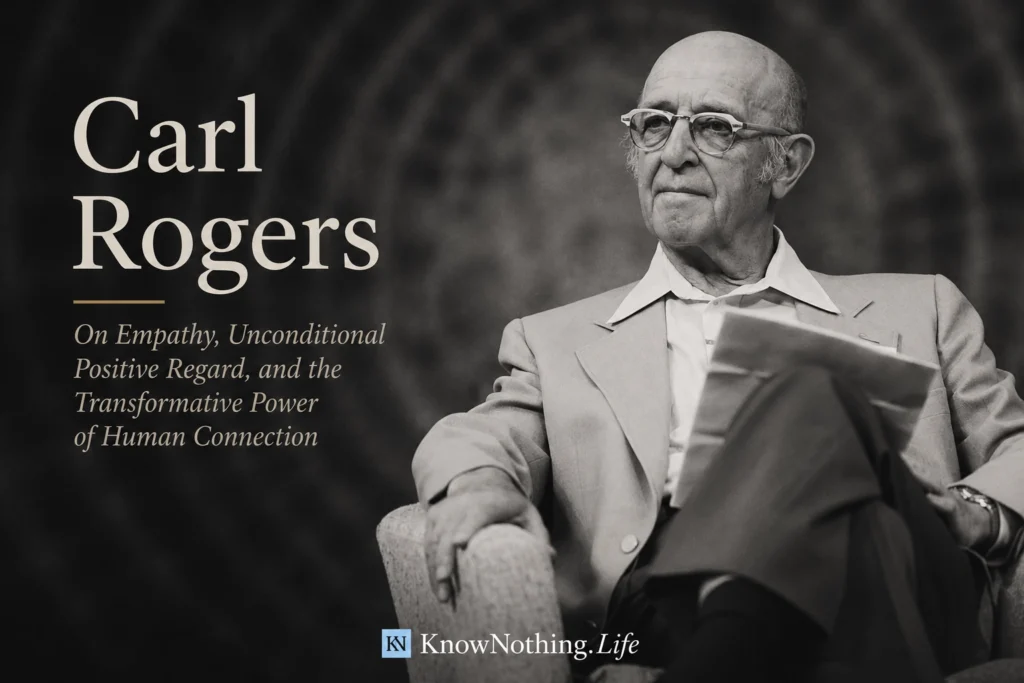
Few figures in modern psychology have reshaped the understanding of human nature as profoundly as Carl Rogers. As one of the founders of humanistic psychology and the creator of person-centered therapy, Rogers challenged nearly every major psychological assumption dominating the twentieth century. At a time when psychoanalysis focused heavily on unconscious conflict and behaviorism reduced human action to environmental conditioning, Rogers introduced a radically different perspective: human beings possess an innate drive toward growth, healing, and self-realization when placed in the right conditions.
Rogers believed people are not fundamentally broken organisms requiring control or correction. Instead, he argued that psychological distress often emerges when individuals become disconnected from their authentic selves because of external judgment, social expectations, and conditional acceptance. His work transformed psychotherapy by shifting the therapist’s role away from authority and interpretation toward empathy, acceptance, and authentic human connection. Beyond clinical psychology, his ideas profoundly influenced education, leadership, conflict resolution, and modern conversations about emotional intelligence and personal development.
Early Life and Intellectual Formation
Carl Ransom Rogers was born on January 8, 1902, in Oak Park, Illinois, into a deeply religious and highly disciplined family. Raised in a conservative Protestant household, Rogers experienced a childhood defined by strict moral expectations, intellectual seriousness, and relative social isolation. His parents valued hard work, self-discipline, and religious devotion, but emotional expression was often restrained. Rogers later reflected that these early experiences shaped his lifelong fascination with the relationship between identity, acceptance, and emotional development.
Initially, Rogers had no intention of becoming a psychologist. He enrolled at the University of Wisconsin to study agriculture, reflecting his family’s practical values and rural lifestyle. Over time, however, his interests shifted dramatically toward religion, philosophy, and eventually psychology. A transformative international trip to China exposed him to diverse cultures and beliefs, causing him to question many of the rigid convictions that had shaped his upbringing. This intellectual awakening would later become central to his philosophical commitment to openness, self-discovery, and independent thinking.
Rogers eventually pursued graduate studies at Columbia University, where he trained in clinical psychology while working with troubled children and families. During this period, he began to question traditional therapeutic approaches that placed the therapist in a position of expert authority. His direct experience with patients convinced him that healing often emerged not through interpretation or diagnosis but through genuine understanding and emotional acceptance.
Challenging Traditional Psychology
In the early twentieth century, psychology was largely dominated by two powerful schools of thought. Psychoanalysis, pioneered by Sigmund Freud, viewed human behavior as driven largely by unconscious conflict, childhood trauma, and internal psychological struggle. Behaviorism, advanced by thinkers such as John B. Watson and B. F. Skinner, focused exclusively on observable behavior shaped through reinforcement and environmental conditioning.
Rogers found both frameworks deeply limiting. Psychoanalysis, in his view, overemphasized pathology and treated patients as collections of hidden dysfunctions waiting to be interpreted. Behaviorism ignored the internal world altogether, reducing human beings to predictable machines responding to external stimuli. Rogers believed both approaches fundamentally misunderstood human nature by failing to recognize the individual’s inherent capacity for self-directed growth and healing.
This dissatisfaction helped Rogers become one of the leading architects of humanistic psychology alongside Abraham Maslow. Humanistic psychology emphasized personal agency, self-awareness, emotional authenticity, and the human drive toward fulfillment. Rogers believed psychology had become too focused on controlling behavior and not focused enough on understanding the lived human experience itself.
Person-Centered Therapy
Rogers’ most revolutionary contribution was the development of person-centered therapy, sometimes called client-centered therapy. Unlike traditional therapy models where the therapist acts as expert authority, Rogers argued that the client possesses the internal resources necessary for growth and healing. The therapist’s role is not to direct, diagnose, or interpret, but to create conditions that allow the individual’s natural developmental processes to emerge.
According to Rogers, three core therapeutic conditions are essential for psychological growth. The first is empathy, the therapist’s ability to deeply understand another person’s internal experience. The second is unconditional positive regard, meaning acceptance of the individual without judgment or conditions. The third is congruence, the therapist’s authenticity and emotional genuineness within the therapeutic relationship. When these conditions exist, Rogers believed people naturally move toward greater psychological health.
This model represented a profound departure from traditional psychotherapy. Rogers famously wrote, “The curious paradox is that when I accept myself just as I am, then I can change.” This idea captured the philosophical foundation of his work: genuine transformation begins not with force or correction but with acceptance. Healing occurs when individuals feel safe enough to explore who they truly are without fear of rejection.
The Self and Human Identity
Central to Rogers’ theory was the concept of the self. He argued that every person develops a self-concept, an internal understanding of who they believe themselves to be. Psychological distress often occurs when there is incongruence between the self-concept and lived experience. In simple terms, people suffer when the person they believe they should be conflicts with who they genuinely are.
Rogers believed society frequently creates this conflict through what he called conditions of worth. From childhood, individuals often learn that acceptance and love are conditional upon behaving in ways others approve of. Parents, teachers, institutions, and cultural expectations teach people to suppress authentic feelings in exchange for validation. Over time, this disconnect can create anxiety, depression, identity confusion, and emotional fragmentation.
Healthy development, according to Rogers, requires moving toward congruence—the alignment between authentic experience and self-perception. He believed the healthiest individuals are those capable of living openly, trusting their own experiences, adapting flexibly to change, and engaging with life fully. His famous statement, “What I am is good enough if I would only be it openly,” reflects this deep commitment to authenticity as the foundation of psychological well-being.
Major Works and Intellectual Contributions
Rogers’ ideas reached wide audiences through several influential books that helped redefine psychotherapy. Counseling and Psychotherapy (1942) introduced his early thinking about non-directive therapeutic practice and challenged traditional therapist-centered models. This work began establishing the foundation for what would later become person-centered therapy.
His landmark work Client-Centered Therapy (1951) fully articulated the theory that transformed modern psychotherapy. In this book, Rogers systematically explained how empathy, acceptance, and authentic connection allow psychological healing to emerge naturally. The work became one of the most influential psychotherapy texts of the twentieth century and helped shift therapeutic practice toward more collaborative relationships between therapist and client.
Later, On Becoming a Person (1961) expanded his ideas beyond clinical psychology into broader questions of identity, growth, creativity, and personal transformation. The book remains widely read today because it addresses universal questions about authenticity and self-development. Rogers increasingly believed his ideas applied not only to therapy but to education, leadership, family relationships, and even international diplomacy.
Education and Beyond Therapy
Rogers believed the principles that foster psychological growth also apply directly to education. Traditional educational systems, he argued, often emphasize obedience, memorization, and external evaluation at the expense of curiosity and self-directed learning. He believed true learning occurs when individuals feel psychologically safe enough to explore ideas freely and engage actively with their own interests.
His educational philosophy influenced modern student-centered teaching methods, experiential learning models, and approaches emphasizing emotional safety within classrooms. Teachers, like therapists, should create environments built on empathy, trust, and respect rather than authority alone. Learning is most powerful when students feel ownership over their intellectual development.
Beyond education, Rogers later became involved in conflict resolution and peacebuilding. He applied his principles of empathic communication to political and international disputes, believing authentic listening could reduce polarization and help people navigate deeply entrenched conflict. His work demonstrated that psychological principles developed in therapy could apply broadly to society itself.
Criticism and Scientific Debate
Despite Rogers’ enormous influence, critics argued his theories were overly optimistic about human nature. Behaviorists claimed concepts such as self-actualization, authenticity, and unconditional positive regard were difficult to measure scientifically. More traditional psychoanalysts believed Rogers underestimated the power of unconscious conflict and internal psychological defenses.
Others argued that unconditional acceptance may not fully address severe mental illness or deeply destructive behavioral patterns. Some researchers questioned whether empathy alone can create meaningful therapeutic change across all psychological conditions. These debates remain active in psychotherapy research today.
Yet Rogers welcomed scientific criticism and consistently supported empirical research testing his theories. Over time, large bodies of evidence demonstrated that therapeutic alliance—the quality of connection between therapist and client—is one of the strongest predictors of successful treatment outcomes, reinforcing many of Rogers’ central claims.
Legacy and Lasting Influence
Carl Rogers fundamentally transformed psychotherapy by redefining the relationship between therapist and client. His work helped shift psychology away from authority-driven treatment models toward collaborative, empathic, relationship-centered approaches that now dominate much of modern counseling and psychotherapy practice.
His influence extends far beyond psychology into coaching, education, leadership theory, emotional intelligence research, and conflict resolution. Concepts such as active listening, emotional validation, empathy-driven leadership, and authentic communication trace directly back to Rogers’ ideas. Alongside Abraham Maslow, he helped establish a more optimistic understanding of human potential within modern psychology.
Rogers once wrote, “People are just as wonderful as sunsets if I can let them be.” Few statements better capture his worldview. He believed people flourish not when controlled, judged, or fixed, but when given space to discover who they truly are.
Final Thoughts
To study Carl Rogers is to encounter one of psychology’s most compassionate and transformative thinkers. He challenged deeply entrenched assumptions about therapy, education, and human nature itself by insisting that growth comes not from force but from understanding. His ideas remain deeply influential because they speak to something universal: the human desire to be seen, accepted, and understood authentically.
In a world often driven by judgment, competition, and external expectations, Rogers offered a radically human vision of psychological well-being. His legacy reminds us that transformation rarely begins when people are told what they should become. It begins when people feel safe enough to become who they already are. Few psychologists have placed such profound trust in the human capacity for growth, and that belief continues to shape the future of psychology today.