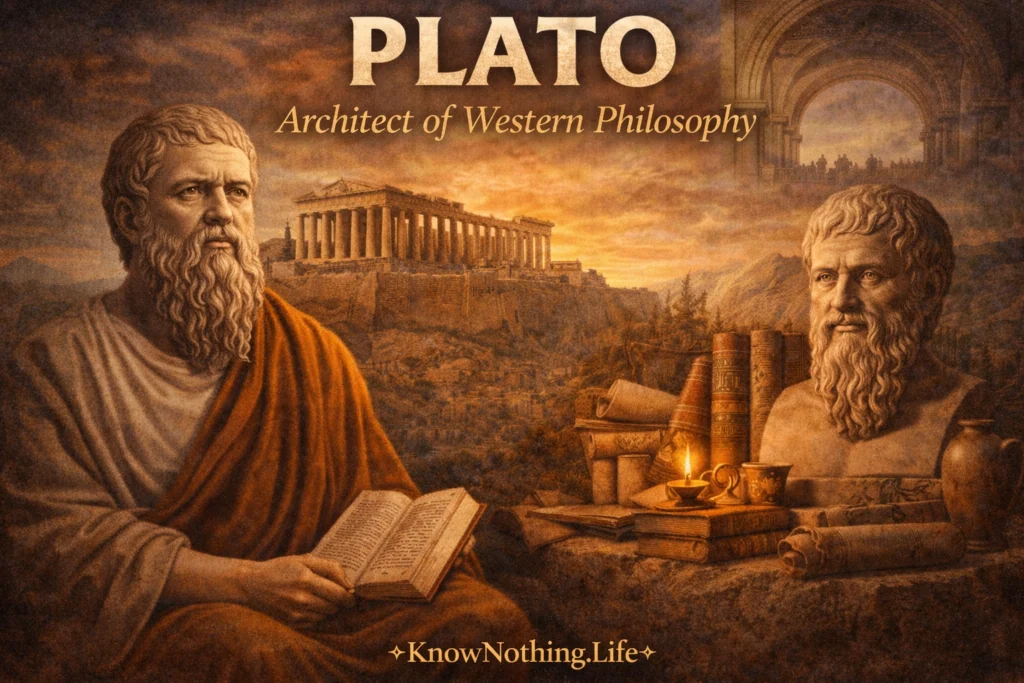
The philosophical legacy of Plato is so foundational that much of Western intellectual history can be read as a continuation—or critique—of his ideas. A student of Socrates and teacher of Aristotle, Plato occupies a central position in a lineage that shaped philosophy, science, politics, and education for over two millennia. Yet his importance lies not only in his role as a transmitter of Socratic thought, but in his original contributions to metaphysics, epistemology, ethics, and political theory.
Born into an aristocratic family in Athens around 427 BCE, Plato lived during a period of profound instability following the Peloponnesian War. The collapse of Athenian political confidence and the execution of Socrates left a deep imprint on his philosophical orientation. Rather than engaging in politics directly, Plato turned to philosophy as a means of understanding—and correcting—the failures of society. His writings, preserved in the form of dialogues, continue to define the questions that philosophy seeks to answer.
Early Life and Intellectual Formation
Plato’s early life was shaped by privilege, education, and political expectation. His family connections placed him close to the ruling elite of Athens, and it is likely that he initially considered a career in public life. However, his encounter with Socrates fundamentally altered his trajectory. Through Socrates, Plato was introduced to a mode of inquiry that prioritized truth over status and moral clarity over political ambition.
The execution of Socrates in 399 BCE became a turning point. Witnessing the democratic state condemn a man he regarded as the most just and wise of his time led Plato to question the legitimacy of political authority grounded in popular opinion. This disillusionment is evident throughout his later works, where he critiques democracy and explores alternative forms of governance rooted in knowledge and virtue.
Following Socrates’ death, Plato traveled extensively, reportedly visiting regions such as Egypt and southern Italy. These journeys exposed him to diverse intellectual traditions, including Pythagorean thought, which influenced his emphasis on mathematics and abstract reasoning. When he eventually returned to Athens, he established a school that would become one of the most important institutions in intellectual history.
The Academy and Philosophical Mission
Around 387 BCE, Plato founded the Academy in Athens, often regarded as the first institution of higher learning in the Western world. Unlike the informal discussions of Socrates, the Academy represented a structured environment for philosophical inquiry, where students engaged with mathematics, dialectics, and the study of forms. It was here that Aristotle would later study, further extending Plato’s influence.
The Academy was not merely a place of education; it was an embodiment of Plato’s philosophical vision. He believed that knowledge was not simply acquired through sensory experience, but through intellectual ascent—an awakening of the mind to higher truths. This belief shaped both the curriculum and the method of instruction, emphasizing dialogue, reasoning, and the pursuit of universal principles.
Plato’s mission extended beyond education into the realm of political reform. He envisioned a society governed not by wealth or power, but by wisdom. His idea of the “philosopher-king”—a ruler guided by knowledge of the good—reflects his conviction that only those who understand truth are fit to lead. This ideal, though rarely realized, remains one of the most influential concepts in political philosophy.
Works and Dialogues
Plato’s philosophical contributions are preserved in a series of dialogues, many of which feature Socrates as the central character. These works are not systematic treatises, but dynamic conversations that explore complex ideas through argument and counterargument. Among the most important are The Republic, The Symposium, Phaedo, and Timaeus.
In The Republic, Plato presents his vision of an ideal state, structured around the concept of justice. The dialogue introduces the famous Allegory of the Cave, a metaphor for human ignorance and the transformative power of philosophical knowledge. Individuals, Plato suggests, are like prisoners in a cave, mistaking shadows for reality. Only through philosophical inquiry can they ascend to the world of true forms.
The Symposium explores the nature of love, presenting it not merely as desire, but as a force that drives the soul toward beauty and truth. In Phaedo, Plato addresses the immortality of the soul, offering arguments that blend logic with metaphysical insight. Meanwhile, Timaeus ventures into cosmology, proposing a structured and rational universe shaped by a divine craftsman.
These works demonstrate Plato’s range as a thinker, moving seamlessly between ethics, metaphysics, and natural philosophy. His dialogues remain central texts in philosophical education, not only for their content but for their method of inquiry.
Theory of Forms and Epistemology
At the core of Plato’s philosophy lies the Theory of Forms, a radical attempt to explain the nature of reality and knowledge. According to this theory, the physical world is not the ultimate reality, but a shadow of a higher, unchanging realm of forms or ideas. These forms—such as beauty, justice, and equality—exist independently of the material world and provide the true basis for knowledge.
This distinction between appearance and reality has profound implications. For Plato, sensory experience is inherently unreliable, as it deals with objects that are constantly changing. True knowledge, therefore, cannot be derived from the senses alone; it must come from intellectual insight into the forms. This perspective elevates reason above perception and establishes philosophy as a path to deeper understanding.
Plato’s epistemology is closely tied to his concept of recollection, the idea that learning is a process of remembering truths that the soul already knows. This view suggests that knowledge is not acquired from external sources, but uncovered through internal reflection. It reinforces his belief in the immortality of the soul and its connection to a higher realm of existence.
Political Philosophy and Ethics
Plato’s political thought is inseparable from his ethical framework. In The Republic, he argues that justice in the state mirrors justice in the individual. A well-ordered society, like a well-ordered soul, is one in which each part fulfills its proper function. This analogy leads to his division of society into three classes: rulers, guardians, and producers.
His critique of democracy is particularly striking. Plato viewed democratic systems as vulnerable to manipulation and driven by the desires of the masses rather than rational judgment. In contrast, he advocated for rule by philosopher-kings—individuals who have attained knowledge of the forms and are therefore capable of governing wisely. While this idea has been both influential and controversial, it reflects his deep concern with aligning power and knowledge.
Ethically, Plato emphasizes the cultivation of virtue through reason. The highest good, often identified with the Form of the Good, serves as the ultimate standard for moral action. To live a virtuous life is to align oneself with this higher reality, transcending the limitations of the physical world. His philosophy thus integrates ethics, politics, and metaphysics into a unified vision of human flourishing.
Quotes and Key Ideas
Plato’s writings are rich with memorable insights that continue to resonate across disciplines. Among his most enduring quotes:
- “The beginning is the most important part of the work.”
- “Ignorance, the root and stem of all evil.”
- “Love is the pursuit of the whole.”
- “Reality is created by the mind; we can change our reality by changing our mind.”
These statements reflect central themes in his philosophy: the importance of education, the dangers of ignorance, the transformative power of love, and the role of the mind in shaping experience. They offer concise expressions of ideas that are developed in greater depth throughout his dialogues.
Beyond individual quotes, Plato’s key contributions include the Allegory of the Cave, the Theory of Forms, and the concept of the philosopher-king. Each of these ideas has influenced not only philosophy, but also literature, psychology, and political theory.
Legacy and Influence
The influence of Plato extends far beyond ancient Greece, shaping intellectual traditions across cultures and centuries. Through the Academy, he established a model for education that persists in modern universities. His student Aristotle would go on to challenge and refine his ideas, creating a dynamic interplay that defined classical philosophy.
In later periods, Plato’s work was preserved and interpreted by thinkers such as Plotinus, whose development of Neoplatonism integrated Platonic ideas with spiritual and mystical traditions. During the Renaissance, Plato’s writings experienced a revival, influencing art, science, and humanist thought. Even in contemporary philosophy, his questions about reality, knowledge, and justice remain central.
Plato’s enduring relevance lies in his ability to bridge abstract thought and practical concerns. His work challenges individuals to look beyond appearances, question assumptions, and strive for a deeper understanding of truth. In doing so, he established philosophy not merely as an academic discipline, but as a lifelong pursuit.
Conclusion
Plato stands as one of the most profound and comprehensive thinkers in human history. Through his dialogues, he preserved the spirit of Socratic inquiry while expanding it into a vast philosophical system that continues to shape the modern world. His exploration of reality, knowledge, and justice offers a framework for understanding both the individual and society.
In an age often dominated by surface-level information, Plato’s philosophy invites a return to depth—to the careful examination of ideas and the pursuit of enduring truths. His legacy is not confined to the past; it lives on in every act of questioning, every search for meaning, and every effort to align knowledge with virtue.