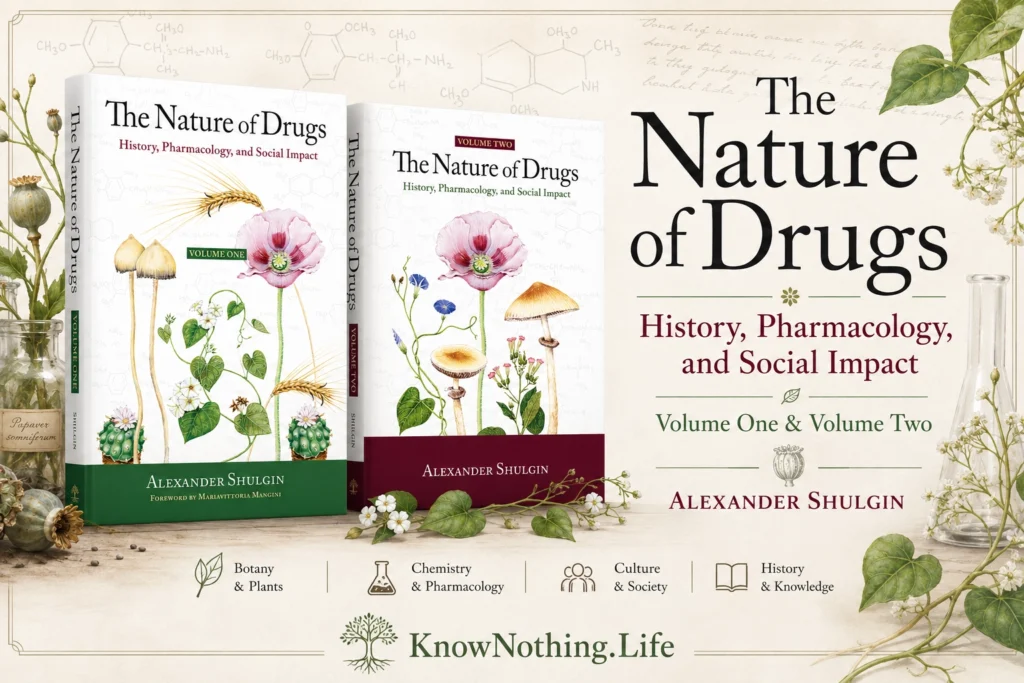
The Nature of Drugs: History, Pharmacology, and Social Impact preserves one of the clearest expressions of Alexander “Sasha” Shulgin’s philosophy of psychopharmacology. Rather than being written as a conventional textbook, the two-volume work was assembled from Shulgin’s 1987 San Francisco State University lectures, recorded on cassette by Ann Shulgin. Volume One, published in 2021, contains lectures 1 through 8; Volume Two continues with lectures 9 through 23. Together they examine what drugs are, how they enter and leave the body, how they affect the nervous system and consciousness, the properties of major drug categories, and the ways law and culture shape society’s understanding of psychoactive substances.
Shulgin begins with a question that sounds elementary: What is a drug? The difficulty of answering it becomes one of the book’s major themes. A substance can be a medicine, poison, recreational intoxicant, sacrament, research instrument, or ordinary commodity depending upon dose, purpose, biology, and social context. Caffeine, alcohol, nicotine, anesthetics, antidepressants, psychedelics, and powerful prescription medications all alter biological systems, yet societies place them into dramatically different moral and legal categories. Shulgin’s first lesson is therefore conceptual: the word “drug” describes chemistry only imperfectly. It also contains assumptions about medicine, acceptable behavior, risk, authority, and culture.
Pharmacology Begins With Dose, Not Moral Categories
Shulgin approaches psychoactive substances first as a chemist. A molecule does not know whether legislators consider it legal, physicians call it medicine, or society regards it as immoral. What matters biologically is how much of a substance reaches relevant tissues, how it interacts with receptors or other molecular targets, how quickly it is metabolized, and how sensitive the individual is to its effects. This perspective reflects one of toxicology’s oldest principles, associated with Paracelsus: substances cannot be divided neatly into inherently poisonous and inherently harmless categories because dose determines much of their biological impact.
Modern clinical pharmacology confirms the importance of this approach. Dose-response relationships are fundamental to balancing desired effects against adverse effects, and the therapeutic window of a substance may vary considerably among individuals. Shulgin uses such principles to challenge simplistic drug education based entirely on labels such as “good drug” and “bad drug.” Pharmacology requires more precise questions: What substance? In what quantity? Through what biological mechanism? In what organism? Under what circumstances? A drug can be beneficial at one exposure and harmful at another, while two chemically related substances can display substantially different pharmacological profiles.
The Body Changes the Drug, and the Drug Changes the Body
A substantial part of Shulgin’s course concerns the journey of drugs through the body. Volume One examines human anatomy, nervous-system organization, methods of administration, drug action, and research methodology. Rather than treating psychoactive experience as something mysterious that simply “happens,” Shulgin places it within pharmacokinetics and pharmacodynamics. Absorption determines how a compound enters circulation; distribution influences where it travels; metabolism converts it into other molecules; and elimination eventually removes it. Simultaneously, pharmacodynamics concerns what the compound and its metabolites actually do at biological targets.
The distinction has psychological importance because subjective intensity is not merely a property contained inside a molecule. The timing and concentration of a compound reaching the nervous system influence how its effects unfold, while genetic variation, metabolism, tolerance, health, expectation, and previous experience can modify the response. This is why pharmacology resists absolute statements such as “Drug X always causes experience Y.” Shulgin’s scientific outlook replaces certainty with conditional reasoning. A psychoactive substance creates a biological intervention, but the resulting experience emerges through interaction with a living, variable human system.
The Nervous System and the Chemistry of Consciousness
The book becomes especially characteristic of Shulgin when it moves from anatomy toward consciousness. Volume One explicitly includes memory and states of consciousness, while Volume Two examines specific drug classes including stimulants, depressants, intoxicants, deliriants, and psychedelics. For Shulgin, psychoactive compounds are interesting not merely because they change behavior but because they provide experimental tools for investigating the relationship between brain chemistry and subjective experience.
This idea connects Shulgin with William James, who argued in The Varieties of Religious Experience that ordinary waking consciousness may represent only one among multiple possible organizations of awareness. Modern psychedelic pharmacology gives that philosophical observation a biological foundation. Research has established that classic psychedelics such as LSD, psilocybin, and mescaline produce many of their characteristic effects through serotonin 5-HT2A receptor activity, showing how molecular interactions can produce profound changes in perception, mood, cognition, and self-experience. Yet the scientific explanation does not eliminate the philosophical puzzle. Knowing that a receptor has been activated is not the same as explaining why that activation produces a particular experience of color, time, meaning, fear, beauty, or altered identity.
Drugs Are Not Their Effects Alone
One of the most useful implications of Shulgin’s approach is that pharmacological action and human experience must be distinguished. Two people can receive the same psychoactive compound and report substantially different experiences. Individual psychology matters, as does environment. This principle became famous in psychedelic culture as set and setting: “set” encompasses expectations, mood, beliefs, personality, and intention, while “setting” refers to physical and social circumstances.
Later research has strengthened the case that these variables deserve serious scientific attention. Ido Hartogsohn’s review connects set-and-setting theory with research on expectancy and placebo effects, emphasizing that non-pharmacological factors can strongly influence responses to psychoactive substances. More recent research continues to investigate the influence of physical surroundings, companions, preparation, and intention. Psychologically, this undermines the idea that a drug acts like a prerecorded experience waiting to play. Chemistry establishes possibilities and constraints, but consciousness participates in determining how those possibilities are experienced.
Addiction Is Not Synonymous With Drug Use
Shulgin’s broad classification of psychoactive substances also encourages an important distinction between use, intoxication, dependence, and addiction. Public discussion often merges these concepts, implying that psychoactivity itself naturally progresses toward compulsive behavior. Pharmacology presents a much more complicated picture. Different drug classes possess substantially different reinforcing properties, tolerance profiles, withdrawal syndromes, and addiction potential. Classic serotonergic psychedelics, for example, are generally not regarded as producing the compulsive dependence patterns associated with substances such as opioids, nicotine, or powerful stimulants.
Contemporary addiction neuroscience further demonstrates why addiction cannot be reduced to the mere presence of a chemical. George Koob and Nora Volkow describe addiction as involving changes across interacting motivational, reward, stress, habit, and executive-control circuits, progressing through cycles of intoxication, withdrawal or negative affect, and preoccupation or anticipation. This modern framework complements Shulgin’s resistance to undifferentiated drug categories. The psychologically relevant question is not simply whether someone has consumed a psychoactive substance but how patterns of reinforcement, motivation, biology, stress, environment, and behavior interact over time.
Alcohol, Tobacco, and the Social Definition of Acceptable Drugs
Volume Two’s discussion of alcohol and tobacco is especially important because these substances reveal how inconsistent cultural definitions of drugs can become. Shulgin examines their chemistry and effects while also considering their cultural histories. Both are psychoactive, both can cause substantial harm, and both have occupied enormously influential roles in human societies. Yet their familiarity often makes them seem conceptually different from substances labeled simply as “drugs.”
This highlights a sociological problem. The risk attributed to a drug and the stigma surrounding its users are not determined by pharmacology alone. Sociologist Robin Room has shown that psychoactive substances accumulate powerful symbolic meanings and that stigma, marginalization, and social inequality can themselves contribute to drug-related harms. Michel Foucault’s broader analyses of social classification and institutional power offer a useful philosophical parallel: categories do more than describe behavior; they influence how institutions respond to people. Shulgin therefore encourages readers to distinguish empirical questions about pharmacology from cultural judgments about which altered states society considers legitimate.
Drug Laws, Knowledge, and the Politics of Fear
Shulgin devotes considerable attention to American drug enforcement and to the relationship between scientific knowledge and prohibition. Volume One includes the history of U.S. drug law enforcement, while the course as a whole develops his philosophy concerning societal and individual freedom around medicinal and exploratory drug use. His famous intellectual posture could be summarized by the phrase promoted by the publisher: “Just Say Know.” Rather than assuming that education should frighten people away from psychoactive substances, Shulgin argues for understanding what substances actually are and what evidence demonstrates about them.
The philosophical comparison with John Stuart Mill’s On Liberty is unavoidable. Mill defended substantial personal autonomy while accepting restrictions when individual actions seriously harm others. Drug policy places those principles into conflict: individual liberty, public health, impaired behavior, addiction risk, medical access, and social costs must all be considered. Shulgin clearly favors intellectual and personal freedom, but the strongest version of his argument is not that every drug is safe or that regulation is unnecessary. It is that policy should begin with accurate distinctions among substances and risks rather than allowing legal categories to substitute for scientific knowledge.
The Difference Between Intoxication, Delirium, and Psychedelia
Volume Two’s division of substances into stimulants, depressants, intoxicants, deliriants, and psychedelics illustrates another central lesson: altered consciousness is not one phenomenon. A sedative state, stimulant state, alcoholic intoxication, anticholinergic delirium, and serotonergic psychedelic experience arise from different pharmacological mechanisms and produce profoundly different psychological conditions. Treating all consciousness-altering substances as versions of the same experience obscures more than it explains.
Psychedelics provide an especially useful example. David Nichols’ comprehensive pharmacological review describes them as substances that strongly alter perception and mood while affecting numerous cognitive processes, with classic psychedelics primarily acting through serotonergic mechanisms. By contrast, addiction-producing stimulants or depressants engage substantially different reward and motivational systems. Shulgin’s classification therefore encourages a more mature psychological vocabulary for altered states. “Being high” is scientifically inadequate because the human nervous system can be altered along many dimensions, involving attention, memory, perception, arousal, inhibition, emotional processing, and self-awareness in distinct combinations.
What The Nature of Drugs Ultimately Teaches
The enduring strength of The Nature of Drugs is not that every detail of a 1987 pharmacology course remains current. Neuroscience, receptor pharmacology, addiction research, psychedelic science, and clinical medicine have all advanced substantially since Shulgin delivered these lectures. The book’s value lies instead in its method of thinking. Shulgin repeatedly asks readers to separate molecule from myth, pharmacology from law, dependence from mere use, dose from identity, and scientific evidence from cultural assumption. The published volumes preserve both a historical record of his teaching and a synthesis of his ideas about drugs, consciousness, and individual freedom.
That method remains relevant precisely because drugs occupy several worlds simultaneously. They are chemicals with measurable molecular properties, biological interventions capable of producing benefit or harm, psychological events shaped by expectation and environment, commodities embedded in markets, and symbols regulated through medicine, religion, law, and morality. No single perspective adequately explains them. The Nature of Drugs ultimately argues that understanding psychoactive substances requires resisting both romanticization and demonization. Shulgin’s most enduring lesson is therefore surprisingly simple: before deciding what society should think about a drug, we should first make the effort to understand what the drug actually is, what it does, how human beings respond to it, and why our culture has chosen to interpret it in the way that it has.