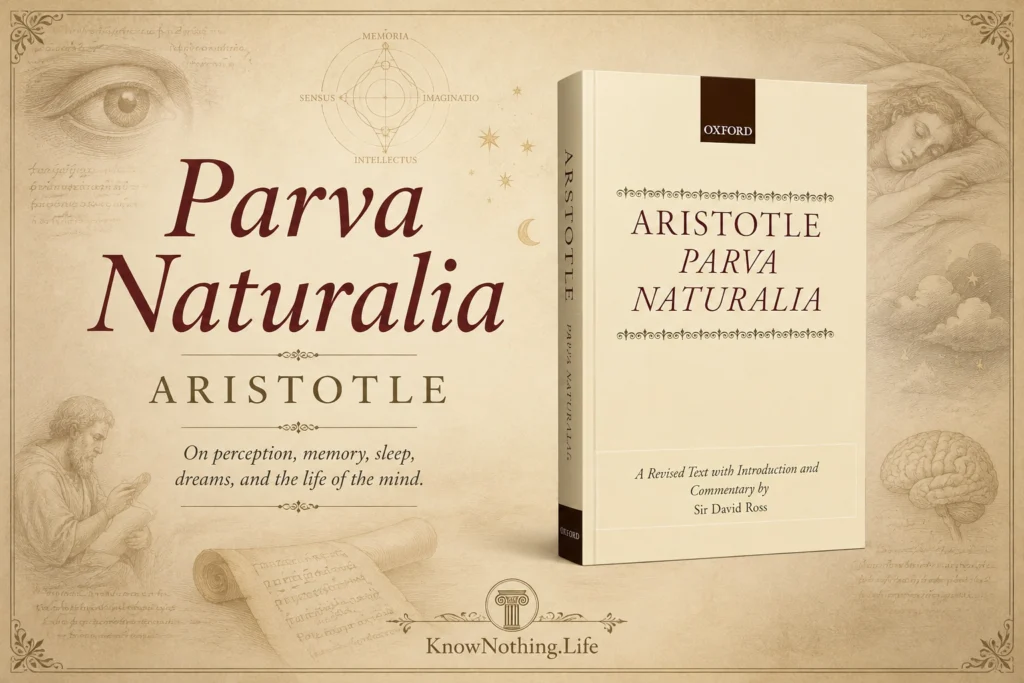
Aristotle’s Parva Naturalia is not a single continuous book but a group of short works concerned with the activities and conditions of living beings. The Latin title means roughly “little works on nature” or “short natural treatises,” and it appears to have emerged only in the medieval period rather than being a collective title Aristotle himself used. The essays are nevertheless connected by subject matter and by Aristotle’s attempt to apply the more general account of the soul developed in On the Soul to concrete phenomena such as perception, memory, sleep, dreaming, longevity, aging, respiration, and death. Depending on editorial tradition, the collection includes On Sense and the Sensible, On Memory and Recollection, On Sleep and Waking, On Dreams, On Divination in Sleep, On Length and Shortness of Life, and the interconnected treatments of youth, old age, life, death, and respiration; some ancient and modern arrangements also associate On the Motion of Animals with this group. The collective title itself appears to have arisen around the thirteenth century, although the individual treatises belong together thematically in Aristotle’s natural philosophy.
What makes Parva Naturalia especially important today is that Aristotle repeatedly refuses to treat psychological life as something wholly detached from the organism. Perceiving, remembering, sleeping, dreaming, aging, and waking are activities of living beings whose bodies matter to how those activities occur. This follows the hylomorphic psychology developed more theoretically in On the Soul, in which soul is not ordinarily an independently operating ghost inhabiting a body but the form and organizing principle of a living organism. The Stanford Encyclopedia of Philosophy consequently describes On the Soul as providing the more abstract framework while the Parva Naturalia applies Aristotle’s psychology to particular phenomena. Although Aristotle’s physiology is frequently obsolete, his guiding question remains remarkably familiar to contemporary psychology and neuroscience: how do mental capacities arise from, depend upon, and interact with the functioning of a living body?
Perception and the Unity of Experience
On Sense and the Sensible extends Aristotle’s analysis of perception beyond the basic theory of the senses in On the Soul. He considers color, sound, smell, taste, and the physical conditions under which perception occurs, but he is also interested in how separate senses contribute to a unified experience. Elsewhere in the collection, particularly On Sleep and Waking, Aristotle argues for a common or central perceptual capacity by which an animal can discriminate between information belonging to different senses. We do not merely see white and taste sweet independently; we can recognize that white is different from sweet. For Aristotle, some coordinating perceptual power therefore has to operate across the individual senses. He also makes perception central to animal life itself: animals differ fundamentally from plants through their possession of sensory capacities, an idea closely connected with his broader psychological system.
The resemblance to modern research on multisensory integration should not be overstated—Aristotle had no knowledge of neural networks or sensory cortices—but the psychological problem is recognizable. The brain does not normally produce five unrelated streams of consciousness; it combines information from multiple modalities into coherent perceptual events. Harry McGurk and John MacDonald famously demonstrated this interaction in their 1976 study “Hearing Lips and Seeing Voices.” When visual information from a speaker’s mouth conflicted with the sound being played, participants could perceive a speech sound different from the auditory stimulus itself, showing that seeing can alter what a person genuinely experiences as hearing. Aristotle’s “common sense” is not a modern neuroscience theory, but his insistence that perception requires some form of cross-sensory coordination anticipates an enduring problem in cognitive science: how many specialized channels become one experienced world.
Memory, Recollection, and Mental Time
On Memory and Recollection is arguably the most psychologically sophisticated work in the collection. Aristotle begins with a deceptively simple distinction: perception concerns what is present, expectation concerns what is future, while memory concerns what is past. Remembering therefore contains a temporal dimension. One does not merely possess an image or thought; one experiences it as deriving from something previously encountered. Aristotle compares the memory trace to an impression made by a seal and asks a difficult representational question: if the past object is absent, how can a present mental image refer to that absent event? His answer is that a representation can be regarded in two ways, much as a painting is simultaneously a physical picture and a likeness of another thing. A mental image becomes a memory when it is apprehended as referring back to a prior experience.
Even more striking is Aristotle’s distinction between simply remembering something and actively recollecting it. Recollection is a search. A person begins from one thought and moves through related thoughts until reaching the desired memory. Aristotle specifically mentions movement through things that are similar, contrary, or contiguous, and observes that habitual sequences become easier to traverse. He even notes the usefulness of starting points and ordered “places” for memory. This account became an important ancestor of later associationist theories developed by thinkers such as Thomas Hobbes, John Locke, David Hume, and the nineteenth-century experimental tradition. Modern memory experiments provide an intriguing parallel. Michael Kahana’s 1996 study of free recall found strong evidence for associative retrieval by temporal contiguity: after recalling one studied item, people showed an increased tendency to recall items encountered nearby in the original sequence. Aristotle’s language of movements and impressions belongs to ancient physiology, but his observation that one memory can cue another through an organized associative path remains fundamental to theories of retrieval.
Sleep and the Limits of Conscious Perception
In On Sleep and Waking, Aristotle approaches sleep as a natural biological phenomenon rather than merely a mysterious interruption of consciousness. His opening questions reveal the scope of the project: Does sleep belong to soul, body, or both? Why must animals sleep? What distinguishes sleeping from waking? He concludes that sleep and wakefulness belong to the same perceptual system and that sleep involves an inhibition or suspension of ordinary sensory functioning rather than the disappearance of the living organism’s capacities. Because perception is an activity involving both soul and body in his system, sleep likewise cannot be attributed exclusively to an immaterial soul or to an inanimate body. This is a particularly clear example of the embodied psychology running through Parva Naturalia.
Aristotle’s specific physiological explanation of sleep—involving digestion, heat, blood, and bodily processes—does not survive modern science. Yet his conviction that sleep performs an organized biological function rather than representing mere inactivity has strong modern echoes. Sleep research now indicates that sleeping brains remain highly active and that sleep contributes to memory processing. In a landmark 2007 experiment, Björn Rasch, Christian Büchel, Steffen Gais, and Jan Born paired learning with an odor and later presented that odor again during slow-wave sleep. Re-exposure during slow-wave sleep improved retention of hippocampus-dependent declarative memories and was associated with hippocampal activation. Contemporary models are obviously far removed from Aristotle’s account, but both reject the intuitive idea that sleep is simply a period during which mental functioning switches off.
Dreams as Natural Psychological Events
Aristotle’s On Dreams is notable for attempting to explain dreaming without appealing primarily to supernatural intervention. Dreams are connected to phantasia, usually translated as imagination or presentation: the mind can continue to experience internally generated perceptual-like appearances even when external sense organs are no longer operating normally. Aristotle observes that sensory stimulation can leave residual effects after the external stimulus disappears. Looking at a bright object can produce an afterimage; watching continuous movement can make stationary objects subsequently appear to move. He proposes that something analogous happens in dreams: sensory processes leave continuing movements whose effects become especially noticeable when ordinary perception is suppressed during sleep.
Modern neuroscience has again replaced Aristotle’s mechanisms while leaving the broader problem intact. Dream experience often recruits neural systems closely related to those involved in waking perception. In 2013, Tomoyasu Horikawa, Masako Tamaki, Yukiyasu Miyawaki, and Yukiyasu Kamitani used fMRI and machine-learning techniques to predict broad categories of visual imagery reported by subjects around sleep onset. Their findings showed meaningful correspondences between neural representations associated with dreamed imagery and representations involved in waking visual perception. Aristotle could not have anticipated brain imaging, but his proposal that dreams emerge from the perceptual system rather than from an entirely separate faculty is philosophically striking. Dreams, in his account, are strange because normal perceptual constraints have changed, not because the mind has entered a completely different metaphysical realm.
Prophetic Dreams and Aristotle’s Naturalistic Skepticism
On Divination in Sleep—often translated as On Prophesying by Dreams—reveals another characteristic feature of Aristotle’s method. He neither dismisses reports of apparently predictive dreams simply because they sound unusual nor accepts them because many people believe in them. At the beginning of the treatise he explicitly recognizes that widespread testimony gives the idea some initial plausibility while also observing that the lack of a credible causal mechanism gives reason for doubt. Aristotle therefore asks whether seemingly prophetic dreams might instead be explained through ordinary causes, coincidence, subtle bodily signals, or the influence that a dream can exert on someone’s later actions.
This is more than skepticism about dream prophecy. It exemplifies Aristotle’s broader commitment to causal explanation. The same intellectual impulse appears throughout the Posterior Analytics, where scientific knowledge requires knowing why something is the case rather than merely observing that it happens. Apparently extraordinary experiences should therefore be investigated through causes before supernatural explanations are invoked. Aristotle does leave more room for unusual causal possibilities than a contemporary experimental scientist would, but the methodological principle is recognizable. A surprising correlation is not yet an explanation. His treatment of dreams consequently joins an important thread running through the Parva Naturalia: subjective experience needs to be understood through the natural processes that produce it rather than being accepted at face value.
Aging, Respiration, Life, and Death
The later treatises widen the perspective from particular mental functions to the life cycle itself. On Length and Shortness of Life asks why some organisms live longer than others, while the works traditionally grouped as On Youth and Old Age, On Life and Death, and On Respiration investigate growth, decline, bodily heat, breathing, and the boundary between living and dying. Aristotle sees these subjects as connected because living organisms possess activities that require bodily maintenance. Youth, maturity, aging, and death are not isolated accidents but stages within a natural developmental sequence. Contemporary scholarship emphasizes that these writings form part of Aristotle’s broader biological project and that nutrition and the maintenance of organic processes play central explanatory roles in his account of life.
Much of the physiology is incorrect by modern standards. Aristotle regarded the heart as far more central to sensation and cognition than neuroscience permits, misunderstood respiration, and worked without knowledge of circulation, neurons, oxygen metabolism, genetics, or cellular aging. But the conceptual move remains significant. Mental life is placed inside a life history. Memory changes with age; sleep belongs to organisms with particular biological capacities; sensation depends on bodily organs; and the possibilities of psychological activity are constrained by growth, health, decline, and death. Even in On Memory and Recollection, Aristotle tries to explain differences between young and old memory through changing bodily conditions. His specific explanations fail, but the larger recognition—that cognition develops and changes along with the organism—would eventually become foundational to developmental psychology, neuropsychology, and cognitive aging research.
Why Parva Naturalia Still Matters
The scientific errors in Parva Naturalia are substantial enough that the collection should not be presented as a primitive neuroscience textbook. Aristotle’s biology was constructed without controlled experimentation in the modern sense and without knowledge of the nervous system needed to explain perception, memory, sleep, or dreams mechanistically. Yet judging the collection only by whether its physiological claims remain correct misses its intellectual achievement. Aristotle separates perception from memory, distinguishes passive remembering from active retrieval, links memory to temporal awareness, analyzes the persistence of sensory effects, treats dreams as products of natural psychological processes, investigates sleep as an embodied biological condition, and examines aging as part of the changing capacities of a living organism. Modern research on associative retrieval, multisensory perception, dream imagery, and sleep-dependent memory demonstrates that many of the questions he isolated remain active research problems even though contemporary answers are radically different.
Read alongside On the Soul, Posterior Analytics, History of Animals, and Parts of Animals, Parva Naturalia shows Aristotle attempting to create a unified science of living experience. The mind is not examined only when it reasons abstractly. It is also studied when it senses a color, searches for a forgotten name, falls asleep, constructs a dream, grows old, or eventually loses the biological conditions necessary for consciousness altogether. This is perhaps the collection’s most enduring philosophical insight. Human psychology cannot be fully understood by studying thought in isolation from perception, time, memory, sleep, bodily regulation, development, and the life cycle of the organism that thinks. More than two thousand years before the rise of scientific psychology, Aristotle was already asking how those processes fit together—and Parva Naturalia remains one of antiquity’s most ambitious attempts to answer that question.