Among the most influential thinkers of modern liberalism, John Stuart Mill stands as a central figure in the defense of individual freedom, rational inquiry, and social progress. Writing in the 19th century during a period of rapid industrial and political transformation, Mill sought to reconcile the ideals of liberty with the demands of an increasingly complex society. His work remains foundational to contemporary debates about free speech, personal autonomy, and the role of government.
Mill’s philosophy is notable for its balance—he was neither an uncritical advocate of individualism nor a blind supporter of collective authority. Instead, he argued that a just society must protect personal freedom while fostering conditions that allow individuals to flourish. His ideas, deeply rooted in utilitarianism yet expanded beyond it, continue to shape political theory, ethics, and public discourse.
Early Life and Intellectual Formation
John Stuart Mill was born in 1806 in London into an intellectually rigorous environment shaped by his father, James Mill, and his father’s close associate, Jeremy Bentham. From an early age, Mill was subjected to an intense educational program designed to cultivate a rational and disciplined mind. By his teenage years, he had mastered classical languages, philosophy, and political economy, acquiring a breadth of knowledge that few could match.
Despite this extraordinary intellectual training, Mill’s upbringing came at a psychological cost. In his early twenties, he experienced a profound mental crisis, questioning the value of the utilitarian philosophy he had been taught. This period of introspection led him to seek a more expansive understanding of human nature, one that acknowledged the importance of emotion, individuality, and personal fulfillment.
A crucial influence during this time was Harriet Taylor Mill, whose intellectual partnership with Mill significantly shaped his later work. Through their collaboration, Mill developed a more nuanced approach to ethics and social theory, incorporating considerations of equality, gender, and personal development into his philosophy.
Utilitarianism Revisited
Mill’s philosophical foundation lies in utilitarianism, a theory initially developed by Bentham, which holds that actions should be judged by their consequences, specifically their contribution to overall happiness. However, Mill refined this doctrine in important ways, addressing criticisms that it reduced human experience to mere calculations of pleasure and pain.
In his work Utilitarianism, Mill distinguishes between higher and lower pleasures, arguing that intellectual and moral pleasures are qualitatively superior to purely physical ones. As he famously stated, “It is better to be a human being dissatisfied than a pig satisfied; better to be Socrates dissatisfied than a fool satisfied.” This distinction elevates the role of human capacities such as reason, imagination, and moral judgment.
By expanding utilitarianism in this way, Mill sought to preserve its emphasis on well-being while recognizing the complexity of human experience. His version of the theory acknowledges that not all forms of happiness are equal, and that a truly fulfilling life involves the cultivation of higher faculties.
On Liberty and the Defense of Individual Freedom
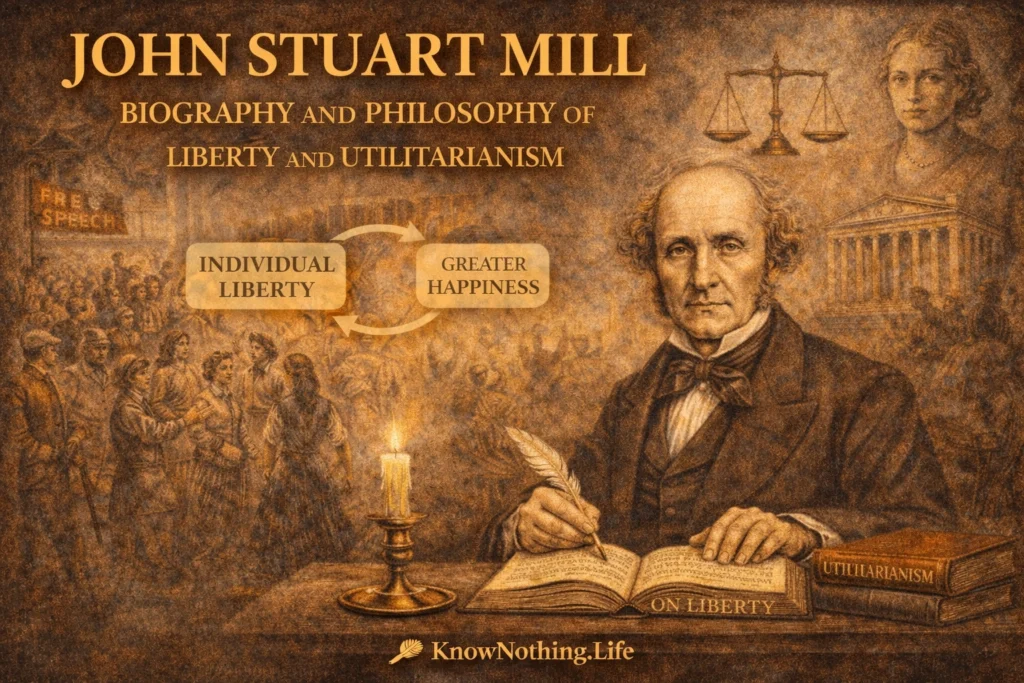
Mill’s most celebrated work, On Liberty, offers a powerful defense of individual freedom against both governmental and social interference. At the core of this work is the “harm principle,” which states that the only legitimate reason for restricting an individual’s liberty is to prevent harm to others. This principle remains a cornerstone of liberal political philosophy.
Mill argued that freedom of thought and expression is essential not only for individual development but for the advancement of society as a whole. Even false or unpopular opinions, he maintained, have value because they challenge prevailing beliefs and contribute to a deeper understanding of truth. As he wrote, “He who knows only his own side of the case knows little of that.”
Beyond free speech, Mill emphasized the importance of individuality as a source of social progress. He believed that allowing individuals to experiment with different ways of living fosters creativity and innovation, benefiting society as a whole. His defense of personal autonomy extends beyond politics, offering a vision of human life grounded in self-discovery and growth.
The Subjection of Women and Social Equality
Mill was also a pioneering advocate for gender equality, a position articulated most clearly in The Subjection of Women. In this work, he argues that the legal and social subordination of women is unjust and detrimental to society. Drawing on both moral and practical considerations, Mill contends that equality between men and women would lead to greater happiness and progress.
His arguments were groundbreaking for their time, challenging deeply entrenched social norms and advocating for reforms such as women’s suffrage and access to education. Mill’s collaboration with Harriet Taylor Mill played a crucial role in shaping these ideas, highlighting the importance of intellectual partnership in his work.
By addressing issues of inequality, Mill expanded the scope of liberal philosophy, demonstrating that the principles of liberty and justice must apply universally. His advocacy for women’s rights reflects a broader commitment to social reform and human dignity.
Political Economy and the Limits of Capitalism
In addition to his philosophical writings, Mill made significant contributions to economic thought, particularly in his work Principles of Political Economy. While he initially adhered to classical economic theories, Mill later developed a more critical perspective on capitalism, recognizing its potential to produce inequality and social instability.
Mill distinguished between the laws of production, which he saw as governed by natural forces, and the distribution of wealth, which he believed could be shaped by human institutions. This distinction allowed him to advocate for reforms aimed at reducing inequality, such as progressive taxation and cooperative ownership.
Unlike Karl Marx, who called for the abolition of capitalism, Mill sought to reform the system from within. His approach reflects a pragmatic commitment to balancing economic efficiency with social justice, a perspective that continues to influence contemporary debates about economic policy.
Ethics, Character, and the Development of the Individual
Mill’s philosophy extends beyond political and economic concerns to encompass a broader vision of human development. He believed that a good society is one that encourages the cultivation of character, intellect, and moral sensibility. This emphasis on personal growth distinguishes his work from more narrowly focused political theories.
Central to this vision is the idea that individuals should be free to pursue their own conception of the good life, provided they do not harm others. This principle allows for a diversity of lifestyles and values, reflecting Mill’s commitment to pluralism and tolerance. He saw this diversity as a strength rather than a weakness, contributing to the richness of human experience.
Mill’s ethical thought also emphasizes the importance of education and cultural development in shaping individuals. By fostering critical thinking and moral awareness, society can create conditions in which individuals are better equipped to make informed and responsible choices.
Legacy and Influence
John Stuart Mill’s influence extends across philosophy, politics, and social theory, shaping modern liberal thought in profound ways. His defense of individual liberty, his refinement of utilitarianism, and his advocacy for social reform have left an enduring mark on intellectual history.
Mill’s ideas continue to inform contemporary discussions about free speech, human rights, and the role of government. His work has been particularly influential in democratic societies, where the balance between individual freedom and collective responsibility remains a central concern.
Beyond his immediate impact, Mill’s philosophy has inspired generations of thinkers to explore the complexities of human freedom and social progress. His commitment to reason, individuality, and justice ensures that his work remains relevant in an ever-changing world.
Final Thoughts
John Stuart Mill stands as one of the most important voices in the tradition of liberal philosophy. His work offers a nuanced and compelling vision of a society that values both individual freedom and collective well-being. By addressing the challenges of his time with intellectual rigor and moral clarity, he provided a framework for thinking about issues that continue to shape our world.
His enduring message—that liberty, when properly understood, is essential to human flourishing—remains as powerful today as it was in the 19th century. Through his writings, Mill invites us to consider not only how we live, but how we might live better, both as individuals and as members of a broader community.