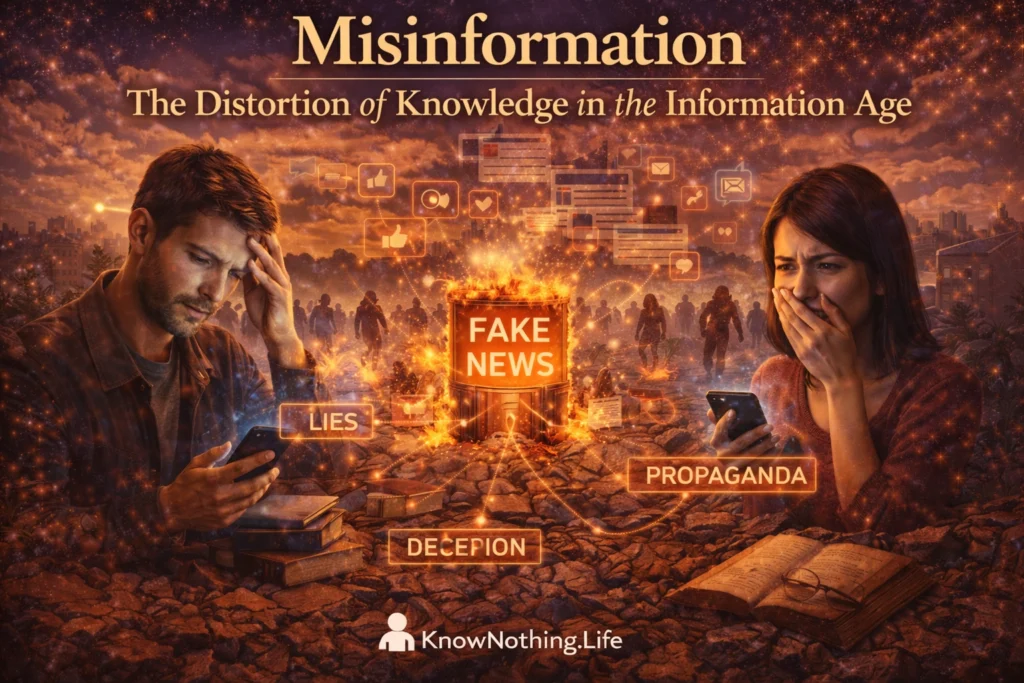
Misinformation represents one of the most pressing epistemological challenges of the modern world. It refers to false or misleading information that is spread regardless of intent, often blurring the line between ignorance and deception. In an era defined by rapid communication, digital platforms, and global connectivity, misinformation has the power to shape beliefs, influence decisions, and undermine trust in knowledge systems.
Unlike traditional epistemological concerns that focus on the justification of true beliefs, misinformation forces philosophers to confront how false beliefs arise, spread, and persist. It raises critical questions: Why do people believe false information? How can individuals distinguish reliable sources from unreliable ones? What role do social and technological systems play in amplifying misinformation?
Philosophers such as Alvin Goldman, Miranda Fricker, Cass Sunstein, and Hannah Arendt have explored aspects of misinformation, from its epistemic consequences to its social and political implications. Their work reveals that misinformation is not merely a failure of individual reasoning but a complex phenomenon shaped by cognitive, social, and institutional factors.
The Nature of Misinformation
Misinformation is typically defined as false or inaccurate information that is spread without necessarily intending to deceive. This distinguishes it from disinformation, which involves deliberate deception. However, the effects of misinformation can be just as harmful, as it can lead individuals to form false beliefs and make poor decisions.
From an epistemological perspective, misinformation challenges the relationship between belief, truth, and justification. A person may hold a belief that seems justified based on available information, yet that belief may still be false if the underlying information is incorrect. This highlights the vulnerability of knowledge systems to error and distortion.
Misinformation also raises questions about epistemic responsibility. To what extent are individuals responsible for verifying the information they consume and share? While individuals play a role in evaluating information, the widespread nature of misinformation suggests that it is also a systemic issue, influenced by the structure of information networks and the behavior of institutions.
Cognitive Factors and the Spread of False Beliefs
One of the key factors contributing to misinformation is the way human cognition processes information. Psychological research has shown that individuals are not purely rational thinkers; instead, they rely on heuristics, biases, and emotional responses that can lead to errors in judgment.
For example, confirmation bias leads individuals to favor information that supports their existing beliefs, while ignoring or dismissing contradictory evidence. This tendency can reinforce misinformation, as people are more likely to accept false information that aligns with their views. Similarly, the availability heuristic causes individuals to overestimate the likelihood of events based on how easily they come to mind, which can be influenced by repeated exposure to misinformation.
Philosophers such as Hannah Arendt have emphasized the vulnerability of truth in the face of human tendencies. Arendt observed that “The ideal subject of totalitarian rule is not the convinced Nazi or the convinced Communist, but people for whom the distinction between fact and fiction… no longer exists.” This insight highlights the epistemic danger of environments where misinformation becomes normalized.
Social Epistemology and Information Networks
Misinformation is not only a cognitive phenomenon but also a social one. It spreads through networks of communication, influenced by social relationships, trust, and authority. Social epistemology provides a framework for understanding how these dynamics affect the distribution of knowledge.
Alvin Goldman has explored how information flows through social systems in Knowledge in a Social World. He emphasizes the importance of reliable sources and epistemic institutions in maintaining the integrity of knowledge. When these systems fail or are undermined, misinformation can spread more easily.
Social media platforms have amplified these dynamics by enabling rapid and widespread dissemination of information. Algorithms that prioritize engagement can inadvertently promote sensational or misleading content, increasing its visibility. This creates an environment in which misinformation can thrive, often outpacing efforts to correct it.
Epistemic Injustice and Misinformation
The concept of epistemic injustice, developed by Miranda Fricker, is closely related to the problem of misinformation. Epistemic injustice occurs when individuals are wronged in their capacity as knowers, often due to prejudice or power imbalances.
Misinformation can both contribute to and result from epistemic injustice. For example, when certain groups are systematically discredited, their testimony may be dismissed, allowing false narratives to dominate. Conversely, misinformation can reinforce stereotypes and biases, further marginalizing affected groups.
Addressing misinformation therefore requires attention to issues of fairness and inclusion. Ensuring that diverse perspectives are heard and respected can help counter the spread of false information and improve the overall quality of knowledge. This highlights the ethical dimension of epistemology, emphasizing the importance of justice in the pursuit of truth.
Political and Institutional Dimensions
Misinformation also has significant political and institutional implications. It can be used to manipulate public opinion, undermine democratic processes, and erode trust in institutions. Cass Sunstein has examined how information cascades and echo chambers contribute to the spread of misinformation.
Sunstein argues that individuals often rely on the behavior of others when forming beliefs, leading to cascades in which false information is widely accepted. In echo chambers, individuals are exposed primarily to information that reinforces their existing views, further entrenching misinformation.
Institutions play a critical role in addressing these challenges. Governments, media organizations, and educational systems must work to promote accurate information and counter misinformation. However, their effectiveness depends on public trust, which can be undermined by the very misinformation they seek to combat.
Strategies for Combating Misinformation
Addressing misinformation requires a multifaceted approach that combines individual, social, and institutional efforts. At the individual level, critical thinking and media literacy are essential for evaluating information and identifying false claims. Individuals must learn to question sources, verify information, and remain open to revision.
At the social level, promoting reliable information networks and fostering trust in credible sources is crucial. This involves supporting institutions that uphold standards of accuracy and accountability. Social norms that discourage the spread of misinformation can also play a role in mitigating its impact.
Technological solutions, such as fact-checking systems and algorithmic adjustments, can help reduce the spread of misinformation. However, these solutions must be implemented carefully to avoid unintended consequences, such as censorship or bias. The challenge lies in balancing the need for accurate information with the preservation of open discourse.
Conclusion
Misinformation represents a profound challenge to the pursuit of knowledge in the modern world. It exposes the vulnerabilities of human cognition, the complexities of social communication, and the limitations of existing epistemic systems. Addressing misinformation requires a comprehensive understanding of these factors and a commitment to promoting truth and reliability.
From the insights of Hannah Arendt to the analyses of Alvin Goldman and Cass Sunstein, philosophical perspectives provide valuable tools for understanding and addressing this issue. By examining the interplay between belief, truth, and social dynamics, we can develop more effective strategies for combating misinformation.
Ultimately, the challenge of misinformation underscores the importance of epistemic responsibility. In a world where information is abundant and rapidly disseminated, the pursuit of truth requires vigilance, critical thinking, and a commitment to intellectual integrity.