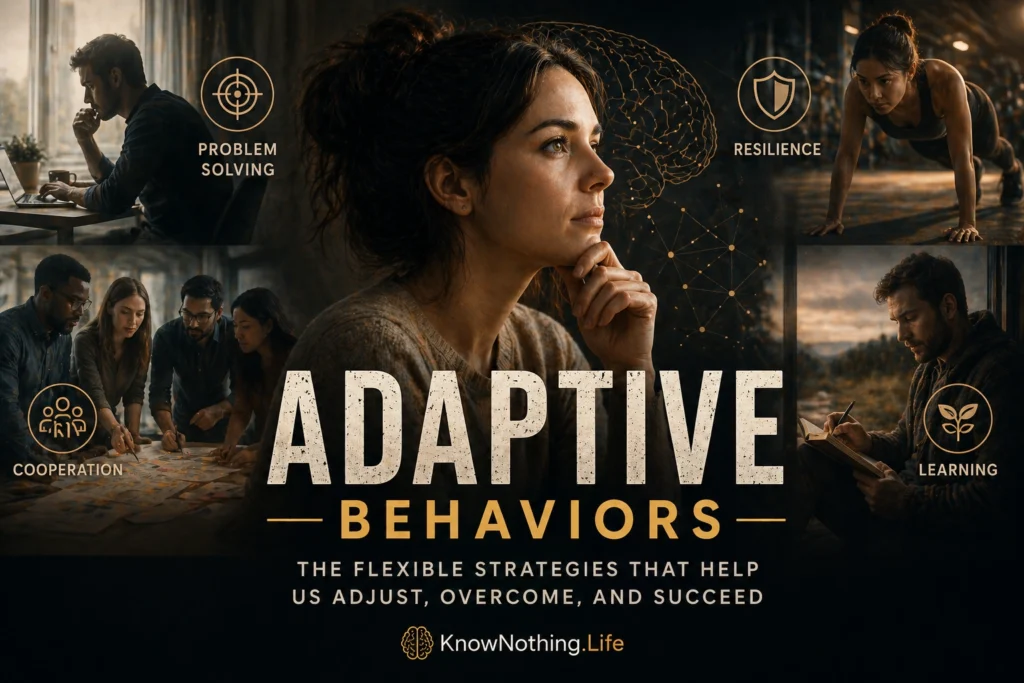
Adaptive behaviors are the actions and strategies individuals use to effectively navigate their environment, meet demands, and achieve goals. These behaviors enable organisms to adjust to changing conditions, solve problems, and maintain well-being across diverse contexts. In humans, adaptive behavior encompasses a wide range of functions, including communication, social interaction, decision-making, and self-regulation. It is not limited to survival in extreme situations but is evident in everyday activities, from learning new skills to managing relationships and responding to stress.
The concept of adaptation is rooted in evolutionary theory, particularly the work of Charles Darwin, who emphasized that organisms evolve traits that enhance their ability to survive and reproduce. Darwin’s insight that “it is not the strongest of the species that survives, but the most adaptable to change” captures the essence of adaptive behavior. In psychological terms, adaptability reflects the capacity to modify behavior in response to environmental demands, integrating biological predispositions with learning and experience.
Evolutionary Foundations of Adaptation
Adaptive behaviors are shaped by evolutionary processes that favor traits enhancing survival and reproduction. Over time, organisms develop behavioral patterns that increase their chances of coping with environmental challenges. In humans, these patterns are supported by complex cognitive and emotional systems that allow for flexible responses to a wide range of situations.
Evolutionary psychologists such as John Tooby and Leda Cosmides have argued that the human mind consists of specialized mechanisms designed to address recurring problems faced by our ancestors. These mechanisms include threat detection, social reasoning, and decision-making processes that guide adaptive behavior. They describe the brain as “a computational system designed by natural selection,” highlighting its role in processing information and generating appropriate responses. While these systems evolved in ancestral environments, they continue to influence behavior in modern contexts.
Learning and Behavioral Flexibility
While evolutionary processes provide the foundation for adaptive behavior, learning is essential for refining and expanding these capabilities. Through experience, individuals can modify their behavior to better suit their environment, developing new skills and strategies. This capacity for learning allows humans to adapt to a wide range of conditions, far beyond those encountered by their ancestors.
The work of B. F. Skinner on operant conditioning demonstrates how behavior can be shaped by reinforcement and consequences. Skinner argued that “behavior is a function of its consequences,” emphasizing the role of feedback in guiding adaptation. Similarly, Albert Bandura’s social learning theory highlights the importance of observation and imitation in acquiring adaptive behaviors. Bandura noted that “learning would be exceedingly laborious… if people had to rely solely on the effects of their own actions,” underscoring the efficiency of social learning. These perspectives illustrate how adaptive behavior emerges from the interaction of innate mechanisms and experiential learning.
Cognitive Processes and Problem-Solving
Adaptive behavior in humans is closely linked to cognitive processes such as perception, memory, and reasoning. These processes enable individuals to interpret their environment, anticipate outcomes, and develop strategies for achieving goals. Problem-solving, in particular, is a key aspect of adaptation, allowing individuals to overcome obstacles and navigate complex situations.
Research by Jean Piaget emphasized that cognitive development involves the processes of assimilation and accommodation, through which individuals integrate new information and adjust their mental frameworks. Piaget argued that “intelligence is what you use when you don’t know what to do,” highlighting the role of cognition in adaptation. Similarly, Herbert A. Simon’s work on bounded rationality suggests that individuals make decisions based on limited information and cognitive resources, using heuristics to navigate complexity. These insights demonstrate how cognitive processes support adaptive behavior in dynamic environments.
Emotional Regulation and Adaptation
Emotions play a crucial role in adaptive behavior by guiding attention, decision-making, and action. Emotional responses such as fear, anger, and joy provide information about the environment and motivate appropriate behavior. However, effective adaptation requires not only experiencing emotions but also regulating them to suit the context.
The concept of emotional intelligence, popularized by Daniel Goleman, highlights the importance of understanding and managing emotions in adaptive functioning. Goleman argues that “emotional intelligence is a key factor in success,” emphasizing its role in navigating social and personal challenges. Emotional regulation involves strategies such as reappraisal and coping, which allow individuals to manage stress and maintain well-being. By integrating emotional and cognitive processes, individuals can respond more effectively to complex situations.
Social Adaptation and Cultural Context
Human adaptive behavior is deeply embedded in social and cultural contexts, as individuals rely on group membership and shared knowledge to navigate their environment. Social adaptation involves understanding norms, forming relationships, and cooperating with others. These behaviors are essential for functioning in complex societies, where success often depends on collaboration and communication.
Anthropological research by Geert Hofstede has highlighted the role of cultural values in shaping behavior, demonstrating that adaptation varies across societies. Cultural norms influence how individuals perceive challenges and respond to them, creating diverse patterns of adaptive behavior. As sociologist Emile Durkheim noted, “Human behavior is shaped by social facts,” emphasizing the influence of collective norms and institutions. This perspective underscores that adaptation is not only an individual process but also a social one.
Adaptive Behavior in Development
Adaptive behaviors develop over the lifespan, influenced by biological maturation, learning, and socialization. In early childhood, adaptive behavior includes basic skills such as communication and self-care, while later development involves more complex abilities such as problem-solving and emotional regulation. These skills are often assessed in developmental psychology to understand individual functioning and identify areas for support.
The work of Lev Vygotsky emphasizes the role of social interaction in development, particularly through the concept of the zone of proximal development. Vygotsky argued that “learning awakens a variety of internal developmental processes,” highlighting the importance of guided learning in shaping adaptive behavior. Developmental processes thus integrate biological, cognitive, and social factors, enabling individuals to adapt to increasingly complex environments.
Maladaptive Behavior and Limits of Adaptation
While adaptive behaviors enhance functioning, not all behaviors are beneficial in every context. Maladaptive behaviors are those that hinder effective functioning or well-being, often arising when previously adaptive strategies are applied in inappropriate situations. For example, avoidance behavior may protect individuals from immediate harm but can lead to long-term difficulties if it prevents engagement with necessary tasks.
Research by Aaron Beck on cognitive distortions highlights how maladaptive thought patterns can influence behavior, leading to anxiety and depression. Beck argued that “the way people interpret situations determines their emotional and behavioral responses,” emphasizing the role of cognition in adaptation. Understanding maladaptive behavior is essential for developing interventions that promote healthier and more effective strategies.
Technology and Modern Adaptation
The rapid advancement of technology has created new environments that require novel forms of adaptation. Digital communication, information overload, and constant connectivity present challenges that differ significantly from those faced by earlier generations. Adaptive behavior in modern contexts involves managing attention, navigating digital interactions, and maintaining balance in a technologically driven world.
Psychologist Herbert A. Simon famously noted that “a wealth of information creates a poverty of attention,” highlighting the challenges of adaptation in the information age. Individuals must develop strategies to filter information, prioritize tasks, and maintain focus. These demands illustrate that adaptation is an ongoing process, requiring continuous adjustment to new conditions.
Future Directions in Adaptive Behavior Research
The study of adaptive behavior is increasingly interdisciplinary, integrating insights from psychology, neuroscience, and environmental science. Advances in brain imaging and genetics are providing new understanding of the biological basis of adaptation, while research on climate change and global health is highlighting the importance of adaptability in addressing complex challenges.
There is also growing interest in resilience, which reflects the capacity to adapt positively in the face of adversity. Psychologist Ann Masten describes resilience as “ordinary magic,” emphasizing that it arises from common human capacities rather than extraordinary traits. Future research will likely continue to explore how individuals and societies can enhance their adaptive capabilities, promoting well-being and sustainability.
Conclusion
Adaptive behaviors are fundamental to human functioning, enabling individuals to navigate their environment, solve problems, and maintain well-being. From evolutionary origins to modern challenges, these behaviors reflect the interplay of biological, cognitive, and social processes. By understanding how adaptation occurs, researchers can develop strategies to enhance resilience and support effective functioning.
Ultimately, adaptation is not a fixed trait but a dynamic process that evolves over time. By fostering flexibility, learning, and emotional regulation, individuals can improve their ability to respond to change and thrive in an ever-changing world.