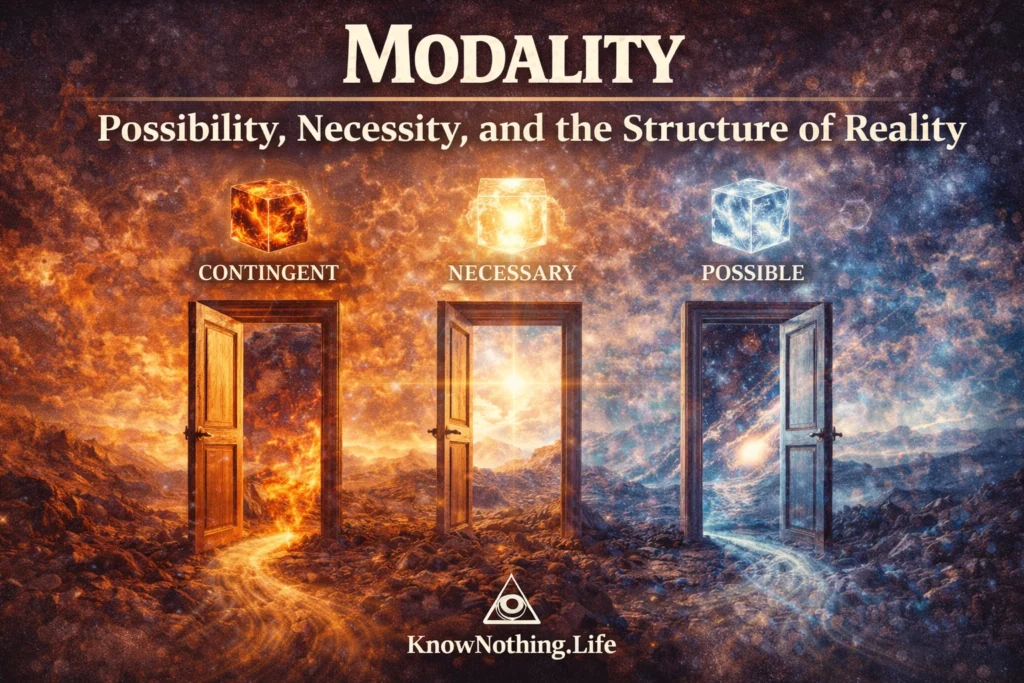
Modality is the branch of philosophy concerned with possibility, necessity, and contingency—how things could be, must be, or might have been otherwise. While everyday language frequently uses modal terms like “possible,” “necessary,” or “impossible,” their philosophical significance runs much deeper. Modality shapes how we think about logic, metaphysics, language, and even science, providing a framework for understanding not just what is, but what could or must be.
At its core, modality asks fundamental questions: Are there truths that could not have been otherwise? Are there possibilities that never actualize but still have some form of existence? What distinguishes necessary truths from contingent ones? These questions reveal that reality is not limited to what actually exists but includes a broader space of potential and necessity. The study of modality thus expands the scope of philosophy beyond the actual world into the realm of possibilities.
Aristotle and the Origins of Modal Thought
The roots of modal philosophy can be traced to Aristotle, who developed early distinctions between necessity, possibility, and contingency in his logical works, particularly in De Interpretatione and the Prior Analytics. Aristotle sought to understand how statements about what must be or might be relate to truth and reasoning.
For Aristotle, necessity refers to what cannot be otherwise, while possibility refers to what can occur without contradiction. Contingency occupies a middle ground—events that may or may not occur. These distinctions allowed Aristotle to develop modal logic, a system for analyzing arguments that involve necessity and possibility.
Aristotle also explored modal concepts in relation to causation and time. He recognized that future events may be contingent, introducing the famous problem of future contingents. For example, the statement “There will be a sea battle tomorrow” raises the question of whether its truth is already determined. This problem highlights the tension between determinism and openness, a theme that continues to shape modal philosophy.
Medieval Philosophy: Modality and Divine Necessity
In medieval philosophy, modality became closely linked with theology, particularly in discussions of divine power and necessity. Thomas Aquinas integrated Aristotelian modal concepts into a Christian framework, exploring the relationship between necessity and contingency in creation.
In Summa Theologica, Aquinas distinguished between necessary and contingent beings. Necessary beings, such as God, cannot fail to exist, while contingent beings depend on external causes for their existence. Aquinas argued that the existence of contingent beings implies the existence of a necessary being, providing a basis for his cosmological argument.
This period also saw the development of sophisticated modal logic, as philosophers sought to clarify the relationships between possibility, necessity, and actuality. Theological concerns about divine omniscience and freedom further complicated these discussions, raising questions about whether God’s knowledge determines future events or allows for genuine contingency.
Early Modern Philosophy: Necessity and Contingency
The early modern period brought new perspectives on modality, particularly in the work of Gottfried Wilhelm Leibniz. Leibniz introduced the idea of possible worlds, suggesting that reality consists of one actual world among many possible alternatives. In his view, God chooses the best possible world to actualize.
Leibniz famously wrote, “Nothing takes place without a sufficient reason.” This principle of sufficient reason implies that even contingent events have explanations, though they could have been otherwise. Leibniz distinguished between necessary truths, which are true in all possible worlds, and contingent truths, which are true only in the actual world.
This framework provided a powerful way of analyzing modality, linking it to logic and metaphysics. It also raised questions about the nature of possibility: do possible worlds have any form of existence, or are they merely conceptual tools? Leibniz’s ideas laid the groundwork for later developments in modal logic and metaphysics.
Kant and the Limits of Modal Knowledge
Immanuel Kant reexamined modality in the context of human cognition. In Critique of Pure Reason, he argued that modal concepts—possibility, actuality, and necessity—do not describe the content of objects but rather the status of judgments.
For Kant, modality is not about what exists independently but about how we relate to knowledge. A proposition is possible if it does not contradict the conditions of experience, actual if it is confirmed by experience, and necessary if it follows from the principles of understanding. This approach shifts modality from metaphysics to epistemology.
Kant’s analysis highlights the role of the human mind in shaping modal judgments. It suggests that our understanding of possibility and necessity is constrained by the structures of cognition, limiting our ability to access the ultimate nature of reality. This perspective continues to influence debates about the scope and limits of modal reasoning.
Contemporary Modal Logic and Possible Worlds
In the 20th century, modality underwent a formal transformation with the development of modern modal logic. Saul Kripke played a central role in this development, introducing rigorous semantics for modal expressions based on possible worlds.
Kripke’s work, particularly in Naming and Necessity, challenged earlier assumptions about necessity and identity. He argued that some truths are necessarily true even if known a posteriori, such as the identity of natural kinds. For example, the statement “Water is H₂O” is necessarily true, even though it was discovered empirically.
Kripke’s framework provides a powerful tool for analyzing modal concepts, allowing philosophers to distinguish between different types of necessity and possibility. It also raises deeper questions about the nature of possible worlds—whether they are real entities, as David Lewis famously argued, or abstract constructs used for analysis.
Modality in Language and Thought
Modality plays a crucial role in language and thought, shaping how people express uncertainty, obligation, and potential. Modal verbs such as “can,” “must,” and “might” reflect underlying modal concepts, allowing individuals to navigate possibilities and constraints.
Philosophers of language have explored how modal expressions relate to meaning and truth. Modal statements often depend on context, reflecting different types of necessity—logical, physical, or moral. This complexity highlights the richness of modality as a conceptual framework.
Psychologically, humans are naturally attuned to modal thinking. The ability to imagine alternative possibilities, consider counterfactual scenarios, and anticipate future outcomes is central to reasoning and decision-making. Modality thus bridges the gap between abstract philosophy and everyday cognition.
The Philosophical Significance of Modality
Modality reveals that reality is not limited to what actually exists. It opens a space for considering alternatives, exploring what could be and what must be. This perspective has implications for metaphysics, logic, and ethics, influencing how we understand necessity, freedom, and possibility.
The distinction between necessary and contingent truths shapes debates about determinism, free will, and the nature of laws. If certain aspects of reality are necessary, they cannot be otherwise, constraining what is possible. If others are contingent, they introduce openness and variability.
Philosophically, modality reflects the human capacity to transcend the immediate and consider the broader structure of reality. It challenges us to think beyond the actual, exploring the boundaries of possibility and the nature of necessity.
Conclusion
Modality stands as a central concept in philosophy, illuminating the structure of possibility and necessity. From the early insights of Aristotle to the theological developments of Thomas Aquinas, the rationalist framework of Gottfried Wilhelm Leibniz, and the modern contributions of Saul Kripke and David Lewis, it has evolved into a rich and complex field.
These perspectives reveal that modality is not merely a linguistic or logical concept but a fundamental aspect of how reality is understood. It shapes how we think about truth, existence, and possibility, providing a framework for exploring both the actual and the potential.
Ultimately, the study of modality invites a broader vision of reality—one that includes not only what is, but what could be and what must be. In doing so, it deepens our understanding of the world and our place within it, revealing the vast landscape of possibility that lies beyond the immediate.