
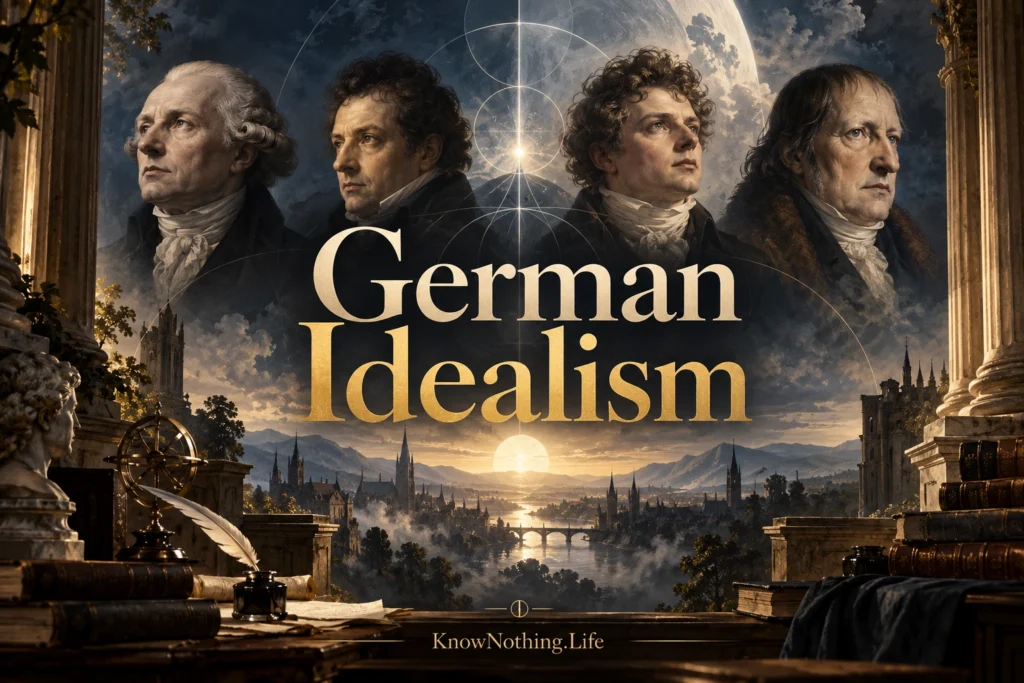
German Idealism stands among the most influential intellectual movements in Western philosophy, fundamentally transforming how philosophers understand consciousness, knowledge, freedom, and reality. Emerging in Germany during the late eighteenth century, it challenged the assumption that the human mind merely observes an independently structured world. Instead, its leading thinkers investigated how consciousness, rationality, and conceptual activity contribute to the possibility of experience and knowledge.
Developed primarily through the writings of Immanuel Kant, Johann Gottlieb Fichte, Friedrich Wilhelm Joseph Schelling, and Georg Wilhelm Friedrich Hegel, German Idealism shaped modern philosophy far beyond its historical period. Its influence extends into existentialism, phenomenology, political theory, psychology, and contemporary debates about consciousness. At its center lies a profound philosophical question: Does the mind simply discover reality, or does the structure of human thought help determine how reality can be experienced and understood?
Historical Origins of German Idealism
German Idealism emerged from the intellectual tensions of the European Enlightenment, particularly the conflict between rationalism and empiricism. Rationalist philosophers such as René Descartes, Gottfried Wilhelm Leibniz, and Baruch Spinoza emphasized reason as a fundamental source of knowledge, while empiricists such as John Locke and David Hume argued that experience provides the foundation of human understanding. Hume’s skepticism about causation created a particularly significant problem. If experience reveals only sequences of events, how can human beings justify their belief that nature operates according to necessary causal laws?
The movement developed against a background of political and cultural transformation, including the French Revolution, the rise of Romanticism, and growing debates about individual liberty. German intellectuals increasingly questioned whether traditional philosophical systems could adequately explain human freedom, moral responsibility, and the relationship between individuals and society. Philosophical discussions at universities such as Jena brought idealism into contact with literature, theology, and emerging theories of history. Thinkers including Friedrich Schiller, Friedrich Hölderlin, and Friedrich Schlegel contributed to the movement’s broader intellectual environment, demonstrating that German Idealism was never exclusively concerned with abstract metaphysics.
Immanuel Kant and the Foundations of Transcendental Idealism
Immanuel Kant (1724–1804) established the foundation of German Idealism through his revolutionary work Critique of Pure Reason (1781; revised 1787). Kant challenged the traditional assumption that knowledge must conform entirely to objects. Instead, he proposed that objects of possible experience must conform to certain structures of human cognition. Space and time, according to Kant, are forms of human sensibility, while concepts such as causality, substance, and unity organize experience through the understanding. His famous declaration captures this relationship: “Thoughts without content are empty, intuitions without concepts are blind.” Knowledge requires both sensory experience and conceptual organization.
This position became known as transcendental idealism. Kant distinguished between phenomena, or things as they appear under the conditions of human experience, and things in themselves, considered independently of those conditions. Importantly, Kant did not argue that the external world was imaginary. His philosophy defended empirical realism while maintaining that human knowledge cannot simply transcend the conditions making experience possible. In Prolegomena to Any Future Metaphysics (1783), he further clarified this distinction. His ethical philosophy, particularly Groundwork of the Metaphysics of Morals (1785) and Critique of Practical Reason (1788), also placed autonomy at the center of moral life, establishing freedom as a defining concern for later German Idealists.
Johann Gottlieb Fichte and the Philosophy of the Self
Johann Gottlieb Fichte (1762–1814) attempted to resolve tensions within Kant’s philosophy by developing a more unified explanation of consciousness. In Foundation of the Entire Wissenschaftslehre (1794–1795), Fichte argued that philosophy should begin with the self’s original activity rather than an assumed division between consciousness and an unknowable external reality. His foundational principle, often expressed as “the I posits itself,” identifies self-consciousness as an activity through which the subject establishes its relation to itself. The self is therefore not merely a passive observer but an active participant in the organization of experience.
Fichte also argued that consciousness requires opposition and limitation. The self encounters what he called the “not-I,” representing the constraints through which experience and practical action become possible. This does not mean that an individual can invent the physical world through personal imagination. Rather, Fichte investigated the structural conditions necessary for self-consciousness and agency. His later Foundations of Natural Right (1796–1797) developed the importance of reciprocal recognition, suggesting that individuals become aware of themselves as free agents through relationships with other rational beings. This emphasis on activity, moral striving, and interpersonal recognition profoundly influenced subsequent idealist philosophy.
Friedrich Schelling and the Unity of Nature and Spirit
Friedrich Wilhelm Joseph Schelling (1775–1854) expanded German Idealism beyond the structures of individual consciousness by investigating the relationship between nature and mind. In Ideas for a Philosophy of Nature (1797) and System of Transcendental Idealism (1800), Schelling challenged philosophical approaches that treated nature as merely an external object confronting human consciousness. He instead understood nature as a dynamic, productive reality whose development makes conscious life possible. His philosophy of nature attempted to explain physical processes, organic development, and mental activity within a unified philosophical framework.
Schelling also assigned extraordinary importance to artistic creativity. In System of Transcendental Idealism, he argued that art reveals a unity between conscious intention and unconscious productivity that theoretical reflection struggles to capture. Artistic creation becomes philosophically significant because it expresses relationships that abstract concepts cannot always make fully explicit. His later Philosophical Investigations into the Essence of Human Freedom (1809) examined individuality, evil, and the limits of rational explanation. These developments distinguished Schelling from philosophers who believed reality could be completely understood through a finished system of logical principles.
Georg Wilhelm Friedrich Hegel and Absolute Idealism
Georg Wilhelm Friedrich Hegel (1770–1831) developed the most comprehensive systematic philosophy associated with German Idealism. His Phenomenology of Spirit (1807) examines the development of consciousness through increasingly complex forms of experience, knowledge, and self-understanding. Hegel rejected the idea that consciousness could be adequately understood in isolation from history, culture, and social relationships. His concept of Geist, commonly translated as spirit or mind, concerns forms of rational and social life that develop through human practices and institutions. In the preface to the Phenomenology, Hegel famously writes, “The true is the whole,” emphasizing that philosophical understanding requires attention to the relationships and developmental processes through which concepts acquire their meaning.
Central to Hegel’s philosophy is dialectical reasoning, which investigates how conceptual positions generate tensions that demand more adequate forms of understanding. Although Hegel’s method is frequently summarized through the formula “thesis, antithesis, synthesis,” this simplified pattern does not accurately capture the complexity of his philosophical method. In Science of Logic (1812–1816), Hegel explores how categories of thought develop through their internal relationships and limitations. His concept of Aufhebung, often translated as sublation, describes a movement in which an earlier position is simultaneously negated, preserved, and transformed within a more comprehensive understanding.
Hegel’s Elements of the Philosophy of Right (1821) extends these principles into ethics, law, politics, and social institutions. Rather than identifying freedom exclusively with unrestricted individual choice, Hegel argues that freedom requires meaningful participation in social relationships and institutions capable of supporting rational agency. His philosophy therefore connects consciousness with historical development and individual identity with collective life. Hegel’s ambitious attempt to understand reason as something expressed through the structures of reality established a philosophical framework that would inspire both powerful intellectual movements and equally forceful criticism.
Freedom, Self-Consciousness, and Human Recognition
Freedom represents one of the deepest unifying concerns of German Idealism, although its major thinkers define freedom differently. Kant associates moral freedom with autonomy, understood as rational obedience to moral principles that agents can recognize as binding. Fichte emphasizes the practical activity through which individuals strive to realize their freedom. Schelling investigates freedom’s relationship to nature, individuality, and the possibility of evil. Hegel develops a social conception in which freedom becomes concrete through participation in ethical institutions and relationships of mutual recognition. These differences reveal that German Idealism was an ongoing philosophical debate rather than a single doctrine accepted by every member.
Hegel’s discussion of lordship and bondage in Phenomenology of Spirit remains particularly influential. It examines how self-consciousness depends upon recognition by another self-conscious being and why unequal relationships fail to provide stable mutual acknowledgment. This argument helped establish recognition as a central category in social philosophy. Contemporary philosopher Axel Honneth developed related themes in The Struggle for Recognition (1992), examining how relationships of recognition contribute to personal identity and social justice. The resulting tradition challenges the picture of human beings as entirely independent individuals whose identities can be understood without considering their relationships with others.
Criticisms and Philosophical Challenges
Despite its intellectual achievements, German Idealism has faced substantial criticism. One recurring objection concerns whether philosophical reasoning can establish claims about reality beyond the limits of possible experience. Kant’s distinction between appearances and things in themselves generated questions about what can legitimately be said concerning an unknowable reality. Later idealists attempted to overcome that division, but critics questioned whether their systems adequately respected the independence of the world. Arthur Schopenhauer, in The World as Will and Representation (1818–1819), developed his own interpretation of Kant while rejecting important aspects of post-Kantian idealism. Søren Kierkegaard subsequently challenged systematic approaches that appeared unable to capture the particularity of lived existence, subjective commitment, and individual choice.
Karl Marx offered another influential criticism by transforming themes inherited from Hegel into a materialist account of society and history. In works such as The German Ideology (written with Friedrich Engels in 1845–1846), Marx argued that philosophical explanations must account for material production, economic relationships, and concrete social conditions rather than treating conceptual development as the primary explanation of historical change. Modern scholarship has further complicated traditional interpretations. Frederick Beiser’s German Idealism: The Struggle Against Subjectivism, 1781–1801 (2002) challenges the assumption that the movement simply elevated individual consciousness above objective reality, emphasizing its efforts to overcome subjectivism and establish a defensible relationship between mind and world.
The Influence of German Idealism on Modern Philosophy
German Idealism influenced the development of phenomenology, existentialism, hermeneutics, critical theory, and modern political philosophy. Edmund Husserl‘s investigations of intentionality and consciousness continued the broader philosophical concern with the conditions of experience, while Martin Heidegger revisited questions concerning being, finitude, and the limitations of metaphysical systems. Marx’s transformation of Hegelian philosophy influenced subsequent accounts of ideology, historical conflict, and social organization. Critical theorists, including Theodor Adorno and Jürgen Habermas, inherited and revised idealist concerns about reason, freedom, and the social conditions of human emancipation.
Its relevance also extends into contemporary philosophy of mind and epistemology. In Mind and World (1994), John McDowell revisited Kantian questions concerning perception, concepts, and the relationship between thought and reality. Robert Pippin’s Hegel’s Idealism: The Satisfactions of Self-Consciousness (1989) helped renew philosophical interest in Hegel’s account of rationality and self-consciousness. Terry Pinkard’s German Philosophy 1760–1860: The Legacy of Idealism (2002) places these developments within their wider historical and intellectual context. Such scholarship demonstrates that German Idealism remains a living field of philosophical investigation rather than merely a completed episode in intellectual history.
Why German Idealism Still Matters
The continuing importance of German Idealism lies in its challenge to simplistic distinctions between the mind and the external world. Human experience is neither an entirely passive reception of information nor an unrestricted creation of individual consciousness. Perception, knowledge, and judgment operate through relationships between sensory encounters, conceptual understanding, and forms of rational activity. These issues remain central to contemporary discussions of artificial intelligence, consciousness, scientific knowledge, and the nature of human understanding, even when modern thinkers reject the metaphysical commitments of the original idealists.
German Idealism also provides a framework for examining the relationship between individual freedom and the larger structures of social life. Questions about personal identity, ethical responsibility, cultural development, and political recognition cannot always be answered by analyzing isolated individuals. By exploring how human beings understand themselves through activity, history, and relationships, the idealists developed philosophical resources that remain useful for evaluating modern societies and their institutions.
Final Thoughts on German Idealism
German Idealism transformed philosophy by shifting attention from the mere existence of objects toward the conditions under which reality becomes intelligible to conscious beings. Beginning with Kant’s investigation of knowledge, developing through Fichte’s philosophy of self-conscious activity and Schelling’s account of nature, and reaching a systematic expression in Hegel’s philosophy, the movement established new ways of understanding thought, freedom, and historical development.
Its greatest achievement may not be any single metaphysical conclusion but its recognition that understanding human existence requires examining the relationships among consciousness, experience, reason, and the world. Although its central arguments remain contested, German Idealism continues to illuminate a fundamental philosophical problem: How can finite human beings understand a reality of which they are themselves a part?