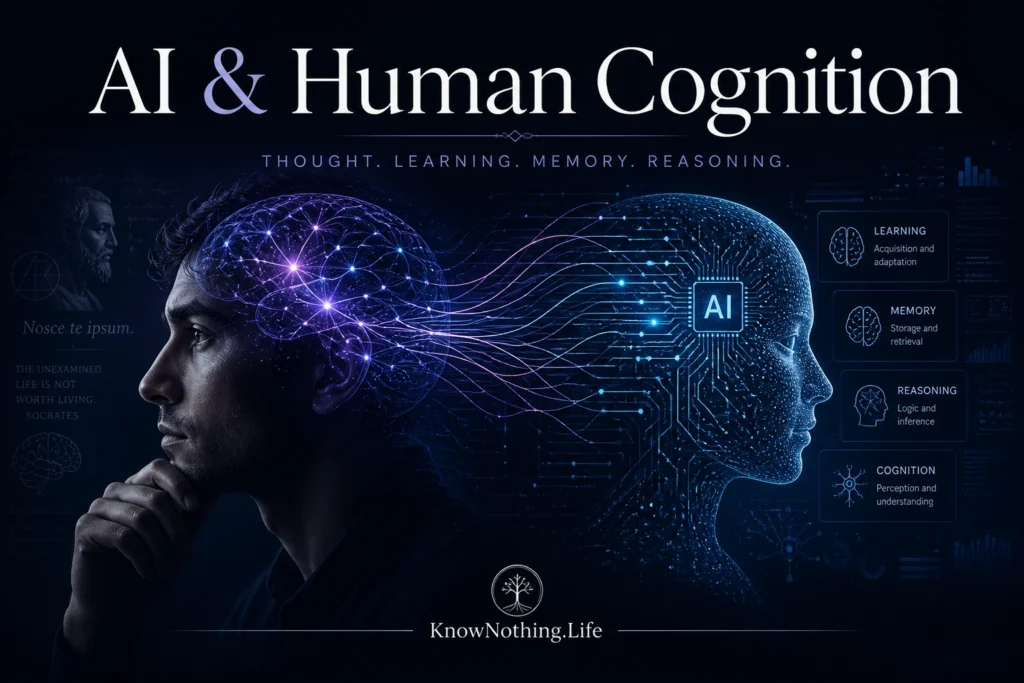
AI and human cognition is the study of how artificial intelligence changes the way people think, learn, remember, decide, create, communicate, and understand themselves. It is not only a technical topic about machines; it is a psychological and philosophical topic about the human mind in a world where thinking is increasingly shared with computational systems. Search engines, recommendation algorithms, large language models, image generators, navigation apps, predictive text, automated tutors, digital assistants, and decision-support tools now influence how people form beliefs, solve problems, organize memory, and interpret reality. AI does not simply provide answers. It can shape the questions people ask, the speed at which they expect knowledge, the confidence they place in external systems, and the habits of attention they bring to the world.
The topic reaches back to foundational questions in cognitive science. Alan Turing, in “Computing Machinery and Intelligence,” replaced the vague question “Can machines think?” with a behavioral test of intelligent performance. Herbert Simon and Allen Newell argued that human problem-solving could be understood through symbolic information processing, while Noam Chomsky challenged behaviorist accounts of language by insisting that mind has internal structure. Later, John Searle’s “Chinese Room” argument questioned whether symbol manipulation alone could produce understanding. These debates matter because AI forces psychology to ask what cognition really is. Is thinking computation? Is language evidence of understanding? Can intelligence exist without consciousness? And what happens to human cognition when artificial systems become everyday partners in thought?
Cognition as Information Processing
Modern psychology was transformed by the cognitive revolution, which treated the mind not as a black box of stimulus and response, but as an active system that encodes, stores, retrieves, transforms, and uses information. Ulric Neisser, in Cognitive Psychology, defined cognition as “all processes by which the sensory input is transformed, reduced, elaborated, stored, recovered, and used.” This definition remains crucial for understanding AI because artificial systems also process information, detect patterns, generate outputs, and guide behavior. The comparison between minds and machines helped give cognitive science its basic language: memory, representation, attention, rules, algorithms, problem spaces, feedback, and learning.
Yet the analogy has limits. Human cognition is embodied, emotional, social, and biologically grounded. A person does not merely process data; they care, fear, desire, imagine, suffer, and act within a world of needs and relationships. Antonio Damasio, in Descartes’ Error, argued against separating reason from emotion, showing that feeling is essential to judgment and decision-making. This matters for AI because artificial intelligence can simulate reasoning without possessing human stakes. A system may produce a correct answer, but it does not experience confusion, responsibility, regret, or moral concern. Human cognition is not only the manipulation of information; it is thinking from within a living body.
AI as Cognitive Extension
One of the most useful ways to understand AI is as an extension of human cognition. Andy Clark and David Chalmers, in “The Extended Mind,” argued that tools outside the brain can become part of cognitive activity when they reliably support memory, reasoning, and action. A notebook, calculator, map, phone, or search engine can function as part of a person’s thinking system. AI expands this idea dramatically. Instead of merely storing information, AI can summarize, suggest, classify, translate, draft, explain, simulate, and generate possibilities. It becomes not just external memory, but external pattern recognition and external language production.
This cognitive extension can be powerful. AI can help people overcome blank-page anxiety, learn unfamiliar concepts, brainstorm ideas, compare arguments, organize research, and receive immediate feedback. It can make expertise more accessible and reduce the friction between question and exploration. But cognitive extension also creates dependency. When people outsource too much memory, judgment, or problem-solving, they may weaken the habits that make independent thought possible. Plato raised a surprisingly relevant concern in Phaedrus, where Socrates warns that writing may create “forgetfulness in the learners’ souls” because they will rely on external marks rather than internal memory. AI raises a modern version of the same problem: when machines think with us, what must we still learn to do for ourselves?
Attention, Speed, and the Compression of Thought
AI changes cognition partly by changing the tempo of thinking. Human thought once required waiting: searching through books, drafting slowly, revising manually, asking teachers, testing ideas in conversation, and tolerating uncertainty. AI compresses many of these processes into seconds. This speed can be liberating, especially for routine tasks or early exploration. A person can move from ignorance to orientation quickly, receiving summaries, definitions, examples, and alternative explanations. In education, work, and creative life, such acceleration can expand what people are able to attempt.
But speed can also flatten thought. Daniel Kahneman, in Thinking, Fast and Slow, distinguished between fast, intuitive thinking and slower, more deliberate reasoning. AI often delivers fast fluency, and fluency can feel like truth. A polished answer may create the impression that a question has been settled before the user has wrestled with it. The danger is not merely error; it is premature closure. Human cognition develops through effort, delay, confusion, and revision. If AI removes too much friction, people may receive answers without forming understanding. The mind may become efficient at consuming explanations but weaker at generating, testing, and owning them.
Memory, Knowledge, and Cognitive Offloading
AI intensifies a long trend toward cognitive offloading, the use of external tools to reduce mental effort. People already rely on calendars to remember appointments, GPS to remember routes, search engines to remember facts, and phones to remember contacts. AI adds a more sophisticated layer: it can remember context, summarize documents, retrieve patterns, and generate knowledge-like responses. This can free mental energy for higher-level reasoning, but it can also change what people bother to encode. When information is always available, memory may shift from knowing content to knowing how to retrieve or prompt it.
Socrates’ worry about writing, Nicholas Carr’s concern in The Shallows, and contemporary debates about digital attention all converge here. Memory is not only storage; it is part of understanding. To know something deeply is not merely to access it, but to integrate it into one’s mental world. Facts, examples, images, and arguments become available for analogy, creativity, and judgment only when they are internalized. AI may help organize knowledge, but it cannot internalize knowledge for the user. The human mind still has to do the work of comprehension, connection, and reflective ownership.
Language, Understanding, and the Illusion of Mind
Large language models make AI especially psychologically powerful because language is the medium through which humans normally encounter intelligence. When a system writes fluently, answers questions, explains concepts, and imitates conversation, people naturally attribute understanding to it. This tendency is rooted in social cognition. Human beings are adapted to infer minds from speech, responsiveness, and apparent intention. The more coherent the response, the easier it becomes to experience the system as a partner rather than a tool.
John Searle’s “Chinese Room” argument remains relevant because it challenges the assumption that producing meaningful language equals understanding meaning. Searle argued that a system might manipulate symbols according to rules without genuinely understanding them. Whether one accepts his argument fully or not, it exposes a central issue in AI and cognition: human beings may confuse linguistic performance with inner comprehension. Joseph Weizenbaum, creator of the early chatbot ELIZA, warned in Computer Power and Human Reason that people are quick to project understanding onto machines. AI therefore does not only test machine intelligence; it tests human susceptibility to anthropomorphism.
Creativity, Imagination, and Co-Creation
AI is changing how people create. It can generate images, music, outlines, code, stories, arguments, designs, and variations at extraordinary speed. This challenges older ideas of creativity as purely individual inspiration. Margaret Boden, in The Creative Mind, described creativity as the ability to produce ideas that are new, surprising, and valuable. AI can certainly produce novelty and surprise, but the question of value still depends heavily on human interpretation, purpose, taste, and judgment. A machine can generate options; a human must decide what matters.
The most interesting future may be co-creation rather than replacement. AI can act as a mirror, collaborator, provocateur, or amplifier. It can offer possibilities the person would not have considered, expose weak arguments, generate stylistic alternatives, or help translate vague intuition into form. Yet creativity also requires constraint, struggle, memory, and personal meaning. If people accept AI outputs too passively, creative judgment may weaken. If they use AI actively, revising, rejecting, combining, and directing, it may expand imagination. The psychological difference lies in whether the human remains an author or becomes merely a selector.
Decision-Making, Bias, and Trust
AI increasingly participates in decision-making, from recommendations and hiring tools to medical triage, financial scoring, policing, education, and workplace analytics. This raises cognitive questions about trust. People may overtrust AI because it appears objective, mathematical, or authoritative. They may also undertrust it because it feels opaque, alien, or threatening. Both reactions can be irrational. The real challenge is calibrated trust: knowing when a system is useful, when it is uncertain, when it is biased, and when human judgment must override it.
Herbert Simon’s concept of bounded rationality is useful here. Human beings do not make decisions with perfect knowledge or unlimited processing capacity; they satisfice, use heuristics, and rely on simplified models. AI can help by processing large amounts of data, but it can also encode bias from training data, design choices, and institutional priorities. Cathy O’Neil, in Weapons of Math Destruction, warned that algorithmic systems can scale unfairness when they are opaque, consequential, and difficult to challenge. AI therefore changes human cognition by altering not only how people decide, but whom they blame, question, and trust when decisions go wrong.
Education and the Future of Learning
AI may transform education more deeply than any previous digital tool. It can tutor, quiz, translate, explain at different levels, generate practice problems, adapt to learning pace, and help students revise writing. In principle, this supports Lev Vygotsky’s idea of the “zone of proximal development,” the space between what a learner can do alone and what they can do with guidance. AI can provide scaffolding at scale, offering immediate assistance when teachers, tutors, or peers are unavailable.
But learning is not the same as answer production. A student who uses AI to complete assignments without mental struggle may bypass the very processes that build skill. Jean Piaget argued that children actively construct knowledge rather than simply receive it. That insight applies beyond childhood. Understanding grows through effortful reconstruction: making mistakes, testing explanations, forming examples, and connecting new ideas to prior knowledge. AI can support this process when used as a tutor, questioner, or feedback tool. It can damage it when used as a substitute for thinking. The educational question is not “Should AI be used?” but “Does this use strengthen or weaken cognition?”
Identity, Agency, and the Human Self
AI also affects identity. When people use AI to write, decide, advise, create, or communicate, they may begin to wonder where their own thought ends and the tool begins. This is not entirely new; human beings have always formed identity through language, culture, teachers, books, and communities. But AI feels different because it responds immediately and adaptively. It can imitate the user’s style, anticipate preferences, and become woven into daily self-expression. The self becomes increasingly hybrid, shaped by dialogue with artificial systems.
Agency is the key issue. Albert Bandura’s theory of self-efficacy emphasized people’s belief in their ability to act effectively. If AI helps people act, learn, and create, it can strengthen agency. If it leads people to feel incapable without assistance, it can weaken agency. The healthiest relationship with AI may be one in which the tool expands capacity without replacing responsibility. Human beings must remain answerable for their beliefs, choices, words, and actions. AI can assist cognition, but it cannot carry the burden of being a person.
Ethics, Consciousness, and Human Meaning
AI forces psychology back toward philosophical questions about consciousness and meaning. Thomas Nagel, in “What Is It Like to Be a Bat?”, argued that consciousness has a subjective character: there is something it is like to be a conscious organism. Current AI may process language and patterns, but it does not obviously possess subjective experience. This distinction matters because human cognition is lived from the inside. Pain hurts, memory matters, shame burns, love binds, and death gives urgency to choice. Human meaning arises within finite, vulnerable, embodied existence.
At the same time, AI may change how humans understand their own minds. If machines can perform tasks once considered uniquely intelligent, people may need to separate intelligence from consciousness, fluency from wisdom, and problem-solving from personhood. Hannah Arendt, in The Human Condition, distinguished labor, work, and action, emphasizing that human life is not only production but meaningful participation in a shared world. AI can produce outputs, but it does not belong to the human world in the same way. The ethical task is to use artificial intelligence without reducing human beings to information processors.
Final Thoughts on AI & Human Cognition
AI and human cognition is one of the defining psychological subjects of the twenty-first century because artificial intelligence is becoming part of the architecture of thought. It shapes attention, memory, language, creativity, decision-making, education, identity, and trust. Used wisely, AI can expand human capacity, democratize knowledge, support learning, improve accessibility, and stimulate creativity. Used passively or exploitatively, it can weaken attention, flatten understanding, automate bias, encourage dependency, and blur the difference between fluency and wisdom.
The major thinkers in this field help clarify what is at stake. Turing asks how intelligence can be recognized; Neisser defines cognition as information processing; Clark and Chalmers show how tools extend the mind; Plato warns that external aids can weaken memory; Kahneman reveals the danger of fast fluency; Searle questions whether symbol manipulation equals understanding; Weizenbaum warns against projecting humanity onto machines; Boden clarifies creativity; Simon explains bounded rationality; Vygotsky and Piaget show that learning requires active construction; Nagel reminds us that consciousness has an inner life. AI may become a powerful partner in cognition, but it should not become a replacement for human judgment, responsibility, or meaning. The future of intelligence will depend not only on what machines can do, but on what humans remember to cultivate in themselves.