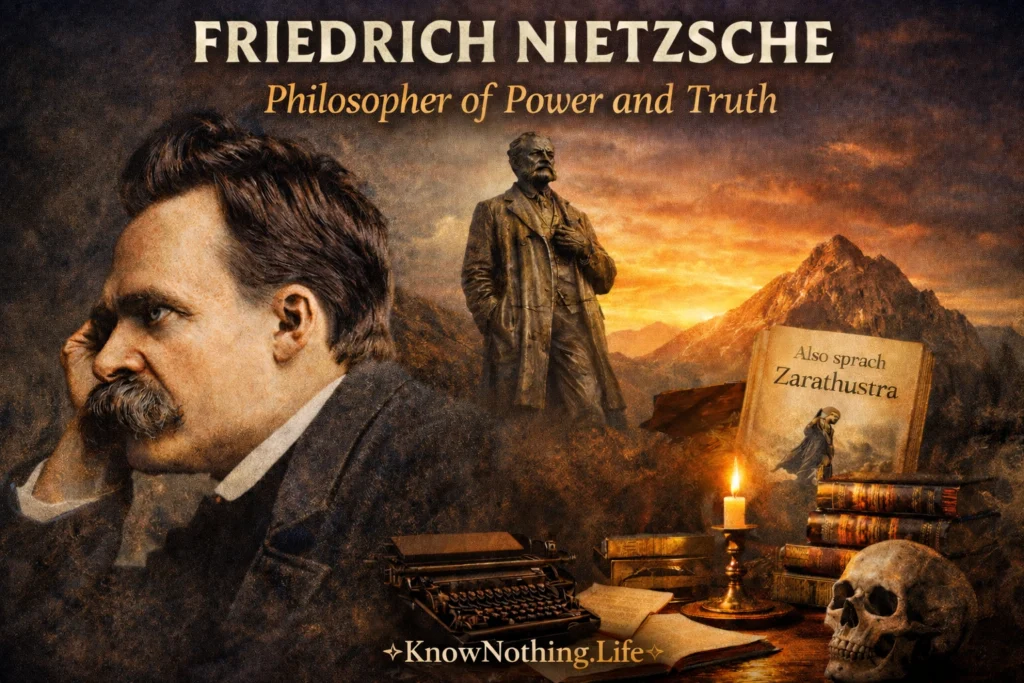
The philosophy of Friedrich Nietzsche resists easy categorization, unfolding instead as a challenge—sometimes explosive, often unsettling—to the moral, religious, and philosophical foundations of Western civilization. Writing in the late 19th century, Nietzsche sought not merely to critique inherited values, but to expose their origins and question their legitimacy. His work stands as both a diagnosis of cultural decay and a call for radical transformation.
Born in 1844 in Röcken, Nietzsche came of age in a Europe shaped by scientific progress, religious doubt, and shifting social structures. Unlike many philosophers who aimed to construct systematic frameworks, Nietzsche adopted a more literary and provocative style, blending aphorism, poetry, and philosophical argument. His writings challenge readers to confront uncomfortable truths about morality, power, and the nature of existence itself.
Early Life and Intellectual Formation
Nietzsche’s early life was marked by both intellectual promise and personal hardship. The son of a Lutheran pastor, he experienced the loss of his father at a young age, an event that shaped his early exposure to religion and suffering. Despite these challenges, he demonstrated exceptional academic ability, eventually studying classical philology at the University of Bonn and later at Leipzig.
At the remarkably young age of 24, Nietzsche was appointed professor of philology at the University of Basel, a position that reflected his extraordinary talent. During this period, he developed a close intellectual relationship with the composer Richard Wagner, whose work initially inspired him. However, Nietzsche later distanced himself from Wagner, criticizing what he saw as the composer’s nationalism and reliance on religious themes.
Health issues plagued Nietzsche throughout his life, ultimately forcing him to resign from his academic position. This withdrawal from institutional life marked the beginning of his most productive period as an independent thinker. Freed from academic constraints, he devoted himself entirely to writing, producing a series of works that would later redefine philosophy.
Major Works and Philosophical Style
Nietzsche’s writings are distinctive not only for their content, but for their style. Rejecting the systematic approach of philosophers like Kant, he embraced a fragmented, aphoristic method that reflects the complexity of his ideas. His major works include Thus Spoke Zarathustra, Beyond Good and Evil, On the Genealogy of Morality, and The Gay Science.
In Thus Spoke Zarathustra, Nietzsche introduces the figure of Zarathustra, a prophetic character who proclaims the need for humanity to transcend itself. The text blends philosophy with poetic narrative, presenting ideas such as the “Übermensch” (often translated as “Overman” or “Superman”) and the concept of eternal recurrence. This work stands as one of his most ambitious and enigmatic creations.
Beyond Good and Evil and On the Genealogy of Morality offer more direct critiques of traditional moral systems. Nietzsche challenges the assumption that moral values are universal or objective, arguing instead that they are shaped by historical and psychological forces. His method of “genealogy” traces the origins of moral concepts, revealing the power dynamics underlying them.
Critique of Morality and Religion
One of Nietzsche’s most controversial contributions is his critique of morality, particularly what he describes as “slave morality.” He argues that traditional moral systems—especially those rooted in Christianity—emphasize humility, self-denial, and obedience, values that he associates with weakness rather than strength. In contrast, he advocates for a “master morality” that celebrates creativity, power, and self-affirmation.
His famous declaration, “God is dead,” appears in The Gay Science and Thus Spoke Zarathustra. This statement does not simply deny the existence of a deity; it reflects a broader cultural shift in which religious belief no longer provides a foundation for meaning and morality. Nietzsche saw this as both a crisis and an opportunity. Without traditional structures, individuals are confronted with the challenge of creating their own values.
This perspective leads to what Nietzsche describes as nihilism—the recognition that life lacks inherent meaning. Rather than succumbing to despair, he urges a response of creative affirmation. The task of the individual is not to discover preexisting truths, but to actively shape meaning through strength of will and artistic expression.
Will to Power and the Übermensch
Central to Nietzsche’s philosophy is the concept of the “will to power,” a fundamental drive that he sees as underlying all human behavior. Unlike simple survival instincts, the will to power represents a desire for growth, expansion, and self-overcoming. It is not merely about domination over others, but about the continual transformation of the self.
The idea of the Übermensch emerges as an embodiment of this principle. The Übermensch is not a specific individual, but an ideal—a person who creates their own values and lives authentically beyond conventional morality. This figure represents the potential for humanity to transcend its limitations and embrace a more dynamic and creative existence.
Closely related to these ideas is the concept of eternal recurrence, the notion that one should live as if every moment of life were to be repeated infinitely. This thought experiment challenges individuals to evaluate their lives and actions, asking whether they would willingly embrace their existence in its entirety. For Nietzsche, affirmation of life—even in its suffering—is the highest form of strength.
Quotes and Key Ideas
Nietzsche’s writings are filled with striking and memorable statements that capture the intensity of his thought. Among his most well-known quotes:
- “God is dead. God remains dead. And we have killed him.”
- “He who has a why to live can bear almost any how.”
- “Become who you are.”
- “What does not kill me makes me stronger.”
These quotes reflect the core themes of his philosophy: the collapse of traditional values, the importance of purpose, and the transformative power of struggle. They are not merely rhetorical flourishes, but expressions of a deeper philosophical vision that challenges complacency and encourages self-examination.
Nietzsche’s key ideas—will to power, the Übermensch, eternal recurrence, and the critique of morality—have influenced a wide range of disciplines, including psychology, literature, and existential philosophy. His work continues to provoke debate, inspiring both admiration and controversy.
Later Life and Collapse
Nietzsche’s later years were marked by increasing isolation and declining health. Despite producing some of his most important works during this period, he struggled with both physical and mental challenges. In 1889, he suffered a mental collapse in the city of Turin, an event that effectively ended his productive life.
Following this breakdown, Nietzsche spent the remainder of his life under the care of his family, particularly his sister, who played a significant role in managing his legacy. He died in 1900, largely unknown and unrecognized as a major philosopher. It was only after his death that his work gained widespread attention.
The posthumous interpretation of Nietzsche’s philosophy has been complex and sometimes controversial. His ideas were later misappropriated by various political movements, often in ways that distorted his original intentions. Modern scholarship has worked to clarify these misunderstandings, emphasizing the nuanced and critical nature of his thought.
Legacy and Influence
Nietzsche’s influence extends across philosophy, psychology, literature, and cultural theory. He is often associated with existentialism, inspiring thinkers such as Jean-Paul Sartre and Albert Camus, who grappled with questions of meaning and freedom in a seemingly indifferent universe.
In psychology, his exploration of the unconscious and the role of instinct anticipated ideas later developed by Sigmund Freud and Carl Jung. His emphasis on interpretation and perspective also influenced postmodern thinkers, who questioned the existence of objective truth.
Nietzsche’s enduring relevance lies in his willingness to confront uncomfortable realities and challenge deeply held beliefs. His work does not offer easy answers, but it provides a framework for questioning and transformation. In an age of uncertainty, his call to create meaning and embrace life’s complexity remains as powerful as ever.
Conclusion
Friedrich Nietzsche stands as one of the most provocative and transformative thinkers in the history of philosophy. His critique of morality, religion, and truth itself forces a reconsideration of the foundations upon which societies are built. Through his exploration of power, creativity, and self-overcoming, he offers a vision of human potential that is both demanding and liberating.
To engage with Nietzsche is to enter a dialogue that challenges comfort and certainty. His philosophy does not seek to reassure, but to awaken—to push individuals toward a deeper understanding of themselves and the world. In this sense, his legacy is not a set of doctrines, but an ongoing challenge: to think boldly, live authentically, and become who one truly is.