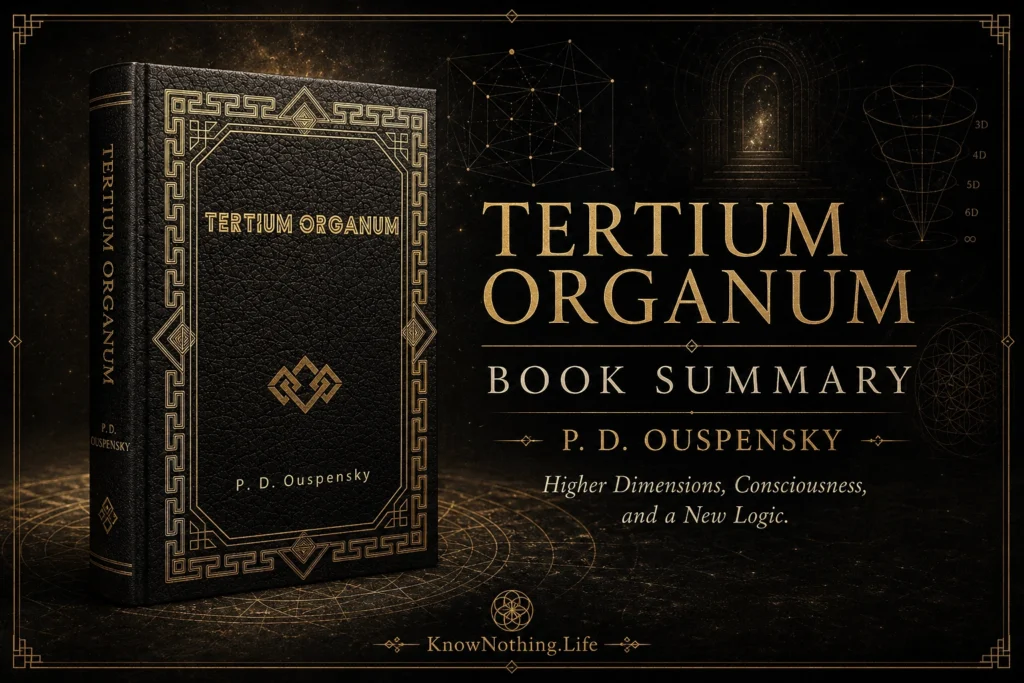
P. D. Ouspensky’s Tertium Organum is an ambitious attempt to unite philosophy, geometry, psychology, mysticism, and religious experience within a single vision of reality. First published in Russian in 1912, it appeared in English in 1920 under the subtitle The Third Canon of Thought: A Key to the Enigmas of the World. Its title follows Aristotle’s Organon, the classical collection of logical works, and Francis Bacon’s Novum Organum, which proposed a new empirical method for investigating nature. Ouspensky announces a third instrument of thought capable of approaching realities that ordinary logic and sensory perception cannot adequately represent.
Ouspensky moves through epistemology, mathematics, animal perception, time, infinity, symbolism, ethics, art, and mystical consciousness. His recurring claim is that people mistake the structure of their perception for the structure of reality. Three-dimensional space, linear time, separate objects, and stable identities describe the world as it appears to ordinary consciousness, but they may not reveal the world as it exists independently of that consciousness. The book asks what reality might look like to a mind freed from familiar categories.
What Do We Actually Know?
Ouspensky begins with radical epistemic doubt. Before explaining the universe, people must distinguish what they directly know from what they merely assume. Matter, force, motion, space, and time are commonly treated as foundations, yet each becomes difficult to define without relying on another unexplained concept. The most immediate data, in his view, are consciousness and the appearances presented within it. This places him near philosophical idealism without simply denying an external world. He argues that experience is a representation shaped by the capacities and limitations of the perceiving mind.
The central influence is Immanuel Kant’s Critique of Pure Reason. Kant maintained that space and time are forms through which human sensibility organizes appearances, not properties automatically attributable to things as they exist in themselves. Ouspensky adopts the distinction between phenomena and noumena but pushes it in a more speculative direction. Where Kant warned against claiming ordinary knowledge of the thing-in-itself, Ouspensky believes expanded consciousness may disclose the noumenal order. Research supports the narrower idea that expectations and prior knowledge influence perception, not that a higher faculty perceives ultimate reality.
The Fourth Dimension and Perception
Ouspensky’s best-known device is dimensional analogy. A two-dimensional being confined to a plane would encounter only cross-sections of three-dimensional objects. A sphere passing through its world might appear first as a point, then as an expanding circle, a contracting circle, and finally nothing. Unable to see the whole sphere, the creature might interpret one object as a sequence of events. Ouspensky suggests that humans may relate to four-dimensional reality similarly. What appears as motion, change, birth, and death could be partial encounters with structures extending beyond ordinary perception.
His fourth dimension is not modern spacetime. Hermann Minkowski joined three spatial dimensions with time in a four-dimensional physical framework grounded in special relativity. Ouspensky instead uses higher dimensionality as a bridge between geometry and consciousness, sometimes suggesting that time is how a higher spatial dimension appears to a limited mind. The proposal is metaphysical, not experimentally established. Roger Shepard and Jacqueline Metzler later showed that people can mentally rotate three-dimensional objects systematically, demonstrating flexible spatial representation but not literal perception of another spatial dimension.
Time and Incomplete Knowledge
Ouspensky regards time as evidence that perception is incomplete. People experience events sequentially because consciousness occupies a moving present. The past appears fixed, the future unreal, and the current instant uniquely existent. From a higher-dimensional viewpoint, however, an entire life might resemble a line whose points are contained within a larger structure. A person experiences one cross-section at a time and calls that passage “time,” much as an imagined flat being might encounter successive sections of a solid without perceiving the whole.
The theory is not a reliable anticipation of relativity or neuroscience, but it raises a psychological question: how is temporal experience constructed? Lera Boroditsky’s research showed that people commonly understand time through spatial metaphors and that spatial framing can affect temporal reasoning. Events lie ahead or behind, feel long or short, and seem to approach or recede. This supports Ouspensky’s intuition that time and space are cognitively intertwined, although it does not prove that time is an illusion or a concealed spatial direction.
Higher Logic and the Reconciliation of Opposites
Ouspensky believes Aristotelian logic is suited to a world of apparently separate objects but inadequate for a reality in which opposites belong to a larger unity. Conventional reasoning depends on identity and noncontradiction: a thing is itself and cannot simultaneously be its opposite in the same respect. In Ouspensky’s “higher logic,” something may be both itself and not itself when viewed from a more inclusive level. A life is a sequence to temporal consciousness, yet it could be one complete form to a consciousness capable of apprehending the whole.
This does not replace formal logic; contradictions do not become true merely because they sound profound. A charitable reading treats Ouspensky’s language as perspectival rather than irrational. A circle and a sequence of changing line segments can describe the same object from different dimensional standpoints without violating logic. His deeper point resembles dialectical and nondual traditions: oppositions such as self and world, unity and multiplicity, or permanence and change may arise from partial viewpoints. Readers must separate this useful insight from claims protected from criticism by being labeled higher truth.
Mysticism as Expanded Consciousness
The later chapters turn from geometry toward mystical experience. Ouspensky surveys Plotinus, Vedanta, Christian mysticism, Sufism, Buddhism, and accounts of “cosmic consciousness,” arguing that contemplatives across cultures report unity, timelessness, heightened meaning, and diminished separation between self and world. He interprets this convergence as evidence that mystical states reveal higher-dimensional reality. Art, poetry, love, and moral insight become partial expressions of a consciousness able to perceive relationships hidden from ordinary analytical thought.
William James offered a more cautious psychological framework in The Varieties of Religious Experience. James identified ineffability, noetic quality, transiency, and passivity as recurring features of mystical states. He took their power seriously without treating subjective certainty as proof of metaphysics. This distinction is essential for reading Ouspensky. Similar experiences may reveal stable features of consciousness, but cannot by themselves identify a transcendent, neurological, or cultural source. Ouspensky is strongest as a phenomenologist and weakest when private conviction is asked to establish objective fact.
Consciousness and Human Evolution
For Ouspensky, higher knowledge is inseparable from moral transformation. Expanded consciousness would not merely add information; it would weaken the illusion that individuals exist as wholly separate units. If the self belongs to a larger living whole, cruelty toward others becomes ignorance about one’s own nature. Love is therefore not merely an emotion but an intuition of unity, while egoism reflects confinement within a narrow perspective. His highest form of cognition is simultaneously intellectual, emotional, and ethical.
This vision anticipates Ouspensky’s later writing on self-observation and possible human evolution, although the book predates his 1915 meeting with G. I. Gurdjieff. Transformation here is described through expanded perception, mystical insight, and higher logic rather than the disciplined Fourth Way practices of his later career. The language of higher and lower humanity can sound elitist, but the central challenge is universal: ordinary consciousness should not be assumed to be the final measure of what can be known.
The Meaning and Limits of Tertium Organum
Tertium Organum remains compelling because it destabilizes easy certainty. Ouspensky asks readers to imagine that perception supplies cross-sections rather than wholes, that time reflects the organization of consciousness, and that apparent separateness may conceal deeper relationships. Dimensional analogy makes abstract questions vivid, while his comparisons among science, art, and mysticism capture an early twentieth-century fascination with unseen realities.
The book is not validated physics, neuroscience, or formal logic. Its claims about animal consciousness are outdated, its dimensional cosmology is speculative, and agreement among mystics does not prove an external metaphysical world. Yet as philosophical imagination it remains provocative. Ouspensky’s enduring question is not whether readers can visualize a tesseract, but whether the categories through which they understand reality are reality itself. Tertium Organum suggests that intellectual humility begins when the mind recognizes that what appears complete may be only a section of something larger.