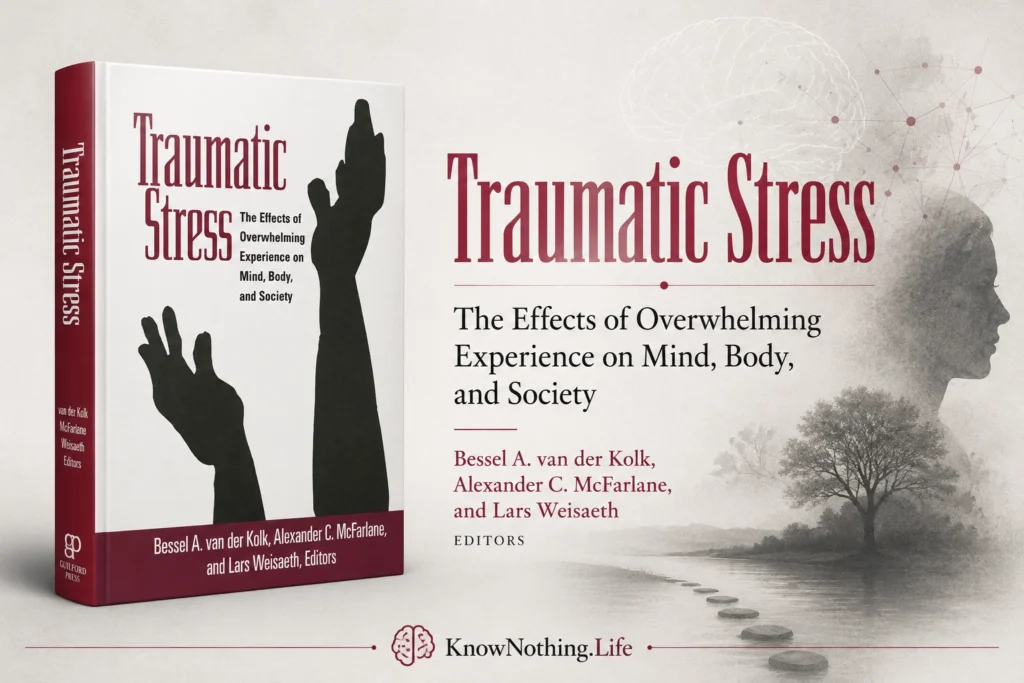
Published in 1996, Traumatic Stress: The Effects of Overwhelming Experience on Mind, Body, and Society is a major interdisciplinary volume edited by Bessel A. van der Kolk, Alexander C. McFarlane, and Lars Weisaeth. Rather than presenting post-traumatic stress disorder as a narrow collection of psychiatric symptoms, the book examines trauma across biology, memory, development, relationships, culture, and treatment. Its 25 chapters bring together researchers and clinicians working on subjects ranging from acute combat reactions and childhood trauma to dissociation, psychopharmacology, cognitive behavioral therapy, and the social recognition of victims. The organizing idea is that PTSD should be understood as a changing process of adaptation rather than simply a static disorder.
That approach immediately broadens the psychological question. An overwhelming experience does not affect everyone identically, nor does exposure automatically lead to PTSD. Trauma interacts with developmental stage, prior experience, biological response, meaning, relationships, and social support. The book therefore resists both extremes: the assumption that traumatic events mechanically determine later psychopathology and the older tendency to blame symptoms primarily on constitutional weakness. Its perspective is closer to William James’ understanding of consciousness as an adaptive process and to Pierre Janet’s theory that psychological functioning depends upon the capacity to integrate experience. Trauma becomes pathological when adaptation to danger continues interfering with adaptation to the present.
From Acute Stress to a Life Organized Around Danger
One of the volume’s important distinctions is between an immediate reaction to catastrophe and the development of chronic post-traumatic difficulties. Fear, physiological arousal, confusion, intrusive recollections, or temporary dissociation can occur following extreme events without necessarily becoming permanent disorders. The sections on acute reactions and later adaptations examine why symptoms diminish for some survivors while becoming entrenched for others. Factors such as the meaning assigned to the event, previous experiences, physiological responses, personality characteristics, and available social support can all influence the eventual course.
Later research reinforces the book’s rejection of a simple trauma-equals-PTSD formula. A major meta-analysis by Eric Ozer and colleagues found that variables occurring during or after trauma—including peritraumatic dissociation and perceived social support—were among significant predictors of subsequent PTSD symptoms. More recent trajectory research has likewise found resilience to be a common pattern following potentially traumatic experiences. Philosophically, this complicates deterministic interpretations of trauma. A catastrophic event alters the range of possibilities confronting a person, but it does not necessarily dictate one psychological future. Vulnerability and resilience coexist within the human capacity to adapt.
When the Body Continues to Expect the Past
Chapter 10 of the volume bears a phrase that van der Kolk would later make famous: “The Body Keeps the Score” Here it refers to the psychobiology of PTSD—the possibility that repeated traumatic stress alters systems governing arousal, stress hormones, attention, and responses to threatening stimuli. The book examines autonomic activity and neurochemical systems involving cortisol, norepinephrine, dopamine, serotonin, and endogenous opioids, while also considering neural pathways involved in integrating perception, arousal, and memory.
Subsequent neuroscience has substantially refined these early models. Reviews of traumatic stress research have implicated interacting systems involving the amygdala, hippocampus, prefrontal regions, stress hormones, and catecholamines, while cautioning against reducing PTSD to any single brain region or chemical abnormality. The broader insight of Traumatic Stress remains useful: traumatic adaptation involves more than conscious beliefs. A survivor can intellectually recognize safety while continuing to experience bodily alarm. Maurice Merleau-Ponty’s philosophy of embodiment offers a useful parallel here. We encounter reality through an already situated body; perception is not detached from our history. Trauma can therefore change not merely what a person remembers, but how the present is anticipated and felt.
Traumatic Memory and Dissociation
Memory occupies an entire section of Traumatic Stress. Van der Kolk and his collaborators argued that overwhelming events may sometimes be remembered differently from ordinary autobiographical experiences, particularly when intense arousal or dissociation interferes with the integration of what occurred. The volume examines intrusive memories, amnesia, sensory recollections, and dissociation as possible features of post-traumatic information processing. Van der Kolk and Rita Fisler’s earlier study of 46 individuals with PTSD reported that some initially described traumatic memories through sensory and affective components—images, smells, sounds, bodily sensations, and emotions—before developing more organized narratives.
This is also an area where later evidence requires qualification. A 2012 review found that the proposed association between dissociation and objectively measured fragmentation of trauma narratives was much weaker than theories had often suggested; associations were stronger when survivors themselves rated their memories as fragmented. The distinction matters. Traumatic Stress is historically important partly because it generated hypotheses rather than because every early hypothesis became settled fact. Its deeper insight survives the debate: PTSD can disturb the ordinary relationship between past and present. Janet had described trauma as a failure of psychological synthesis, while Freud’s Beyond the Pleasure Principle explored the puzzling recurrence of experiences that consciousness would presumably prefer to leave behind. Both traditions illuminate why remembering trauma can sometimes feel less like recalling history and more like confronting an unfinished present.
Self-Regulation, Development, and Childhood Trauma
The book goes beyond the classic PTSD symptoms of intrusion, avoidance, and hyperarousal by examining how chronic trauma may affect self-regulation, attention, identity, interpersonal functioning, and personality development. Van der Kolk’s chapter on complex adaptation argues that trauma occurring at different developmental stages can have different consequences because children are still constructing capacities for regulating emotion and understanding themselves. The volume also emphasizes that trauma occurring within caregiving relationships differs psychologically from impersonal catastrophes because the person responsible for protection may simultaneously become associated with danger.
John Bowlby’s Attachment and Loss provides an important psychological framework for this problem. Children develop expectations about safety, trust, and relationships through repeated interactions with caregivers; traumatic environments can therefore influence not only memories but models of self and others. Research published shortly after Traumatic Stress strengthened the broader developmental argument. The landmark Adverse Childhood Experiences study by Vincent Felitti and colleagues found graded associations between accumulated childhood adversity and numerous later health risks and behavioral difficulties. Later work has linked childhood maltreatment with alterations in stress-responsive systems and broad adult health consequences. These associations are probabilistic, not destiny, but they reinforce the book’s insistence that development matters.
Resilience, Social Support, and the Meaning of Trauma
A particularly important contribution of Traumatic Stress is its attention to resilience. The editors do not portray human beings as uniformly damaged by catastrophe. One of the volume’s central questions is precisely why some individuals develop severe chronic reactions while others recover. Resilience does not necessarily mean that an event caused no pain or that survivors possess some extraordinary toughness. It can instead involve the restoration of functioning through personal capacities, relationships, social resources, meaning, and changing circumstances.
This connects trauma psychology to Viktor Frankl’s reflections in Man’s Search for Meaning. Frankl did not argue that suffering is inherently valuable; rather, he emphasized that the interpretation and meaning of experience can matter profoundly to psychological survival. Traumatic Stress similarly treats context and meaning as psychologically consequential. The presence or absence of social support influences whether a survivor experiences catastrophe as something endured within a community or as abandonment by the social world. Research on PTSD predictors supports the importance of post-trauma social environments, making recovery partly relational rather than exclusively intrapsychic.
Trauma Is Also a Social and Cultural Problem
The subtitle’s final word—“Society”—is not decorative. The book contains chapters on culture, legal systems, childhood, aging, and society’s responsibility toward trauma survivors. The editors ask whether communities recognize traumatic suffering as a shared burden or interpret survivors as responsible for their own difficulties. They also emphasize that cultural beliefs influence how disasters are understood and that religious and communal rituals can shape responses to loss. Trauma therefore exists at the intersection of private experience and public recognition.
This insight has philosophical parallels with Hannah Arendt’s attention to the social conditions that make human experience publicly intelligible and with Judith Herman’s argument in Trauma and Recovery that recognition of trauma has repeatedly depended upon broader political and social movements. The diagnostic history of PTSD itself illustrates the point. Traumatic Stress was published sixteen years after PTSD entered DSM-III in 1980, and its editors explicitly describe the diagnosis as having stimulated renewed research into war, disasters, and interpersonal violence. Whether suffering is acknowledged, denied, compensated, stigmatized, or collectively remembered can become part of the traumatic aftermath.
Treatment as Reclaiming the Present
The final major portion of Traumatic Stress surveys treatment across several traditions, including cognitive behavioral therapy, psychoanalytic psychotherapy, medication, acute intervention, and emerging approaches of the period. The editors resist the idea that every trauma-related difficulty requires precisely the same intervention. Intrusive symptoms, physiological hyperarousal, dissociation, occupational impairment, alienation, and relational difficulties may require different therapeutic strategies. Their overarching goal is nevertheless clear: treatment should help survivors stop responding to present experience as though the original catastrophe were continually returning.
The evidence base has grown considerably since 1996. Controlled research has demonstrated substantial benefits from trauma-focused approaches. Edna Foa and colleagues found prolonged exposure effective for chronic PTSD in assault survivors, and subsequent reviews have identified prolonged exposure, cognitive processing therapy, and trauma-focused CBT among strongly supported psychological treatments. In this respect, one of the book’s central therapeutic ideas has aged well: recovery requires more than erasing symptoms. Trauma must become something that happened then, rather than an organizing principle dictating what is happening now.
What Traumatic Stress Ultimately Teaches
The lasting achievement of Traumatic Stress is its refusal to reduce overwhelming experience to a single level of explanation. Trauma is simultaneously biological and psychological, remembered and embodied, individual and relational, developmental and cultural. The volume moves from acute reactions to chronic adaptation, from neurobiology to memory, from childhood development to social institutions, and finally to treatment. That architecture reflects its central thesis: PTSD emerges through interactions among multiple systems rather than from one defective mechanism.
Nearly three decades of subsequent research have revised some of the book’s specific claims, particularly around traumatic-memory fragmentation and the neurobiological interpretation of PTSD. That scientific revision does not diminish the book’s historical importance; it demonstrates why an interdisciplinary framework was necessary in the first place. Traumatic Stress helped establish a conception of trauma in which symptoms can be understood as adaptations that have become poorly matched to present circumstances. Its deepest psychological insight is consequently both sobering and hopeful: the human organism can be profoundly changed by overwhelming experience, but adaptation is an ongoing process rather than a final verdict. Understanding trauma means understanding how the past acquires power over the present—and how biological regulation, memory, meaning, relationships, treatment, and society can help restore the distinction between the two.