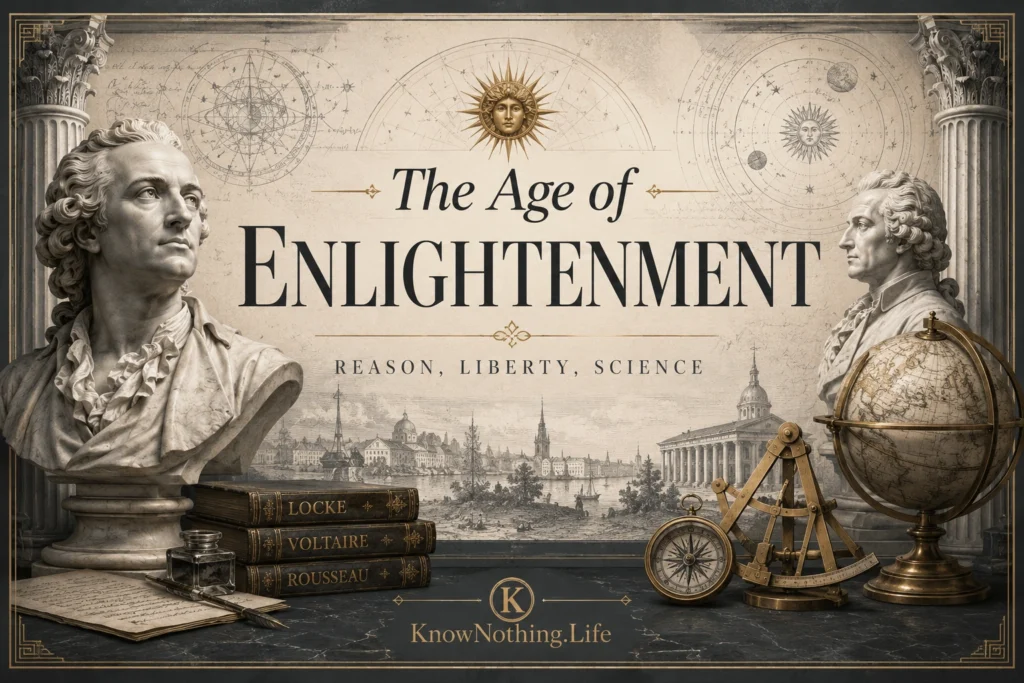
The Age of Enlightenment, sometimes called the Age of Reason, was one of the most consequential intellectual movements in modern history. Developing primarily in Europe during the late seventeenth and eighteenth centuries, the Enlightenment challenged inherited assumptions about political authority, religion, science, morality, economics, and the structure of society itself. Its thinkers disagreed profoundly with one another, so it is misleading to imagine the Enlightenment as a single philosophy. What connected figures such as John Locke, Voltaire, Montesquieu, David Hume, Denis Diderot, Jean-Jacques Rousseau, Adam Smith, Mary Wollstonecraft, and Immanuel Kant was a growing conviction that human beings could investigate the world through reason, observation, criticism, and public debate rather than simply accepting the authority of tradition.
The consequences reached far beyond philosophy. Enlightenment arguments about natural rights, representative government, religious toleration, scientific inquiry, education, economic freedom, and equality influenced political revolutions and helped establish concepts now associated with modern liberal democracy. Yet the Enlightenment was also deeply contradictory. Europeans proclaimed universal liberty while slavery and colonial expansion flourished; philosophers celebrated reason while women remained largely excluded from political and educational institutions. Understanding the Enlightenment therefore requires more than celebrating an “age of reason.” It means examining an intellectual revolution that created some of modernity’s most powerful ideals while exposing tensions that remain unresolved.
The Scientific Revolution and the Origins of Enlightenment Thought
The Enlightenment did not suddenly begin in a particular year. Its foundations were laid during the Scientific Revolution of the sixteenth and seventeenth centuries, when thinkers including Nicolaus Copernicus, Johannes Kepler, Galileo Galilei, Francis Bacon, René Descartes, and Isaac Newton transformed European understandings of nature. Scientific success demonstrated that inherited authorities could be wrong and that systematic investigation could reveal principles previously hidden from human understanding. Newton’s Mathematical Principles of Natural Philosophy, published in 1687, was especially influential. By explaining celestial and terrestrial motion through a comparatively small set of mathematical laws, Newton offered Enlightenment thinkers an extraordinary example of what disciplined inquiry could accomplish. The Stanford Encyclopedia of Philosophy identifies the Scientific Revolution as one of the primary origins of the Enlightenment and describes Newton’s achievement as a major inspiration for eighteenth-century intellectual life.
Francis Bacon’s emphasis on observation and experimentation and Descartes’s insistence on questioning doubtful assumptions represented different approaches, but both helped weaken intellectual dependence on inherited scholastic authority. John Locke then extended empiricism into the study of the human mind in An Essay Concerning Human Understanding (1690), arguing against innate ideas and emphasizing experience as the source of human knowledge. Enlightenment thought consequently involved more than abstract rationalism. It combined confidence in human reason with growing respect for observation, experimentation, skepticism, and evidence. Diderot and Jean le Rond d’Alembert’s great Encyclopédie symbolically reflected this intellectual lineage by honoring Bacon, Locke, and Newton as foundational figures.
Reason and the Courage to Think for Yourself
Few statements capture the ideal of the Enlightenment better than Immanuel Kant’s 1784 essay “An Answer to the Question: What Is Enlightenment?” Kant described enlightenment as humanity’s emergence from intellectual dependence—the condition in which people allow others to determine what they should believe. He summarized its spirit through the Latin phrase Sapere aude, writing: “Have the courage to use your own understanding.” Enlightenment, in this sense, was not simply a collection of correct ideas. It was the willingness to think independently, submit claims to criticism, and resist accepting something merely because a church, monarch, philosopher, or tradition declared it true.
That commitment produced a new attitude toward intellectual authority. Enlightenment philosophers did not necessarily reject religion, government, or tradition altogether; many remained religious, supported monarchy, or disagreed about how far political reform should go. What increasingly became unacceptable was authority that could not defend itself before reason. Skepticism became intellectually productive. David Hume investigated the foundations of causation, morality, religion, and human understanding. Voltaire used satire to attack fanaticism and intolerance. Diderot sought to gather and distribute knowledge through the Encyclopédie. The Enlightenment thus transformed criticism into a cultural ideal: beliefs, institutions, and customs could be examined rather than merely inherited.
Natural Rights and Government by Consent
Political philosophy became one of the Enlightenment’s most revolutionary areas. John Locke’s Two Treatises of Government, published in 1689, challenged theories that treated political authority as an unquestionable extension of divine or paternal power. Locke argued that human beings were naturally free and that legitimate political society depended upon consent. Government existed to protect rights rather than simply command subjects, and political power could lose legitimacy when rulers violated the purposes for which government had been established. In the Second Treatise, Locke repeatedly returned to the idea that political society arises through the “consent of the people.”
Montesquieu developed another enormously influential argument in The Spirit of the Laws (1748). Political liberty, he argued, required institutional arrangements capable of preventing power from concentrating in a single authority. When legislative and executive authority are united, he warned, “there can be no liberty.” Montesquieu’s discussion of legislative, executive, and judicial powers became crucial to later constitutional thinking and profoundly influenced ideas of checks and balances. Political liberty was therefore not merely a declaration of good intentions. It required institutions designed around the recognition that power could be abused.
Rousseau and the Problem of Freedom
Jean-Jacques Rousseau complicated Enlightenment political thought by questioning whether civilization itself necessarily made people freer or better. His Discourse on the Origin and Basis of Inequality Among Men examined how social institutions, property, status, and competition might generate forms of inequality that were not simply natural. In The Social Contract (1762), Rousseau opened with one of political philosophy’s most famous sentences: “Man is born free; and everywhere he is in chains.” His central question was how political authority could become legitimate without destroying the freedom human beings possess by nature.
Rousseau’s answer centered on the social contract and the concept of the general will. Individuals could become citizens of a political community in which laws expressed a collective sovereignty rather than the arbitrary wishes of a ruler. Yet Rousseau’s philosophy also revealed tensions within Enlightenment ideas of freedom. Individual liberty and collective authority do not always point in the same direction, and later thinkers have debated whether the general will protects freedom or creates possibilities for political coercion. Rousseau nevertheless helped shift political legitimacy away from hereditary rulers and toward the people understood as the ultimate source of sovereignty.
Religion, Toleration, and the Attack on Fanaticism
The Enlightenment is sometimes portrayed as simply anti-religious, but its relationship with religion was more complicated. Some Enlightenment thinkers were atheists or materialists, while others remained Christians, embraced deism, or attempted to reconcile religious belief with reason. Deists generally believed that reason could support belief in a creator while rejecting miracles, revelation, and ecclesiastical doctrines they regarded as irrational. Newton’s picture of a mathematically ordered universe encouraged some thinkers to imagine creation as an intelligible system governed by consistent laws rather than continuous supernatural intervention.
The larger struggle involved religious authority and intolerance. Voltaire became one of Europe’s most famous critics of fanaticism and persecution, while Locke’s A Letter Concerning Toleration defended broad religious toleration. Voltaire’s Candide attacked philosophical complacency through satire, especially the idea that suffering could easily be explained as part of an optimally designed universe. After witnessing disaster, war, exploitation, and absurdity, Candide concludes that “we must cultivate our garden.” The line captures something essential about Voltaire’s practical skepticism: grand systems mean little if they distract people from reducing suffering and improving the world immediately around them.
The Enlightenment Expands the Study of Human Society
Enlightenment thinkers increasingly attempted to understand human beings with methods inspired by the study of nature. David Hume hoped to develop a systematic science of human nature, investigating how habits, passions, perceptions, and social experience shape belief and behavior. Adam Smith, remembered primarily for The Wealth of Nations (1776), was also a moral philosopher. In The Theory of Moral Sentiments (1759), Smith explored sympathy, judgment, virtue, and the human desire for social approval. Against an overly simplistic picture of human beings as purely selfish, Smith observed that “there are evidently some principles in his nature” that make us care about the fortunes of others.
Smith’s work illustrates the broadening intellectual ambitions of the Enlightenment. Economics, psychology, sociology, anthropology, aesthetics, political science, and modern historical scholarship did not yet exist in their present institutional forms, but many of their central questions were being systematically explored. Enlightenment authors wanted to understand not merely planets and physical forces but commerce, morality, law, language, emotions, political institutions, population, education, and historical development. The human world itself increasingly became an object of organized inquiry.
Knowledge, the Encyclopédie, and the New Public Sphere
Knowledge also began circulating through expanding networks of books, pamphlets, journals, coffeehouses, academies, salons, correspondence, and learned societies. Denis Diderot and d’Alembert’s monumental Encyclopédie, published across numerous volumes beginning in 1751, became one of the Enlightenment’s defining projects. It attempted not simply to record facts but to organize the arts, sciences, crafts, and intellectual achievements of humanity into an accessible system. Knowledge became something that could be collected, compared, criticized, expanded, and distributed rather than guarded exclusively by traditional institutions.
The growth of reading publics changed who could participate in intellectual culture. Diderot himself became an important public critic of art through his writings on the Paris Salons, exhibitions that exposed broad audiences to leading works of painting and sculpture. Enlightenment was therefore partly a transformation in the social circulation of ideas. Intellectual authority increasingly depended on persuasion within communities of readers rather than simply official position. Modern scholarship consequently treats the Enlightenment not merely as the work of famous philosophers but as a social phenomenon involving authors, readers, publishers, commerce, institutions, and increasingly interconnected publics.
Women, Slavery, and the Contradictions of Universal Liberty
Perhaps the greatest challenge to celebratory accounts of the Enlightenment is the enormous distance between its universal language and eighteenth-century reality. Women remained excluded from most formal political institutions and many educational opportunities. Mary Wollstonecraft exposed this contradiction in A Vindication of the Rights of Woman (1792). If reason justified liberty and education for men, she argued, the same principle had to apply to women. Her argument was uncompromising: “truth must be common to all.” Wollstonecraft directly challenged thinkers, including Rousseau, whose educational theories treated women primarily in relation to men’s needs rather than as independently rational human beings.
The contradiction was even more severe regarding slavery and empire. The century that celebrated natural rights was also deeply connected to Atlantic slavery, colonial conquest, and expanding global commerce. Historians have shown that Enlightenment thought contained both resources for attacking slavery and ideas that reinforced racial hierarchy and imperial domination. Eighteenth-century arguments about universal humanity contributed to abolitionism, yet European commercial expansion and intellectual culture were simultaneously intertwined with systems of forced labor and colonial wealth. The conflict between proclaimed universal freedom and actual enslavement became one of the defining moral contradictions of the era.
The Lasting Legacy of the Enlightenment
The Enlightenment helped provide the intellectual vocabulary through which later generations would argue about constitutional government, human rights, democracy, freedom of conscience, equality before the law, scientific inquiry, secular government, education, economic organization, and individual autonomy. Its ideas influenced the American and French Revolutions and continued through later struggles over abolition, women’s rights, democratic participation, and political reform. Yet its greatest legacy may not be any particular political system. It is the principle that institutions and beliefs can be subjected to public criticism and required to justify themselves.
That principle also means the Enlightenment must be applied critically to itself. Its greatest thinkers were neither infallible nor uniformly committed to the universal implications of the ideals they articulated. The movement included reformers and radicals, skeptics and believers, monarchists and republicans, defenders and critics of empire. In that sense, Kant’s challenge remains more valuable than any attempt to turn Enlightenment thinkers into unquestionable authorities. Sapere aude—dare to know—means continuing to question even those who taught humanity to question.
The Age of Enlightenment changed the intellectual direction of the modern world because it encouraged people to believe that knowledge could expand, authority could be challenged, governments could be judged, and society could be improved through human effort. Locke asked what made political authority legitimate. Montesquieu asked how liberty could survive power. Rousseau asked whether society could reconcile authority with freedom. Smith investigated the forces binding economic and moral life together. Wollstonecraft demanded that supposedly universal reason actually become universal. Voltaire attacked dogmatism, while Kant transformed enlightenment itself into an unfinished task of intellectual independence. More than two centuries later, their disagreements remain alive because the questions they asked—about truth, liberty, equality, power, knowledge, and human progress—are still the questions modern societies have not finished answering.