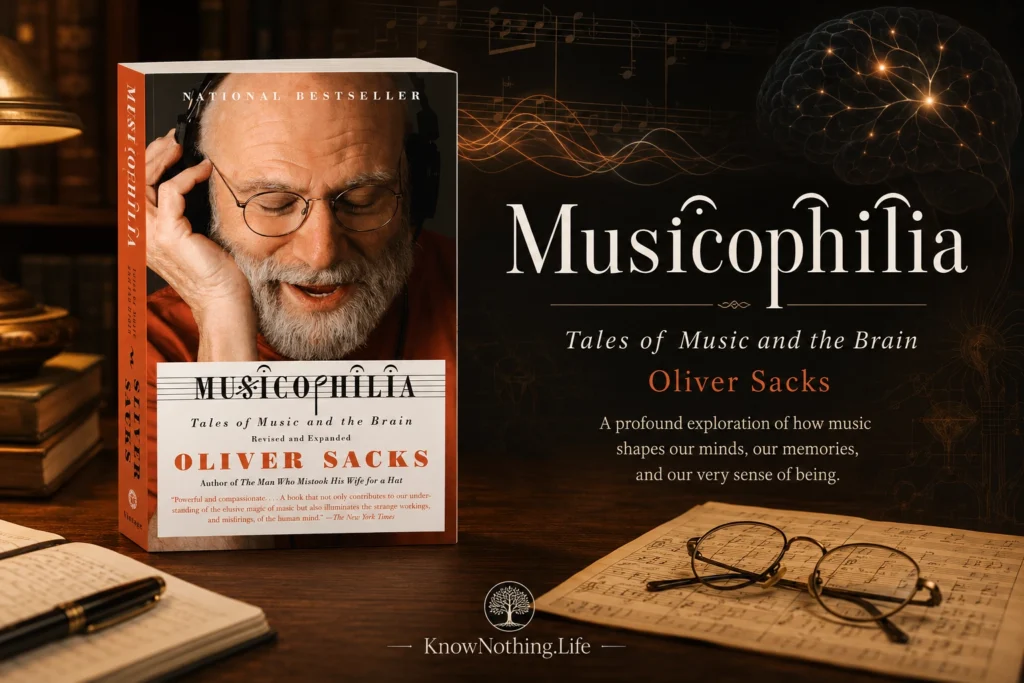
Oliver Sacks’ Musicophilia: Tales of Music and the Brain, first published in 2007 and later expanded, is an investigation into one of the strangest facts about human consciousness: music can affect us with a force radically disproportionate to its apparent practical purpose. A melody cannot feed us, protect us from danger, or explain an idea with the precision of language, yet music can produce tears, physical chills, irresistible movement, vivid memories, overwhelming joy, and even altered states of consciousness. Sacks approaches this mystery in his characteristic way—not by constructing a single grand theory, but by assembling neurological case histories in which ordinary musical abilities become exaggerated, damaged, preserved, or transformed. His subjects include people with musical hallucinations, congenital amusia, absolute pitch, Parkinson’s disease, aphasia, dementia, Williams syndrome, autism, and extraordinary forms of musical memory. He also describes Tony Cicoria, a physician whose life changed after being struck by lightning and who subsequently developed an intense, almost compulsive passion for piano and composition.
The title Musicophilia refers to a love—or sometimes an overwhelming hunger—for music. But Sacks’ deeper subject is not musical taste. It is the architecture of the human brain. Neurological disorders reveal that “musicality” is not one ability but a collection of partly separable capacities involving pitch, rhythm, melody, harmony, memory, movement, emotion, imagery, and expectation. Modern cognitive neuroscience supports this general view. Isabelle Peretz and Max Coltheart have argued from cases of selective musical impairment that music processing contains multiple distinguishable components rather than a single mental faculty. Sacks transforms this scientific insight into a philosophical one: music feels unified because a healthy brain silently integrates many systems. When one component disappears while others survive, we glimpse the normally hidden machinery from which musical experience emerges.
Musical Hallucinations and the Music the Brain Generates Itself
Some of the most unsettling chapters concern people who hear music when no external music is playing. These musical hallucinations may involve childhood songs, hymns, orchestral passages, popular tunes, or endlessly repeated fragments. The experience can initially seem supernatural or psychiatric, yet Sacks shows that musical hallucinations can occur in people with hearing loss, neurological disease, epilepsy, medication effects, or other disturbances without implying psychosis. A large clinical literature now supports this complexity. Reviews have documented musical hallucinations associated with hearing impairment, brain lesions, epilepsy, psychiatric disorders, and pharmacological causes, with no single mechanism explaining every case.
The phenomenon reveals something fundamental about perception. We usually imagine hearing as a process in which the outside world sends sound inward, but hallucination demonstrates that auditory experience can also be constructed from within. The brain contains systems capable of generating recognizable musical patterns even when the corresponding sound is absent. Sacks places everyday “earworms”—songs or fragments that repeat involuntarily in the mind—on a much milder continuum with such experiences. The result recalls David Hume’s distinction between impressions and ideas while complicating it neurologically: a sufficiently vivid internally produced representation may acquire some of the experiential qualities normally associated with sensation. Musicophilia repeatedly shows that the border separating remembering music, imagining music, and actually hearing it is less absolute than ordinary consciousness makes it seem.
Amusia, Absolute Pitch, and the Many Forms of Musicality
At the opposite extreme from overwhelming music lies amusia, an inability to process aspects of music normally. Someone with congenital amusia may have normal hearing and intelligence yet struggle to detect pitch differences, recognize melodies, or hear music as coherent. Acquired brain injury can also disrupt musical abilities selectively. This matters because music is often assumed to be simply an optional cultural accomplishment. Research by Isabelle Peretz and Krista Hyde instead suggests that congenital amusia may involve selective impairment in fine-grained pitch processing and that the brain contains networks particularly important for musical organization. For some people, a symphony that others experience as richly structured may genuinely sound confused or unpleasant.
Sacks contrasts such cases with absolute pitch, the ability to identify a musical note without an external reference. Here again, biology and experience intertwine. A study of more than 600 musicians found a strong relationship between early musical training and absolute pitch: about 40 percent of respondents who began musical instruction at age four or younger reported it, compared with only about 3 percent who began at age nine or later. Family clustering also suggested a possible inherited component. Sacks uses such differences to attack the idea of a single scale running from “unmusical” to “musical.” A person may have extraordinary pitch perception but limited rhythmic ability, intense emotional sensitivity without technical knowledge, or sophisticated musical understanding without absolute pitch. Musical minds are mosaics rather than rankings.
Clive Wearing and Music After Memory Disappears
One of the book’s most profound stories concerns British musician and musicologist Clive Wearing, whose brain was devastated by encephalitis in 1985. Wearing developed extraordinarily severe amnesia. His conscious present could last only seconds before seeming to restart, and much of his autobiographical past became inaccessible. His diaries repeatedly record the feeling of having just awakened into consciousness for the first time. Yet when seated at a piano or placed before a choir, he could still perform with remarkable musical competence. The discrepancy is astonishing: a man unable to remember an ordinary conversation can retain elaborate musical structures, motor programs, stylistic knowledge, and the capacity to conduct.
The case demonstrates why psychology no longer treats memory as a single storage system. Episodic memory for personal events can be severely destroyed while procedural abilities and other forms of learned knowledge remain comparatively preserved. Studies of musicians with Alzheimer’s disease have similarly documented cases in which people retained the ability to perform previously learned compositions despite profound impairment in consciously recalling information about them. Wearing’s case also raises a philosophical problem about personal identity. John Locke famously connected continuity of the person with continuity of consciousness and memory. Yet Clive Wearing remains recognizable as a person even when autobiographical continuity is catastrophically damaged. His love for his wife and his relationship with music persist. Sacks therefore suggests that identity may be supported not only by explicit autobiographical narrative but also by habits, emotional attachments, skills, bodily patterns, and deeply learned forms of participation in the world.
Rhythm, Parkinson’s Disease, and Music as a Motor Organizer
Sacks had already observed the extraordinary relationship between music and movement in his postencephalitic patients described in Awakenings. Musicophilia expands the idea. Some people with Parkinsonian disorders who struggle to initiate walking can move far more fluidly when given a strong rhythm. Music does not simply cheer them up; rhythmic structure can provide an external temporal framework around which movement becomes organized. Someone who freezes while attempting to cross a room may suddenly walk in time with a beat. The effect reveals that motor capacity can remain present even when the nervous system has difficulty internally organizing its initiation and timing.
Contemporary evidence supports the rehabilitative potential of rhythmic auditory stimulation. A meta-analysis of 18 randomized studies involving 774 people with Parkinson’s disease found improvements in stride length, gait speed, freezing, motor-function scores, and quality-of-life measures with rhythmic auditory stimulation, though the magnitude and consistency of effects vary across outcomes and protocols. Another systematic review likewise found significant improvements in velocity, step length, and stride length. Philosophically, these findings undermine the idea of the self as an isolated commander issuing instructions to the body. Movement can be reorganized through interaction with an external rhythm. Music temporarily becomes part of the system through which the person acts.
When Singing Can Survive the Loss of Speech
The relationship between music and language produces another striking dissociation. Some people with severe nonfluent aphasia following left-hemisphere stroke have extreme difficulty producing ordinary speech yet can sing words or familiar songs surprisingly well. Sacks uses such cases to show that speech and singing overlap without being identical neurological functions. Music may provide rhythm, pitch contours, formulaic phrases, emotional engagement, and alternative pathways capable of supporting verbal production when ordinary speech systems have been damaged.
This observation helped inspire therapies such as Melodic Intonation Therapy, developed in the 1970s. MIT guides patients through highly structured intoned phrases, rhythm, and hand tapping in an attempt to rebuild functional verbal expression. Modern evidence is encouraging but more nuanced than popular accounts sometimes imply. A 2024 systematic review and meta-analysis of 11 studies involving 329 people with nonfluent aphasia found that neurologic music therapy significantly improved repetition ability, while evidence was not sufficient to demonstrate comparable improvement in naming, comprehension, spontaneous speech, or general communication. Sacks’ larger point therefore survives without requiring exaggerated therapeutic claims: when one route through the brain becomes unavailable, rhythm and melody can sometimes provide another route into capacities that appear lost.
Music, Dementia, and the Persistence of the Autobiographical Self
The chapters on dementia may be the most emotionally powerful in Musicophilia. Sacks describes people who can no longer reliably identify relatives, remember recent events, or maintain ordinary conversation yet become suddenly animated when familiar music begins. A song can evoke singing, rhythmic movement, emotional expression, and sometimes memories inaccessible moments earlier. Sacks does not portray music as curing dementia. Instead, he presents it as one of the remaining pathways through which a severely impaired person may reconnect temporarily with emotional and autobiographical life.
Research since Musicophilia has helped clarify why these observations are plausible while also showing that preservation is not universal. Petr Janata’s fMRI research found that autobiographically significant music recruits medial prefrontal regions involved in self-referential and autobiographical processing. Studies of Alzheimer’s disease have found that some musical abilities and memories can survive disproportionately well, although familiar-melody recognition and other musical functions can also deteriorate. In one experiment, people with Alzheimer’s disease recognized information presented as sung lyrics better than the same material presented as speech. Sacks’s clinical insight is therefore best understood not as “music memory cannot be lost,” but as something subtler: musical, emotional, procedural, and autobiographical systems can decline at different rates, leaving unexpected islands of continuity within cognitive deterioration.
Why Music Feels Good: Emotion, Anticipation, and Reward
Sacks continually returns to the mystery of musical emotion. Why should a sequence of tones produce longing, tension, tears, chills, or euphoria? Philosophers have struggled with the question for centuries. Arthur Schopenhauer, in The World as Will and Representation, placed music above the other arts because he believed it expressed the underlying dynamics of reality directly rather than representing particular objects. Friedrich Nietzsche gave music a similarly central place in human existence, especially in The Birth of Tragedy. Sacks is less metaphysical, but he shares their sense that music can reach emotional levels that ordinary propositional language often cannot.
Neuroscience has begun identifying mechanisms behind this intensity. Valorie Salimpoor, Robert Zatorre, and colleagues used PET and fMRI to study people listening to intensely pleasurable music. They found dopamine release in the striatum during peak emotional responses, with the caudate particularly involved during anticipation and the nucleus accumbens during moments of maximal pleasure. Later pharmacological work showed that increasing dopaminergic activity strengthened musical pleasure and motivation while blocking dopamine reduced them, providing stronger evidence for a causal role of the dopamine system. Music therefore recruits circuitry associated with motivation and reward even though it provides no obvious material reward. A predicted resolution, harmonic turn, or anticipated climax can become valuable in itself.
Music as Part of Human Identity
The most important argument in Musicophilia emerges gradually from its cases: music is not simply entertainment added on top of a fully formed human mind. It interacts with some of the systems that organize memory, emotion, movement, anticipation, social experience, and identity. That does not mean every human being loves music equally. Sacks is particularly interested in the enormous variation among individuals—from those with amusia or little musical interest to people for whom music seems almost indispensable. What unites the cases is the extent to which changing the brain can change a person’s relationship with music, while music can in turn change the functioning of the brain and body.
This is also why Sacks resists reducing music entirely to a particular “music center.” His cases show the opposite. Pitch, rhythm, memory, movement, emotion, imagery, and language can dissociate because music depends upon interactions across many systems. The Oliver Sacks Foundation summarizes the book through precisely this range: music can haunt people as hallucination, animate movement in Parkinsonism, facilitate expression after stroke, and organize people whose memory has been devastated. The phenomenon is powerful because music can recruit so many layers of a human being simultaneously.
Why Musicophilia Still Matters
Neuroscience has advanced considerably since Musicophilia appeared. Researchers can now describe music-related reward systems, autobiographical memory networks, auditory-motor entrainment, congenital amusia, and music-based rehabilitation with greater precision. Some of the therapeutic possibilities Sacks found exciting also require caution: music therapy does not restore every lost function, responses vary substantially between patients, and compelling clinical anecdotes should not be confused with randomized evidence. Yet later studies repeatedly validate his broader method—unusual neurological cases can reveal capacities that remain invisible when the brain is working normally.
Musicophilia ultimately asks why an abstract pattern of sound can become so thoroughly woven into a human life. A melody can survive when factual memory disappears. Rhythm can unlock movement when deliberate intention fails. Singing can remain when speech is damaged. Familiar music can bring autobiographical experience momentarily back into reach. Musical hallucinations show that the brain can create music in the absence of sound, while amusia demonstrates that the capacity to organize sound musically can itself disappear. Sacks’s lasting insight is that music is both something the brain perceives and something through which the brain organizes itself. To understand why humans make, remember, desire, and sometimes desperately need music is therefore to understand something fundamental about memory, emotion, embodiment, identity, and the architecture of consciousness itself.