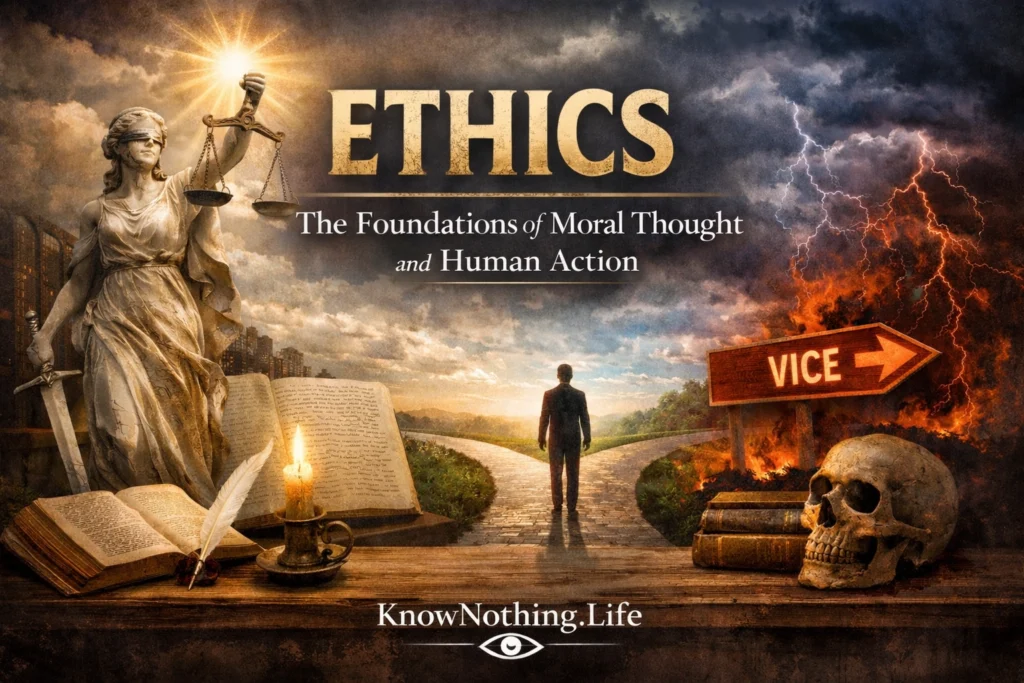
Ethics is the philosophical study of what it means to live well, act rightly, and evaluate human conduct in terms of good and bad, right and wrong, virtue and vice. It is one of the oldest and most enduring branches of philosophy, stretching back to ancient civilizations where thinkers sought to understand not just how people behave, but how they ought to behave. Unlike descriptive disciplines that observe human actions, ethics is fundamentally normative—it asks what should be done, what is worth valuing, and what kind of life is worth living. In this sense, ethics serves as both a theoretical framework and a practical guide, shaping decisions in everyday life as well as in law, politics, medicine, and emerging technologies.
From the dialogues of Socrates to contemporary debates about artificial intelligence and global justice, ethical inquiry has continually evolved to meet new challenges. Yet its central concerns remain remarkably stable: justice, responsibility, happiness, duty, and the nature of moral truth. As Aristotle observed in Nicomachean Ethics, “The good for man is an activity of the soul in accordance with virtue,” suggesting that ethics is not merely about rules, but about the cultivation of character and the pursuit of human flourishing.
Ethics is not confined to academic philosophy; it is embedded in every human interaction. Whether deciding how to treat others, how to allocate resources, or how to balance personal desires with social obligations, individuals constantly engage in ethical reasoning—often implicitly. Understanding ethics as a discipline allows us to make these judgments more consciously, critically, and responsibly.
The Historical Development of Ethical Thought
The roots of ethical philosophy lie in ancient Greece, where thinkers like Socrates challenged traditional moral assumptions by insisting that ethical knowledge must be examined and justified. His famous claim, “The unexamined life is not worth living,” reflects the idea that moral understanding requires reflection and dialogue. Plato, in works such as Republic, extended this inquiry by exploring justice as both a personal virtue and a social ideal, envisioning a harmonious society structured around moral truth.
Building on this foundation, Aristotle developed virtue ethics, emphasizing the cultivation of moral character over adherence to rigid rules. In Nicomachean Ethics, he argued that virtues such as courage, temperance, and justice are developed through habit and guided by reason. Ethics, for Aristotle, was inseparable from the concept of eudaimonia, often translated as “flourishing” or “well-being.” This approach positioned ethics as a practical discipline concerned with how to live a fulfilling life within a community.
During the Enlightenment, ethical theory took a different turn with thinkers like Immanuel Kant and John Stuart Mill. Kant’s deontological ethics, articulated in Groundwork of the Metaphysics of Morals, emphasized duty and universal moral laws. His categorical imperative—“Act only according to that maxim whereby you can at the same time will that it should become a universal law”—redefined morality as grounded in rational consistency rather than consequences. In contrast, Mill’s Utilitarianism proposed that the right action is the one that maximizes overall happiness, encapsulated in the principle of “the greatest happiness for the greatest number.” These contrasting frameworks—duty-based and consequence-based—continue to shape ethical debates today.
Major Ethical Theories
Ethical philosophy is often organized around three major traditions: virtue ethics, deontology, and consequentialism. Each offers a distinct perspective on what makes actions right or wrong, and each addresses different aspects of moral life.
Virtue ethics, rooted in the work of Aristotle, focuses on the character of the moral agent rather than specific actions. It asks not “What should I do?” but “What kind of person should I be?” Virtues are seen as stable dispositions that enable individuals to act appropriately across a wide range of situations. This approach emphasizes moral development, practical wisdom (phronesis), and the importance of community in shaping ethical behavior. Modern philosophers such as Alasdair MacIntyre have revived virtue ethics, arguing in After Virtue that contemporary moral discourse has lost its grounding in coherent traditions of character and purpose.
Deontology, most famously associated with Immanuel Kant, centers on rules, duties, and principles. According to this view, certain actions are inherently right or wrong, regardless of their consequences. Moral obligations arise from rational principles that apply universally, and individuals must act out of respect for these principles. Kant famously argued that humans should always be treated as ends in themselves, never merely as means—a formulation that has had profound implications for human rights and dignity.
Consequentialism, particularly in its utilitarian form, evaluates actions based on their outcomes. John Stuart Mill refined this view by distinguishing between higher and lower pleasures, suggesting that intellectual and moral pleasures are more valuable than purely physical ones. Contemporary thinkers like Peter Singer have extended consequentialist reasoning to global issues such as poverty and animal welfare, arguing that ethical responsibility extends beyond immediate social circles. Each of these theories provides valuable insights, but none offers a complete solution, leading many philosophers to adopt pluralistic or hybrid approaches.
Ethics in Practice: Applied and Contemporary Issues
Ethics becomes most tangible when applied to real-world situations, where abstract principles must be translated into concrete decisions. Applied ethics addresses specific domains such as medical ethics, business ethics, environmental ethics, and bioethics. In these contexts, ethical reasoning guides decisions about life and death, fairness and exploitation, sustainability and responsibility. For example, medical ethics grapples with questions about patient autonomy, informed consent, and the allocation of scarce resources—issues that became especially prominent during global health crises.
Technological advancement has introduced new ethical challenges that traditional frameworks must adapt to address. Artificial intelligence, genetic engineering, and data privacy raise questions about responsibility, agency, and the limits of human intervention. Philosophers and ethicists are increasingly called upon to navigate these complex issues, balancing innovation with caution. As Hans Jonas argued in The Imperative of Responsibility, modern technology requires a new ethical framework that accounts for long-term consequences and the vulnerability of future generations.
Social and political ethics further complicate the picture by addressing issues of justice, equality, and power. Thinkers like John Rawls, in A Theory of Justice, proposed principles of fairness based on the idea of an “original position” behind a veil of ignorance, where individuals design a just society without knowing their own social status. Meanwhile, critics such as Friedrich Nietzsche challenged conventional morality itself, arguing that moral systems often reflect underlying power structures rather than objective truths. These debates highlight the dynamic and contested nature of ethics in contemporary life.
Moral Psychology and the Nature of Ethical Judgment
Ethics is not only a philosophical endeavor but also a psychological one, involving the cognitive and emotional processes that underlie moral judgment. Research in moral psychology explores how people make ethical decisions, how emotions influence moral reasoning, and how social contexts shape moral beliefs. Philosophers like David Hume famously argued that reason is “the slave of the passions,” suggesting that moral judgments are ultimately grounded in feelings rather than purely rational deliberation.
Modern studies support the idea that intuition plays a significant role in ethical decision-making. Psychologists such as Jonathan Haidt have proposed models in which moral judgments arise from quick, automatic intuitions, with reasoning often serving to justify these initial responses. This challenges the traditional philosophical emphasis on rationality and suggests that ethical education must also address emotional intelligence and social awareness.
At the same time, the capacity for reflection and critical thinking remains essential. Ethical reasoning allows individuals to question their intuitions, consider alternative perspectives, and revise their beliefs. This interplay between intuition and reflection underscores the complexity of moral life, where neither pure reason nor pure emotion is sufficient on its own. Understanding this dynamic can lead to more nuanced and compassionate ethical judgments.
Ethics and the Future of Humanity
As humanity faces unprecedented global challenges—climate change, technological disruption, and increasing social inequality—ethical thinking becomes more important than ever. These issues transcend national boundaries and require collective action, raising questions about global responsibility and intergenerational justice. Philosophers and policymakers alike must grapple with how to balance competing interests while safeguarding the well-being of both present and future populations.
Emerging fields such as environmental ethics and AI ethics illustrate the expanding scope of moral inquiry. Environmental ethics challenges anthropocentric views by emphasizing the intrinsic value of non-human life and ecosystems. Meanwhile, AI ethics raises questions about autonomy, accountability, and the potential consequences of creating systems that may surpass human intelligence. These developments suggest that ethics must evolve alongside technological and social change, remaining responsive to new forms of risk and opportunity.
Ultimately, ethics is not a static body of knowledge but an ongoing conversation. It requires continuous engagement, critical reflection, and a willingness to confront difficult questions. As Immanuel Kant wrote, “Two things fill the mind with ever new and increasing admiration… the starry heavens above me and the moral law within me.” This enduring sense of wonder reflects the profound significance of ethics—not only as a field of study, but as a fundamental aspect of what it means to be human.