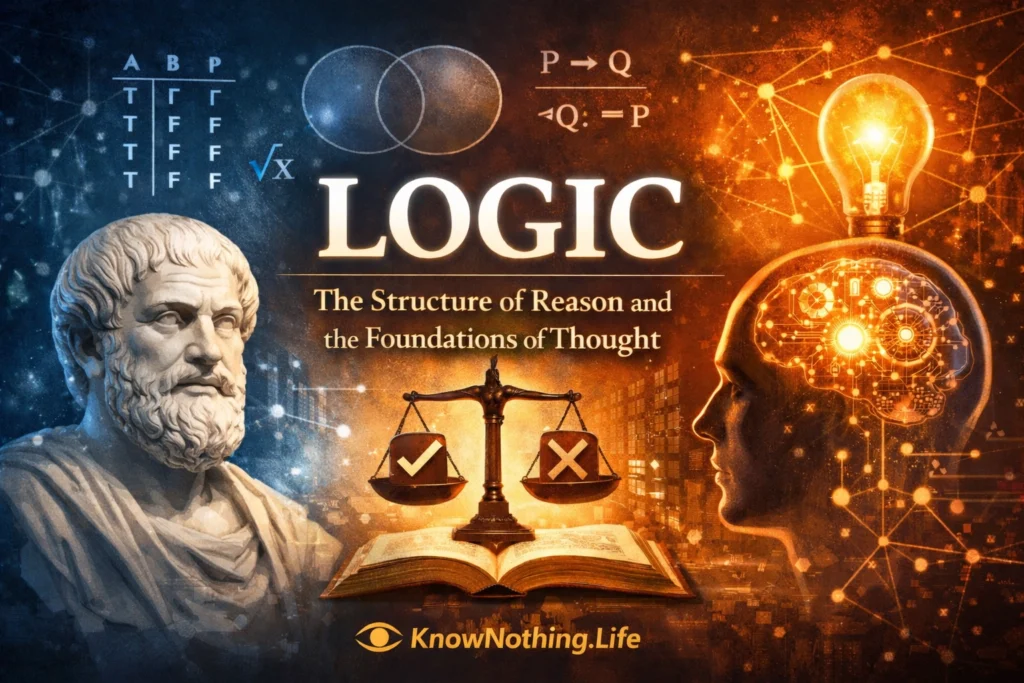
Logic is the study of valid reasoning—the principles that distinguish good arguments from bad ones. It provides the framework for analyzing how conclusions follow from premises, ensuring that thought proceeds in a coherent, consistent, and justifiable manner. As both a philosophical discipline and a practical tool, logic underlies fields as diverse as mathematics, science, law, and everyday decision-making.
At its core, logic is concerned with form rather than content. It examines the structure of arguments, asking whether a conclusion necessarily follows from given premises, regardless of the subject matter. This focus allows logic to function as a universal language of reasoning, applicable across domains. Whether evaluating a philosophical claim or constructing a scientific theory, logic provides the standards by which reasoning can be assessed.
The importance of logic extends beyond academic inquiry. In a world saturated with information, the ability to think logically is essential for navigating arguments, identifying fallacies, and making informed decisions. By understanding the principles of logic, individuals can sharpen their reasoning skills and engage more effectively with complex ideas.
Historical Foundations of Logic
The origins of logic can be traced to ancient Greece, where philosophers sought to formalize the principles of reasoning. Aristotle is widely regarded as the founder of formal logic. In works such as Organon, he developed a system of syllogistic logic that analyzes arguments in terms of categorical relationships. For example, from the premises “All humans are mortal” and “Socrates is a human,” one can logically conclude that “Socrates is mortal.” This structure illustrates how valid reasoning depends on the relationship between premises and conclusion.
Aristotle’s system dominated logical thought for centuries, providing a foundation for medieval scholastic philosophy. Thinkers such as Thomas Aquinas integrated Aristotelian logic into theological inquiry, using it to clarify arguments about faith and reason. During this period, logic was considered an essential component of education, forming part of the trivium alongside grammar and rhetoric.
The development of modern logic began in the 19th century with the work of philosophers such as Gottlob Frege. In Begriffsschrift, Frege introduced a formal system that extended logic beyond syllogisms to include quantifiers and functions. This innovation laid the groundwork for symbolic logic, transforming the field into a precise and mathematically rigorous discipline.
Deductive and Inductive Reasoning
Logic is often divided into two main types of reasoning: deductive and inductive. Deductive reasoning involves drawing conclusions that necessarily follow from given premises. If the premises are true and the argument is valid, the conclusion must also be true. This type of reasoning is central to mathematics and formal logic, where certainty and rigor are paramount.
Inductive reasoning, by contrast, involves drawing general conclusions from specific observations. While inductive arguments can be strong or weak, they do not guarantee the truth of their conclusions. Instead, they provide probabilistic support. For example, observing that the sun has risen every day in the past leads to the expectation that it will rise tomorrow, but this conclusion is not logically certain.
Philosophers have long debated the justification of induction. David Hume famously argued that inductive reasoning cannot be logically justified, as it relies on the assumption that the future will resemble the past. This problem of induction highlights the limits of logic and the role of habit and experience in shaping human reasoning.
Formal Logic and Symbolic Systems
The development of formal logic in the modern era introduced symbolic systems that allow for precise analysis of arguments. These systems use symbols to represent logical relationships, enabling complex reasoning to be expressed and evaluated systematically. Propositional logic, for example, analyzes statements in terms of logical connectives such as “and,” “or,” and “not,” while predicate logic extends this framework to include quantifiers and variables.
Bertrand Russell and Alfred North Whitehead made significant contributions to formal logic in their work Principia Mathematica. They sought to demonstrate that mathematics could be derived from logical principles, an ambitious project that underscored the foundational role of logic in intellectual inquiry. Russell’s work also addressed paradoxes and inconsistencies, highlighting the need for careful formulation of logical systems.
Formal logic has applications beyond philosophy, particularly in computer science and artificial intelligence. Logical systems underpin programming languages, algorithms, and automated reasoning, demonstrating the practical relevance of abstract logical principles. These developments illustrate how logic continues to evolve and adapt to new contexts.
Fallacies and Critical Thinking
An important aspect of logic is the identification and analysis of fallacies—errors in reasoning that undermine the validity of arguments. Fallacies can be formal, involving flaws in logical structure, or informal, involving issues such as ambiguity, irrelevance, or emotional manipulation. Understanding fallacies is essential for evaluating arguments and avoiding mistakes in reasoning.
Common fallacies include the ad hominem, which attacks the person rather than the argument; the straw man, which misrepresents an opponent’s position; and the appeal to authority, which relies on the opinion of an authority figure rather than evidence. Recognizing these patterns allows individuals to critically assess arguments and engage in more effective reasoning.
Critical thinking involves not only identifying fallacies but also constructing sound arguments. This requires clarity, coherence, and the ability to evaluate evidence. Logic provides the tools for this process, enabling individuals to navigate complex issues and make reasoned judgments. In this sense, logic is not merely an abstract discipline but a practical skill with broad applications.
Logic, Language, and Meaning
The relationship between logic and language is a central concern in philosophy. Logical analysis often involves clarifying the meaning of statements and examining how language can obscure or reveal logical structure. Ludwig Wittgenstein, in Tractatus Logico-Philosophicus, argued that the structure of language reflects the structure of reality, suggesting that logical analysis can illuminate the nature of the world.
Wittgenstein’s later work, however, emphasized the diversity of language use and the importance of context. In Philosophical Investigations, he argued that meaning is determined by use, challenging the idea that language can be fully captured by formal logic. This shift highlights the complexity of the relationship between logic and language, suggesting that logical analysis must be complemented by attention to context and practice.
These perspectives illustrate the broader philosophical significance of logic. It is not only a tool for analyzing arguments but also a means of exploring the nature of meaning, truth, and understanding. By examining how language and logic interact, philosophers gain insight into the foundations of human thought.
Logic in Contemporary Thought
In contemporary philosophy and science, logic continues to play a central role. Developments in modal logic, which examines necessity and possibility, and non-classical logics, such as fuzzy logic and paraconsistent logic, have expanded the scope of the field. These systems address limitations in classical logic and provide new tools for analyzing complex phenomena.
Logic is also integral to fields such as artificial intelligence, where it underpins systems for reasoning and decision-making. Algorithms that process information, make predictions, and solve problems rely on logical principles to function effectively. This demonstrates the enduring relevance of logic in an increasingly technological world.
At the same time, philosophical debates about logic persist. Questions about the nature of truth, the limits of formal systems, and the relationship between logic and reality continue to inspire inquiry. These discussions reflect the dynamic and evolving nature of logic as both a discipline and a tool for understanding the world.
Conclusion
Logic is the foundation of rational thought, providing the principles that govern valid reasoning and coherent argumentation. From its origins in the work of Aristotle to its modern developments in symbolic systems and computational applications, logic has remained a central component of intellectual inquiry.
Through the contributions of thinkers such as Gottlob Frege, Bertrand Russell, and Ludwig Wittgenstein, the field has evolved into a sophisticated and versatile discipline. It continues to inform our understanding of reasoning, language, and knowledge.
Ultimately, logic is more than a set of abstract rules—it is a tool for navigating the complexities of thought and communication. By cultivating logical skills, individuals can engage more effectively with ideas, evaluate arguments, and contribute to meaningful dialogue. In this way, logic remains an essential guide to clear thinking and intellectual rigor.