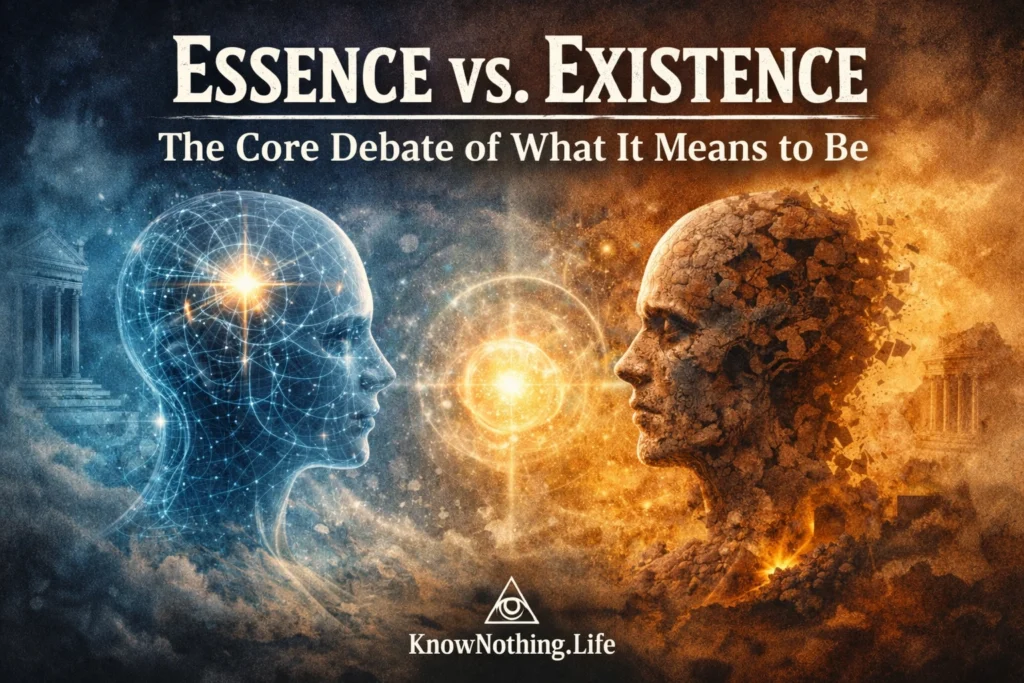
The distinction between essence and existence lies at the heart of philosophical inquiry into what it means for anything to be. At first glance, the terms seem straightforward: essence refers to what something is—its defining nature—while existence refers to the fact that it is. Yet when examined closely, this distinction becomes one of the most profound and contested issues in metaphysics, theology, and existential philosophy.
The question can be framed simply: does a thing’s nature come before its existence, or does existence precede and define its nature? For much of philosophical history, essence was considered primary. Things were believed to possess inherent natures that determined their characteristics and purpose. However, modern philosophy, particularly existentialism, challenged this view, arguing that existence comes first and that essence is something created rather than discovered. This shift fundamentally altered how humans understand identity, freedom, and meaning.
Classical Philosophy: Essence as Primary
In classical philosophy, essence was understood as the defining reality of a thing—what makes it what it is. Plato’s theory of Forms provides one of the earliest articulations of this idea. In works like The Republic, Plato argued that every object in the physical world participates in an ideal Form, which represents its true essence. A chair, for instance, is a chair because it reflects the eternal Form of “chairness,” even if imperfectly.
Building on this, Aristotle developed a more grounded account of essence in his work Metaphysics. For Aristotle, essence is not located in a separate realm but is embedded within the substance itself. He defined essence as “what it was to be” (to ti ēn einai), meaning the set of characteristics that make a thing what it is. A human being, for example, has an essence defined by rationality.
In this framework, existence is secondary to essence. A thing must first have a definable nature before it can exist as a particular instance. This perspective dominated philosophical thought for centuries, shaping not only metaphysics but also theology, where the essence of God was often considered necessary and unchanging.
Medieval Philosophy: Essence and Existence in Theology
The relationship between essence and existence took on new significance in medieval philosophy, particularly in the work of Thomas Aquinas. Drawing on Aristotle, Aquinas argued that in all created beings, essence and existence are distinct. A thing’s essence does not guarantee its existence; it must be brought into being by an external cause.
In his seminal work Summa Theologica, Aquinas explained that only in God are essence and existence identical. God’s essence is existence itself—ipsum esse subsistens. This means that God does not merely have existence but is existence. By contrast, all other beings are contingent; their existence depends on something beyond their essence.
This distinction allowed Aquinas to address fundamental theological questions about creation, causality, and necessity. It also reinforced the idea that essence provides a framework for understanding what a thing is, while existence determines whether that thing is actualized in reality. Medieval philosophy thus preserved the primacy of essence while introducing a more nuanced account of its relationship to existence.
Early Modern Philosophy: Doubt and Redefinition
The early modern period introduced skepticism about traditional metaphysical assumptions, including the relationship between essence and existence. René Descartes approached the issue through his method of doubt, seeking a foundation for knowledge that could not be questioned. In Meditations on First Philosophy, he argued that the essence of the self lies in thought, leading to the famous statement: “Cogito, ergo sum”—“I think, therefore I am.”
For Descartes, essence and existence are closely linked in the case of the thinking subject. The act of thinking reveals both the nature and the existence of the self simultaneously. However, Descartes maintained that for other entities, essence and existence remain distinct, particularly in his arguments for the existence of God.
Later philosophers, such as Immanuel Kant, challenged the idea that existence can be treated as a property of a thing’s essence. In Critique of Pure Reason, Kant argued that existence is not a predicate—it does not add anything to the concept of a thing. A hundred real coins, he noted, do not differ in concept from a hundred possible coins; existence simply determines whether the concept is instantiated in reality. This critique reshaped the philosophical understanding of existence, separating it more clearly from essence.
Existentialism: Existence Precedes Essence
The most radical rethinking of the relationship between essence and existence emerged in existentialist philosophy. Jean-Paul Sartre famously declared, “Existence precedes essence.” In his work Existentialism Is a Humanism, Sartre argued that human beings are not born with a predetermined nature. Instead, they first exist and then define themselves through their actions.
This view rejects the classical idea of fixed essences. For Sartre, there is no inherent human nature that dictates how individuals must live. Instead, each person is responsible for creating their own essence through choices and commitments. This radical freedom comes with a burden: without predetermined meaning, individuals must confront the responsibility of defining themselves.
Søren Kierkegaard, often considered a precursor to existentialism, also emphasized the importance of individual existence. In works like Fear and Trembling, he explored the tension between universal truths and personal experience, arguing that authentic existence requires a subjective commitment that goes beyond abstract definitions.
Existentialism thus shifts the focus from what things are to how they exist. It transforms the essence-existence debate into a question of lived experience, emphasizing freedom, responsibility, and the creation of meaning.
Identity, Freedom, and Human Nature
The debate between essence and existence has profound implications for understanding identity and human nature. If essence comes first, then individuals are defined by inherent characteristics that shape their lives. This perspective supports the idea of objective human nature, which can guide ethical and social norms.
By contrast, if existence precedes essence, then identity is fluid and self-determined. This view emphasizes freedom but also introduces uncertainty. Without a fixed essence, there is no predetermined path or purpose. As Sartre noted, “Man is nothing else but what he makes of himself.” This statement captures both the empowerment and the anxiety associated with existential freedom.
Psychologically, this tension reflects the human struggle between structure and autonomy. People seek stability and meaning, yet they also desire the freedom to define themselves. The balance between these forces shapes personal development, influencing how individuals navigate choices, relationships, and goals.
Contemporary Perspectives and Ongoing Debates
In contemporary philosophy, the essence-existence distinction continues to evolve. Analytic philosophers often approach the issue through modal logic, examining necessity and possibility. Saul Kripke, for example, argued that certain properties are essential to objects, even if they are discovered empirically. This suggests that essence remains a meaningful concept, even in a scientific framework.
At the same time, developments in science and technology challenge traditional notions of essence. Advances in genetics, artificial intelligence, and virtual reality raise questions about what defines identity and existence. If a person’s characteristics can be altered or replicated, what constitutes their essence? These questions blur the boundaries between fixed nature and constructed identity.
Philosophers also continue to explore the relationship between language and ontology, examining how concepts of essence and existence are shaped by linguistic structures. These discussions highlight the complexity of the debate, showing that it cannot be resolved by a single framework but requires ongoing inquiry.
Conclusion
The distinction between essence and existence remains one of the most profound and enduring questions in philosophy. From the classical emphasis on essence in the works of Aristotle to the existentialist assertion of Jean-Paul Sartre that existence comes first, the debate reflects a fundamental tension in how humans understand reality.
This tension is not merely theoretical. It shapes how individuals perceive themselves and their place in the world. Whether one believes in a fixed nature or embraces the freedom to create meaning, the relationship between essence and existence influences every aspect of thought and experience.
Ultimately, the power of this debate lies in its openness. It does not offer a single definitive answer but invites continuous reflection. As philosophy evolves, so too does the understanding of what it means to be—an inquiry that remains as vital today as it was in the time of the ancient Greeks.