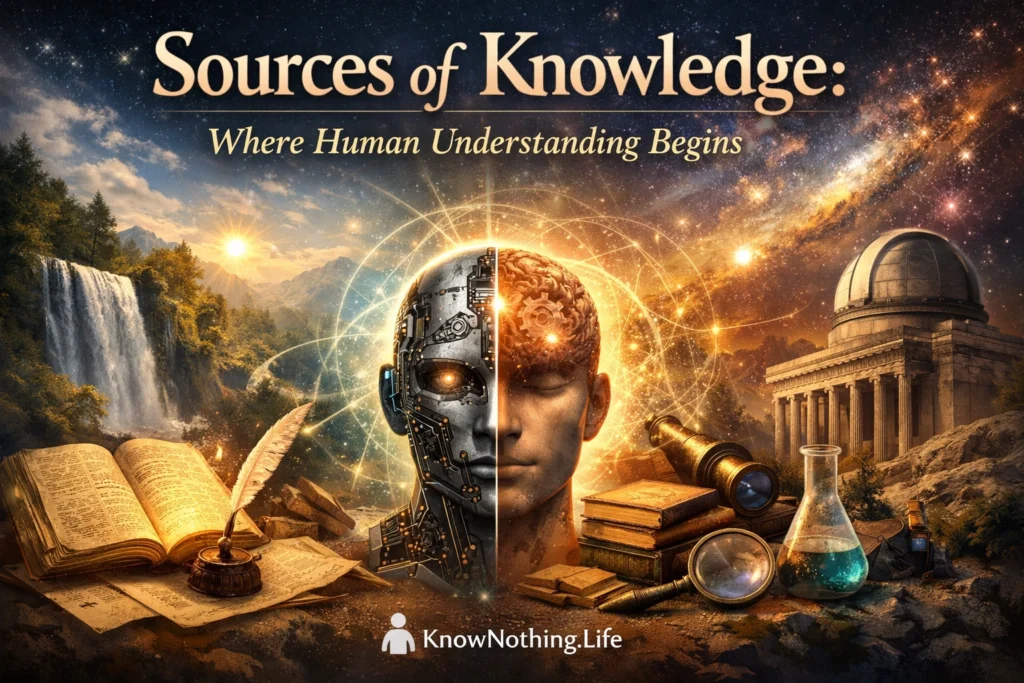
The question of where knowledge comes from is one of the oldest and most persistent concerns in philosophy. While epistemology examines the nature and limits of knowledge, the study of its sources focuses on how knowledge is acquired in the first place. Are we born with innate ideas, or is all knowledge derived from experience? Can reason alone yield truths about the world, or must we rely on the senses? These questions lie at the center of philosophical inquiry and continue to shape debates across disciplines.
Throughout history, philosophers have proposed competing accounts of the origins of knowledge, often aligning themselves with either rationalism or empiricism. Thinkers such as Plato and René Descartes argued that certain knowledge is innate or accessible through reason alone, while figures like John Locke and David Hume emphasized the role of sensory experience. These opposing perspectives highlight the complexity of understanding how knowledge originates.
In modern philosophy, the discussion has expanded to include additional sources such as memory, testimony, introspection, and intuition. Rather than seeking a single origin, contemporary epistemology often recognizes multiple, interrelated sources of knowledge. By examining these sources, philosophers aim to understand not only how we come to know things, but also how reliable those processes are and how they contribute to our broader understanding of the world.
Reason and Rationalism
Reason has long been considered a fundamental source of knowledge, particularly within the rationalist tradition. Rationalists argue that certain truths can be known independently of sensory experience, through the use of pure thought and logical deduction. This view is closely associated with René Descartes, who sought to establish a foundation for knowledge that could withstand even the most radical doubt.
In Meditations on First Philosophy, Descartes famously arrived at the conclusion “Cogito, ergo sum” (“I think, therefore I am”), which he regarded as indubitable. For Descartes, this insight demonstrated that certain knowledge could be attained through reason alone, without reliance on the senses. Similarly, Gottfried Wilhelm Leibniz argued that the mind contains innate ideas that shape our understanding of the world, asserting that “nothing is in the intellect that was not first in the senses—except the intellect itself.”
Rationalism emphasizes the power of the mind to generate knowledge through reflection and analysis. Mathematical and logical truths are often cited as examples of knowledge that does not depend on experience. However, critics argue that reason alone cannot provide knowledge of the external world, raising questions about the limits of rationalism as a comprehensive account of knowledge.
Experience and Empiricism
In contrast to rationalism, empiricism holds that knowledge arises primarily from sensory experience. According to this view, the mind begins as a blank slate, and all knowledge is acquired through interaction with the world. This perspective is most famously articulated by John Locke in An Essay Concerning Human Understanding, where he describes the mind as a “tabula rasa.”
Empiricism places great emphasis on observation and experimentation, making it foundational to the development of modern science. David Hume extended this approach by arguing that even our most basic concepts, such as causation, are derived from patterns of experience rather than logical necessity. In An Enquiry Concerning Human Understanding, Hume famously noted that our belief in cause and effect is based on habit rather than rational proof.
While empiricism provides a powerful account of how we learn about the world, it also faces challenges. If all knowledge is derived from experience, how do we account for abstract concepts such as mathematics or logic? Moreover, sensory experience can be misleading, raising questions about the reliability of perception as a source of knowledge.
Perception and the External World
Perception is often regarded as the most immediate and fundamental source of knowledge about the external world. Through our senses, we gain access to information about objects, events, and environments. Philosophers have long debated the extent to which perception can be trusted and whether it provides direct or indirect access to reality.
Direct realists argue that perception gives us immediate access to the world as it is, while indirect realists contend that we perceive representations or mental images rather than the objects themselves. These debates are closely tied to skepticism, which questions whether our sensory experiences can be relied upon at all. René Descartes, for example, raised doubts about perception by suggesting that our senses can deceive us.
Despite these concerns, perception remains a central source of knowledge in everyday life. It allows us to navigate our environment, recognize patterns, and respond to changes in our surroundings. Modern philosophy and cognitive science have further explored how perception works, revealing both its strengths and its limitations as a source of knowledge.
Memory, Introspection, and Testimony
Beyond reason and perception, philosophers recognize additional sources of knowledge that play crucial roles in our cognitive lives. Memory, for instance, allows us to retain and recall past experiences, providing continuity to our understanding of the world. Without memory, knowledge would be limited to the present moment, making learning and reasoning impossible.
Introspection offers another source of knowledge by allowing individuals to access their own mental states. Through introspection, we can know our thoughts, feelings, and intentions. This form of knowledge is often considered immediate and self-evident, though it is not immune to error or bias. Philosophers have debated the extent to which introspection provides reliable access to the mind.
Testimony, or knowledge gained from others, is increasingly recognized as a fundamental source of knowledge. Much of what we know—about history, science, and even everyday facts—comes from the reports of others. Philosophers such as Thomas Reid argued that trust in testimony is a basic feature of human cognition. However, reliance on testimony also raises questions about authority, credibility, and the potential for misinformation.
Intuition and A Priori Knowledge
Intuition is often cited as a source of a priori knowledge—knowledge that is independent of experience. Philosophers have used intuition to explain how we grasp certain truths, particularly in mathematics and logic. For example, we seem to know that 2 + 2 = 4 without needing to observe instances of it in the world.
Immanuel Kant provided a sophisticated account of a priori knowledge in Critique of Pure Reason, arguing that the mind imposes structures on experience that make knowledge possible. Kant distinguished between analytic truths, which are true by definition, and synthetic a priori truths, which extend our knowledge without relying on experience.
Intuition, however, remains a controversial source of knowledge. Critics argue that intuitions can vary between individuals and may be influenced by cultural or psychological factors. Nevertheless, intuition continues to play a significant role in philosophical reasoning, particularly in the use of thought experiments and conceptual analysis.
Contemporary Perspectives on Sources of Knowledge
Modern epistemology has moved beyond the strict opposition between rationalism and empiricism, recognizing that knowledge often arises from a combination of sources. Philosophers now examine how different sources interact and how their reliability can be assessed in various contexts.
Social epistemology has highlighted the importance of collective knowledge, emphasizing the role of institutions, communication, and collaboration. Thinkers like Alvin Goldman have explored how information spreads through social networks and how trust is established. Similarly, Miranda Fricker has examined how social factors can influence whose knowledge is recognized, particularly in her work Epistemic Injustice.
Advances in cognitive science have also reshaped our understanding of knowledge sources by revealing the mechanisms underlying perception, memory, and reasoning. These interdisciplinary approaches provide a more comprehensive picture of how knowledge is formed, highlighting both the strengths and limitations of human cognition.
Conclusion
The study of the sources of knowledge reveals the richness and complexity of human understanding. From reason and experience to perception, memory, and testimony, each source contributes to the formation of knowledge in distinct ways. Rather than relying on a single origin, contemporary philosophy recognizes that knowledge emerges from the interaction of multiple cognitive processes.
As John Locke observed, “No man’s knowledge here can go beyond his experience.” Yet the contributions of rationalists, empiricists, and modern thinkers suggest that knowledge extends beyond any single source. By examining these diverse origins, epistemology continues to deepen our understanding of how we come to know—and how we can trust what we know.
In an increasingly complex world, understanding the sources of knowledge is more important than ever. It allows us to evaluate information critically, recognize the limits of our understanding, and navigate the challenges of truth and belief with greater clarity.