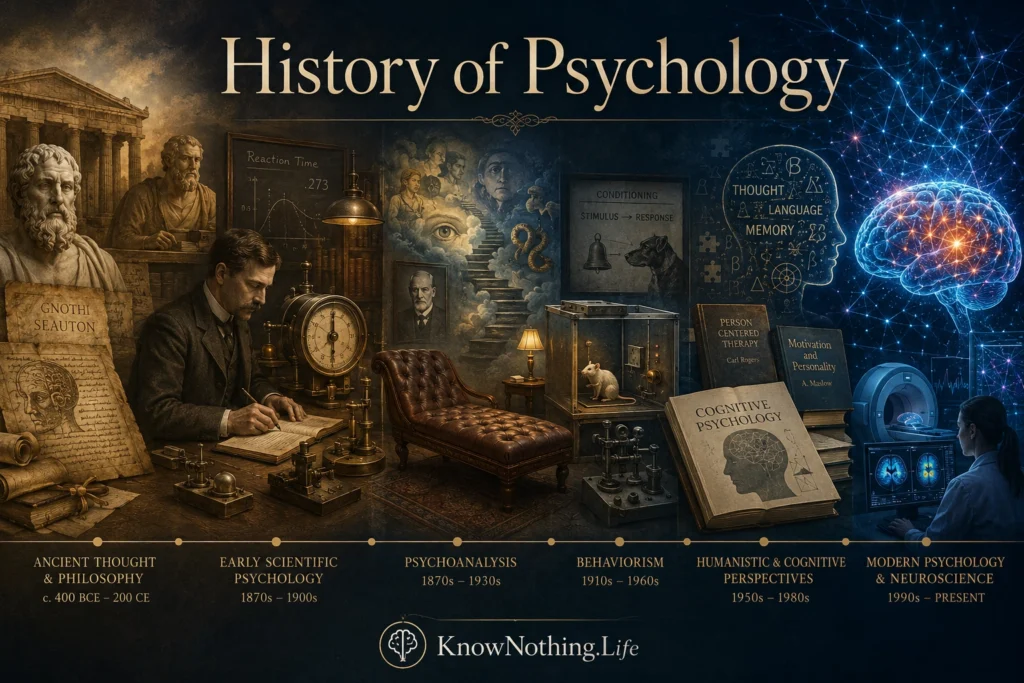
The history of psychology is the story of how human beings learned to study themselves. Long before psychology became a formal science, philosophers, physicians, theologians, and educators asked questions about perception, memory, emotion, reason, madness, habit, identity, and moral character. What is the mind? How does experience shape personality? Are human actions freely chosen, biologically driven, socially learned, or unconsciously motivated? Psychology emerged from these older questions, but it gradually separated itself from philosophy by developing laboratories, experiments, clinical methods, statistical tools, and theories of behavior.
Modern psychology is often defined as the scientific study of mind and behavior, but that definition conceals a long and complex struggle over what should count as legitimate psychological knowledge. Some psychologists studied conscious experience; others rejected consciousness and focused only on observable behavior. Some emphasized instincts and biology; others emphasized learning, culture, and social conditions. Some treated mental illness through interpretation and conversation; others sought biological, behavioral, or cognitive explanations. The field developed not as a single straight path, but as a series of competing traditions that gradually expanded psychology’s subject matter.
Philosophical Origins of Psychology
Psychology’s deepest roots lie in ancient philosophy. Plato, in dialogues such as Republic and Phaedo, treated the soul as the seat of reason, appetite, and spirit. His tripartite theory of the soul anticipated later divisions between rational control, emotional impulse, and desire. Aristotle, in De Anima (On the Soul), offered a more biological and observational account, asking how living beings perceive, remember, desire, and move. Aristotle’s famous claim that the soul is the “form” of a living body made psychology inseparable from life itself rather than a separate ghostly substance.
In the early modern period, psychology was shaped by debates over reason, experience, and the relationship between mind and body. René Descartes, in Meditations on First Philosophy and Discourse on Method, defended mind-body dualism and gave philosophy one of its most famous declarations: “I think, therefore I am.” Descartes argued that the thinking mind and extended body were distinct, though connected. His position influenced centuries of debate about consciousness, free will, and the nervous system. Even later psychologists who rejected dualism continued to work within questions Descartes made central: how does mental life relate to the physical body?
The British empiricists gave psychology another foundation. John Locke, in An Essay Concerning Human Understanding, argued that the mind begins as a tabula rasa, or blank slate, and that knowledge comes from experience. David Hume, in A Treatise of Human Nature, analyzed association, habit, emotion, and belief, famously writing that reason is “the slave of the passions.” Hume’s emphasis on habit and association later influenced learning theory, behaviorism, and cognitive psychology. By the eighteenth century, many of psychology’s central problems were already visible: nature and nurture, emotion and reason, consciousness and body, freedom and habit.
Physiology and the Birth of Scientific Psychology
Psychology became a distinct science in the nineteenth century because the study of the nervous system, sensation, and measurement advanced rapidly. Physiologists showed that mental life could be studied indirectly through the body. Johannes Müller developed the doctrine of specific nerve energies, arguing that the quality of sensation depends on the nerve pathway stimulated, not merely the external object. Hermann von Helmholtz measured the speed of nerve conduction, showing that nervous activity followed physical laws rather than mysterious spiritual principles. These discoveries helped make mind scientifically approachable.
The formal founding of experimental psychology is usually credited to Wilhelm Wundt, who established a psychology laboratory at the University of Leipzig in 1879. In Principles of Physiological Psychology, Wundt argued that psychology should investigate immediate conscious experience through controlled observation and experiment. He used methods such as reaction-time measurement and trained introspection, seeking to analyze perception, attention, and sensation. Wundt’s laboratory became a training center for psychologists from many countries, helping establish psychology as an independent academic discipline.
Wundt’s work did not settle psychology’s identity, but it gave the field institutional form. Psychology now had laboratories, journals, students, professional societies, and research programs. At the same time, psychologists disagreed about whether introspection could be reliable. Could people accurately report their own mental states? Could consciousness be broken into elements like chemistry? These questions shaped the first major school of psychology in the United States: structuralism.
Structuralism, Functionalism, and Early American Psychology
Edward B. Titchener, a student of Wundt, developed structuralism, which sought to identify the basic elements of conscious experience. In works such as An Outline of Psychology, Titchener described psychology as the analysis of sensations, images, and feelings. Structuralists believed that trained observers could report the components of experience with precision. For example, rather than saying “I see an apple,” a structuralist observer might describe color, shape, brightness, and sensory qualities. The goal was to map the structure of the mind.
Structuralism soon faced criticism from William James, whose The Principles of Psychology became one of the most influential works in the history of the field. James argued that consciousness was not a collection of static parts but a flowing process. He famously described consciousness as a “stream,” writing that it “does not appear to itself chopped up in bits.” James’s approach became known as functionalism because it asked what mental processes do and how they help organisms adapt. Instead of analyzing consciousness into elements, functionalists studied attention, habit, emotion, will, and practical adjustment to the environment.
Functionalism fit the American intellectual climate because it was influenced by Charles Darwin’s theory of evolution. Darwin’s On the Origin of Species and The Expression of the Emotions in Man and Animals suggested that behavior and emotion could be understood in adaptive terms. If organisms evolve, then mental processes may have functions shaped by survival and reproduction. This evolutionary outlook widened psychology’s scope to include children, animals, education, work, and everyday behavior.
Psychoanalysis and the Unconscious
While experimental psychology developed in universities, clinical psychology and psychotherapy were deeply influenced by Sigmund Freud. In works such as The Interpretation of Dreams, Three Essays on the Theory of Sexuality, and The Ego and the Id, Freud argued that human behavior is shaped by unconscious wishes, conflicts, defenses, and childhood experiences. His famous statement that dreams are the “royal road to the unconscious” captured his belief that hidden mental life could be interpreted through symptoms, slips, fantasies, and dreams.
Freud’s theory of psychoanalysis transformed Western ideas about personality. He proposed that the mind contains unconscious forces that resist direct awareness and that psychological suffering often emerges from conflict between desire, fear, guilt, and social prohibition. Whether one accepts or rejects Freud’s specific theories, his influence is immense. He helped make childhood, sexuality, repression, symbolism, and talk therapy central to modern thought. He also changed the cultural vocabulary of the self; terms such as repression, projection, defense mechanism, and unconscious motivation entered ordinary language.
Freud’s followers and critics expanded psychoanalysis in different directions. Carl Jung, in works such as Psychological Types, emphasized archetypes, symbolism, and the collective unconscious. Alfred Adler focused on inferiority, compensation, and social striving. Anna Freud developed ego psychology and the study of defense mechanisms, while Melanie Klein advanced object relations theory. Psychoanalysis was often criticized for being difficult to test scientifically, but it remains historically essential because it made psychology confront hidden motives, personal narrative, and the meaning of symptoms.
Behaviorism and the Study of Observable Action
In the early twentieth century, psychology shifted sharply toward behaviorism. John B. Watson, in his 1913 article “Psychology as the Behaviorist Views It,” rejected introspection and argued that psychology should be “a purely objective experimental branch of natural science.” For Watson, consciousness was too private and unreliable to serve as the foundation of science. Behaviorists studied stimulus and response, learning, conditioning, and environmental control. The goal was to predict and influence behavior without appealing to invisible mental states.
Behaviorism drew support from the work of Ivan Pavlov, whose studies of conditioned reflexes showed that animals could learn associations between stimuli. Pavlov’s experiments with dogs demonstrated classical conditioning, in which a neutral stimulus becomes capable of producing a response after being paired with a biologically significant stimulus. Watson applied similar principles to human emotion, most famously in the controversial Little Albert experiment with Rosalie Rayner, which suggested that fear could be conditioned.
Later, B. F. Skinner developed operant conditioning, arguing that behavior is shaped by its consequences. In The Behavior of Organisms and Science and Human Behavior, Skinner examined reinforcement, punishment, schedules of reward, and environmental control. His statement that “behavior is shaped and maintained by its consequences” expresses the core of his system. Behaviorism became powerful in education, animal training, therapy, and experimental psychology, though critics argued that it neglected thought, meaning, language, and inner experience.
Humanistic Psychology and the Person
By the mid-twentieth century, some psychologists believed behaviorism and psychoanalysis were too narrow. Behaviorism seemed to reduce people to conditioned responses, while psychoanalysis often emphasized pathology and unconscious conflict. Humanistic psychology emerged as a “third force” that emphasized growth, freedom, meaning, creativity, and self-actualization. It aimed to study the whole person rather than isolated behaviors or hidden drives.
Abraham Maslow, in Motivation and Personality, proposed a hierarchy of needs, moving from physiological survival to safety, belonging, esteem, and self-actualization. He argued that psychology had focused too heavily on illness and should also study healthy development. Carl Rogers, in On Becoming a Person, developed person-centered therapy, emphasizing empathy, authenticity, and unconditional positive regard. Rogers wrote, “The curious paradox is that when I accept myself just as I am, then I can change.” His approach placed the therapeutic relationship at the center of healing.
Humanistic psychology influenced counseling, education, leadership, and popular culture. It helped psychology speak about dignity, purpose, and personal growth. Critics argued that it could be too optimistic or difficult to measure, but its legacy remains visible in positive psychology, psychotherapy, self-development, and theories of motivation.
The Cognitive Revolution
In the 1950s and 1960s, psychology underwent the cognitive revolution, which restored the scientific study of memory, attention, language, problem-solving, and mental representation. Behaviorism had made psychology more rigorous, but many psychologists concluded that behavior could not be fully explained without reference to internal processes. The rise of computers also gave researchers new metaphors for information processing, coding, storage, retrieval, and computation.
George A. Miller’s 1956 paper “The Magical Number Seven, Plus or Minus Two” became a landmark in cognitive psychology by examining limits of short-term memory and information processing. Noam Chomsky’s review of Skinner’s Verbal Behavior challenged behaviorist explanations of language, arguing that grammar and linguistic creativity could not be explained simply by reinforcement. Ulric Neisser’s Cognitive Psychology helped name and organize the field, defining cognition as the processes by which sensory input is transformed, stored, recovered, and used.
The cognitive revolution did not simply return psychology to introspection. It used experiments, models, reaction times, errors, memory tasks, and later brain imaging to infer mental processes scientifically. This movement reshaped almost every branch of psychology, including developmental psychology, social psychology, clinical psychology, artificial intelligence, linguistics, and neuroscience.
Contemporary Psychology
Today, psychology is a broad, pluralistic science. Biological psychology and neuroscience study brain systems, hormones, genetics, neurotransmitters, and neural networks. Developmental psychology examines change across the lifespan, from infancy to aging. Social psychology studies attitudes, identity, conformity, prejudice, persuasion, and group behavior. Clinical psychology investigates mental disorders and treatments, while cognitive psychology continues to study perception, memory, learning, attention, and decision-making.
Contemporary psychology also pays much greater attention to culture, diversity, ethics, and research methods. Earlier psychology often treated Western, educated populations as if they represented humanity as a whole. Modern researchers increasingly recognize that culture shapes emotion, selfhood, morality, cognition, and social behavior. The replication crisis in psychology has also forced the field to reexamine statistical practices, transparency, sample size, and scientific reliability. This has made psychology more self-critical and methodologically careful.
The history of psychology shows that no single school has fully explained human life. Wundt gave psychology a laboratory; James gave it a living stream of consciousness; Freud gave it the unconscious; Watson and Skinner gave it observable behavior; Rogers and Maslow gave it personal growth; cognitive psychologists gave it mental processes; neuroscience gave it the brain. Each tradition corrected and expanded the others.
Final Thoughts
The history of psychology is not merely a list of theories. It is a record of changing answers to the question of what human beings are. Are we rational souls, biological organisms, conditioned responders, unconscious dreamers, information processors, social selves, or meaning-seeking persons? Psychology’s answer has become increasingly layered: we are all of these at once. Human life includes biology, experience, memory, culture, emotion, behavior, consciousness, and relationship.
Psychology became powerful because it refused to remain only speculation. It developed experiments, therapies, measurements, observations, and models. Yet it remains connected to ancient philosophical questions about identity, freedom, knowledge, and suffering. Its history is therefore both scientific and humanistic. To study the history of psychology is to study the long effort to understand how the mind works, why people behave as they do, and how human beings can suffer, adapt, learn, heal, and grow.