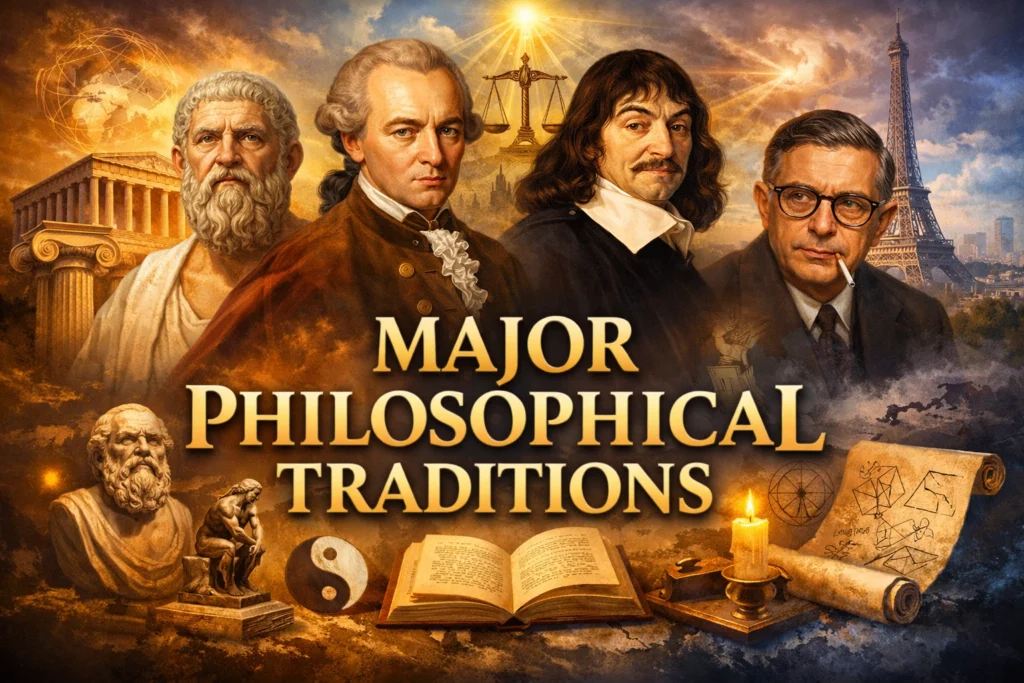
Philosophy has developed through a rich tapestry of traditions, each offering distinct approaches to understanding reality, knowledge, ethics, and human existence. These traditions are not isolated systems but evolving conversations that span cultures and centuries, shaping how individuals interpret the world and their place within it. From ancient metaphysics to modern analytic inquiry, philosophical traditions provide frameworks that guide reasoning, challenge assumptions, and illuminate fundamental questions about life.
The diversity of philosophical traditions reflects the complexity of human thought. Some traditions emphasize rational analysis and logical clarity, while others focus on experience, intuition, or spiritual insight. Despite their differences, they share a common aim: to make sense of existence and to articulate principles that can guide human action. By examining these traditions, we gain insight into the intellectual foundations of modern thought and the enduring questions that continue to shape philosophical inquiry.
Ancient Greek Philosophy and the Birth of Western Thought
One of the earliest and most influential philosophical traditions emerges in ancient Greece, where thinkers sought to explain the natural world and human life through reason rather than myth. Socrates, though he left no written works, is known through the dialogues of his student Plato. In works such as The Republic, Plato explores questions of justice, knowledge, and the ideal state, presenting a vision of reality grounded in eternal forms.
Socrates’ method of questioning, known as the Socratic method, emphasizes critical inquiry and the examination of beliefs. He famously declares, “The unexamined life is not worth living,” highlighting the importance of reflection in achieving wisdom. This approach establishes a foundation for philosophical inquiry that prioritizes dialogue and reasoning.
Aristotle, Plato’s student, develops a comprehensive system of philosophy in works such as Nicomachean Ethics and Metaphysics. Aristotle’s emphasis on empirical observation and logical analysis shapes subsequent traditions, influencing fields ranging from ethics to science. His idea that “virtue is a mean between extremes” reflects a balanced approach to ethical life, emphasizing moderation and practical wisdom.
Eastern Philosophical Traditions
While Western philosophy often emphasizes rational analysis, Eastern traditions offer complementary perspectives that focus on harmony, balance, and the integration of mind and world. In ancient China, Confucius develops a philosophy centered on ethics, social relationships, and moral cultivation. In texts such as the Analects, he emphasizes the importance of virtue, respect, and proper conduct, arguing that social harmony arises from moral character.
Another influential Chinese tradition is Daoism, associated with Laozi and the Tao Te Ching. Daoism emphasizes the concept of the Dao, or the natural way, and advocates for living in accordance with the rhythms of nature. Laozi writes, “Nature does not hurry, yet everything is accomplished,” reflecting a philosophy that values simplicity, spontaneity, and non-interference.
In India, philosophical traditions such as Hinduism and Buddhism explore questions of existence, suffering, and liberation. Siddhartha Gautama, the founder of Buddhism, teaches that suffering arises from desire and can be overcome through ethical living and mindfulness. These traditions emphasize introspection and spiritual development, offering insights that complement Western approaches to philosophy.
Medieval Philosophy and the Synthesis of Faith and Reason
The medieval period is characterized by the integration of philosophical inquiry with religious thought. In the Christian tradition, Thomas Aquinas seeks to reconcile faith and reason in works such as Summa Theologica. Drawing on Aristotle, Aquinas argues that reason can be used to understand and support religious truths, creating a synthesis that influences Western thought for centuries.
In the Islamic world, philosophers such as Avicenna and Averroes engage with Greek philosophy, preserving and expanding its insights. Their work contributes to the transmission of philosophical ideas across cultures, demonstrating the interconnectedness of intellectual traditions.
Medieval philosophy often focuses on questions of existence, divine nature, and the relationship between reason and revelation. While grounded in religious frameworks, it also advances philosophical methods and concepts that continue to influence modern thought.
Modern Philosophy and the Rise of Rationalism and Empiricism
The modern period marks a shift toward new methods of inquiry, emphasizing both rationalism and empiricism. René Descartes, in Meditations on First Philosophy, establishes a foundation for knowledge based on doubt and reason, famously stating, “I think, therefore I am.” His approach exemplifies rationalism, the belief that knowledge arises primarily from reason.
Empiricists such as John Locke and David Hume emphasize experience as the source of knowledge. Locke argues that the mind begins as a blank slate, shaped by sensory experience, while Hume questions the certainty of causation and the limits of human understanding. These debates shape the development of epistemology and influence later philosophical traditions.
The tension between rationalism and empiricism culminates in the work of Immanuel Kant, who seeks to reconcile these perspectives in Critique of Pure Reason. Kant argues that knowledge arises from the interaction between sensory experience and the structures of the mind, offering a synthesis that transforms modern philosophy.
Contemporary Traditions: Analytic and Continental Philosophy
In the twentieth century, philosophy becomes increasingly specialized, giving rise to distinct traditions such as analytic and continental philosophy. Analytic philosophy, associated with thinkers like Bertrand Russell and Ludwig Wittgenstein, emphasizes logical analysis, clarity, and the study of language. Wittgenstein’s work, particularly Philosophical Investigations, explores how language shapes meaning and understanding.
Continental philosophy, by contrast, focuses on broader questions of existence, culture, and human experience. Martin Heidegger, in Being and Time, examines the nature of being and the human condition, while Jean-Paul Sartre explores existentialism, emphasizing freedom and responsibility. Sartre famously declares, “Man is condemned to be free,” highlighting the burden of choice in human life.
These traditions reflect different approaches to philosophy, with analytic philosophy prioritizing precision and continental philosophy emphasizing interpretation and critique. Together, they illustrate the diversity of contemporary thought.
The Interconnectedness of Philosophical Traditions
While philosophical traditions are often categorized by geography or methodology, they are deeply interconnected. Ideas travel across cultures and eras, influencing and reshaping one another. The transmission of Greek philosophy through Islamic scholars, the integration of Eastern ideas into Western thought, and the global exchange of contemporary perspectives all demonstrate the fluidity of philosophical development.
This interconnectedness highlights the importance of dialogue and openness in philosophical inquiry. No single tradition has a monopoly on truth; each offers insights that can enrich our understanding of complex questions. By engaging with multiple traditions, we can develop a more comprehensive and nuanced perspective on philosophy.
The Enduring Legacy of Philosophy
Major philosophical traditions continue to shape how we think about knowledge, ethics, and the nature of reality. They provide tools for critical reflection and frameworks for addressing the challenges of modern life. Whether through rational analysis, empirical investigation, or spiritual insight, philosophy remains a vital part of human inquiry.
The enduring legacy of these traditions lies in their ability to provoke questions and inspire thought. They remind us that understanding is not static but an ongoing process, shaped by dialogue, experience, and reflection. In this sense, philosophy is not merely a body of knowledge but a way of engaging with the world, inviting us to explore the deepest questions of existence with curiosity and rigor.