
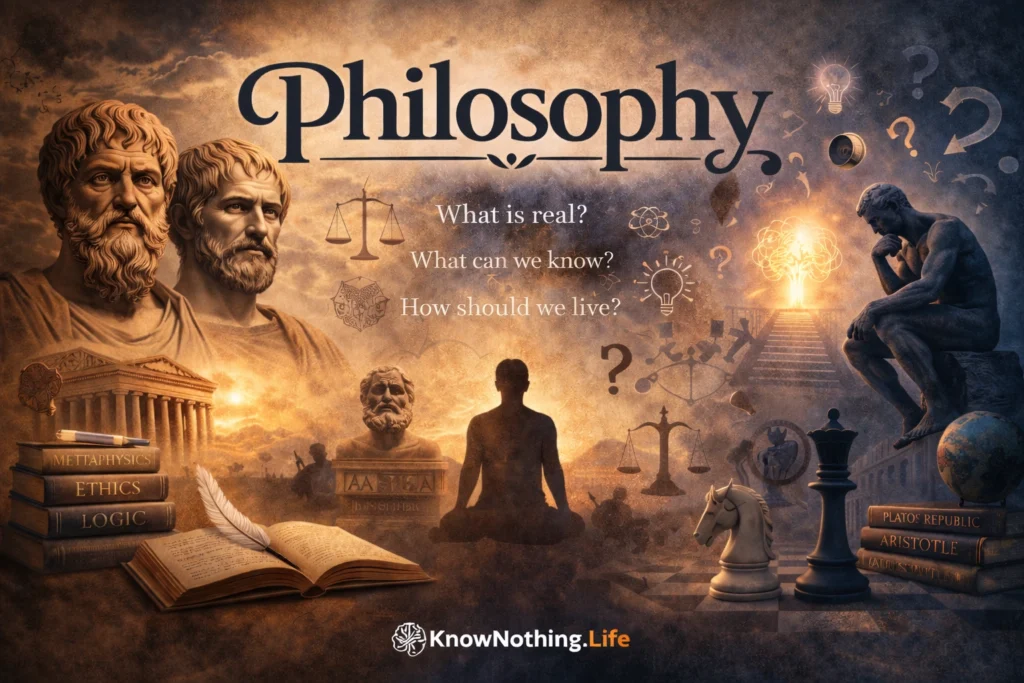
Philosophy is the pursuit of fundamental truth—an inquiry into the nature of reality, knowledge, existence, and meaning itself. It asks the deepest questions humans can pose: What is real? What can we know? How should we live? From ancient thinkers like Plato and Aristotle to modern philosophers, this discipline has shaped the intellectual foundations of science, ethics, politics, and logic. Philosophy is not merely abstract speculation; it is a rigorous way of thinking that sharpens reasoning, challenges assumptions, and reveals the structures underlying human thought and experience.
PHILOSOPHY ATICLE ARCHIVES
- Absolute vs. Relational Time: Competing Visions of Temporal Reality
- Absurdism: Meaning, Rebellion, and the Human Condition
- Aesthetics: The Philosophy of Beauty, Art, and Experience
- Alchemy: Transformation, the Philosopher’s Stone, and the Search for Hidden Wisdom
- Analytic Philosophy: Language, Logic, and the Pursuit of Clarity
- Anarchism: Freedom, Authority, and the Rejection of the State
- Ancient Philosophy: Origins of Thought and the Foundations of Inquiry
- Animal Ethics: Moral Status, Suffering, and the Boundaries of Care
- Applied Ethics: Bridging Moral Theory and Real-World Decision-Making
- Are Plants Conscious? Intelligence, Sentience, and the Mystery of Plant Life
- Argument Structure: The Framework of Reasoned Thought
- Arguments for God: Reason, Reality, and the Case for the Divine
- Artificial Intelligence: Mind, Machines, and the Future of Intelligence
- Artistic Value: Meaning, Worth, and the Evaluation of Art
- Attention: Focus, Awareness, and the Structure of Experience
- Authenticity: Identity, Freedom, and the Pursuit of a True Self
- Authority and Legitimacy: Power, Justification, and the Right to Rule
- Bayesian Reasoning: Probability, Belief, and Rational Updating
- Behavioral Economics: Psychology, Decision-Making, and the Limits of Rationality
- Belief and Doubt: The Dynamic Foundations of Knowledge
- Best Philosophy Quotes from History’s Greatest Thinkers
- Bias and Reasoning: Limits, Errors, and the Structure of Human Thought
- Bioethics: Moral Decision-Making in Medicine, Life, and Technology
- Brain in a Vat: Reality, Illusion, and the Limits of Knowledge
- Buddhism: Suffering, Awakening, and the Path to Liberation
- Business Ethics: Principles, Responsibility, and Moral Decision-Making in Commerce
- Capitalism vs Socialism: Markets, Power, and the Organization of Economic Life
- Causal Laws: The Principles That Govern Why Things Happen
- Causation: Understanding Why Things Happen
- Chinese Philosophy: Harmony, Order, and the Way of Human Life
- Christianity: Jesus, the Church, and the Faith That Shaped World History
- Classical Greek Philosophy: Reason, Virtue, and the Foundations of Western Thought
- Climate Ethics: Responsibility, Justice, and the Moral Challenge of a Warming World
- Cognitive Philosophy: Mind, Knowledge, and the Structure of Thought
- Coherence Theory of Truth: Truth as Systematic Consistency
- Coherentism: Knowledge as a Web of Beliefs
- Compatibilism: Freedom Within a Determined World
- Confucianism: Harmony, Virtue, and the Moral Order of Society
- Conscious vs Unconscious Mind
- Consciousness & States of Mind
- Consciousness: The Mystery of Experience and Awareness
- Conservatism: Tradition, Order, and the Preservation of Social Continuity
- Contemporary Philosophy: Language, Mind, and the Complexity of Modern Thought
- Continental Philosophy: History, Experience, and the Depth of Human Meaning
- Correspondence Theory of Truth: Aligning Belief with Reality
- Cosmological Argument: Cause, Contingency, and the Origin of Existence
- Cosmology: Understanding the Origin, Evolution, and Ultimate Fate of the Universe
- Creativity: Imagination, Innovation, and the Making of Meaning
- Critical Pedagogy: Education, Power, and the Practice of Liberation
- Critical Theory: Power, Society, and the Possibility of Emancipation
- Critical Thinking: The Discipline of Reflective Reasoning
- Cultural Relativism: Understanding Values Across Worlds
- Death and Mortality: Finitude, Meaning, and the Limits of Human Existence
- Decision-Making: Choice, Rationality, and the Architecture of Action
- Deconstruction: Language, Meaning, and the Instability of Text
- Deductive vs Inductive Reasoning: Certainty, Probability, and the Nature of Inference
- Deep Ecology: Intrinsic Value, Interconnectedness, and the Ethics of the Earth
- Democracy vs Authoritarianism: Power, Participation, and the Shape of Political Order
- Deontology: Duty, Moral Law, and the Ethics of Principle
- Determinism vs. Indeterminism: Is the Future Fixed or Open?
- Dialectic: Contradiction, Dialogue, and the Movement of Thought
- Digital Identity: Selfhood, Data, and the Construction of the Online Person
- Distributive Justice: Fairness, Equality, and the Allocation of Resources
- Do Scientists Believe in God?
- Dreams
- Dualism: Mind, Body, and the Two Realms of Reality
- Dudeism: The Philosophy of Abiding in an Overcomplicated World
- Eastern Philosophy: Wisdom, Harmony, and the Nature of Reality
- Ego and Self-Awareness: Consciousness, Identity, and the Inner Observer
- Emerging & Interdisciplinary Areas: Expanding the Boundaries of Knowledge
- Emotional Ethics: Feeling, Value, and Moral Judgment
- Emotional Rationality: Reason, Feeling, and the Logic of Human Judgment
- Emotivism: Morality as Expression, Not Description
- Empiricism: Knowledge Through Experience
- Environmental Ethics: Moral Responsibility in a Fragile World
- Environmental Philosophy: Nature, Value, and the Ethics of the Earth
- Epistemic Virtue: The Character of the Knower
- Epistemology: The Study of Knowledge, Truth, and Belief
- Equality and Inequality: Fairness, Difference, and the Structure of Society
- Essence vs. Existence: The Core Debate of What It Means to Be
- Ethics of AI: Responsibility, Power, and the Future of Intelligent Systems
- Ethics of Care: Relationships, Responsibility, and the Moral Life
- Ethics: The Foundations of Moral Thought and Human Action
- Eudaimonia: Flourishing, Virtue, and the Fulfillment of Human Life
- Existential & Human Philosophy: Freedom, Meaning, and the Reality of Being
- Existentialism: Freedom, Meaning, and the Human Condition
- Expression: Emotion, Meaning, and the Inner Life in Philosophy and Art
- Faith vs Reason: Belief, Knowledge, and the Limits of Understanding
- Fallacies: Errors in Reasoning and the Illusion of Argument
- Falsifiability: Testing, Truth, and the Boundaries of Science
- Feminist Philosophy: Knowledge, Power, and the Reconstruction of Thought
- Flourishing: Human Potential, Virtue, and the Fullness of Life
- Formal Logic: The Architecture of Valid Reasoning
- Formalism: Symbols, Systems, and the Structure of Mathematical Truth
- Foundationalism: Building Knowledge on Secure Grounds
- Free Will: The Power to Choose and the Problem of Freedom
- Freedom and Anxiety: Choice, Responsibility, and the Weight of Possibility
- Gender Theory: Identity, Power, and the Construction of Difference
- German Idealism: The Philosophy of Consciousness, Freedom, and the Nature of Reality
- Gettier Problems: The Challenge That Reshaped the Theory of Knowledge
- Group Knowledge: When Knowing Becomes Collective
- Hard Determinism: A World Without Free Will
- Hedonism: Pleasure, Value, and the Pursuit of the Good Life
- Hellenistic Schools: Philosophy as a Way of Life in an Uncertain World
- Hermeneutics: Interpretation, Understanding, and the Meaning of Texts
- Hermeticism: Hermes Trismegistus, Ancient Wisdom, and the Philosophy of Correspondence
- Hindu Traditions: Continuity, Diversity, and the Living Heritage of Dharma
- Historical Causation: Explaining Events, Forces, and Human Action in History
- History of Philosophy: Ideas, Traditions, and the Evolution of Thought
- Human Enhancement: Technology, Identity, and the Future of the Human Condition
- Human-Centered & Psychological Philosophy: Mind, Meaning, and the Study of Human Experience
- Identity and Change: What Remains the Same Through Transformation
- Identity: Meaning, Formation, and the Nature of the Self
- Ideologies: Belief Systems, Power, and the Shaping of Political Life
- Indian Philosophy: Consciousness, Liberation, and the Search for Ultimate Reality
- Informal Logic: Reasoning in the Real World
- Integrated Information Theory: Consciousness, Φ, and the Mystery of Experience
- Intentionality: Aboutness, Mind, and the Structure of Thought
- Interpretation of Art: Meaning, Understanding, and the Role of the Viewer
- Interpretation of History: Meaning, Perspective, and the Construction of the Past
- Intersectionality: Identity, Power, and the Complexity of Social Experience
- Intuition: Immediate Knowledge Beyond Reason and Experience
- Intuitionism: Mathematics, Mind, and the Limits of Formal Truth
- Is Suicide Illegal? Law, History, Morality, and the Shift From Punishment to Prevention
- Is Superman a Hero? Power, Virtue, and the Philosophy of Heroism
- Is the Universe Conscious? Mind, Reality, and the Biggest Question in Existence
- Islam: Muhammad, the Qur’an, and the Faith of Submission to God
- Jainism: Nonviolence, Multiplicity, and the Path to Liberation
- Japanese Philosophy: Impermanence, Harmony, and the Search for Meaning
- Justice and Fairness: Foundations of a Moral Society
- Justice and Punishment: Morality, Responsibility, and the Limits of Legal Power
- Justice: Fairness, Order, and the Moral Structure of Society
- Justification Theories: How Beliefs Become Knowledge
- Justified True Belief: The Classical Theory of Knowledge
- Kabbalah: Jewish Mysticism, the Sefirot, and the Hidden Structure of Creation
- Know Nothing
- Kyoto School: Philosophy of Nothingness, Experience, and the Encounter Between East and West
- Learning Theories: Understanding How Humans Acquire Knowledge
- Legal Interpretation: Meaning, Authority, and the Practice of Judging
- Legal Positivism: Law, Authority, and the Separation from Morality
- Legalism: Power, Order, and the Machinery of the State
- Liberalism: Freedom, Rights, and the Architecture of Modern Society
- Libertarianism: Freedom, Choice, and the Rejection of Determinism
- Liberty: Freedom, Autonomy, and the Limits of Power
- Life Satisfaction: Evaluation, Meaning, and the Quality of a Life
- Linguistic Relativism: Language, Thought, and the Structure of Reality
- Logic: The Structure of Reason and the Foundations of Thought
- Logical Analysis: Structure, Clarity, and the Discipline of Reason
- Logicism: Reducing Mathematics to Logic and the Foundations of Certainty
- Love, Fear, Anger: Core Emotions and the Architecture of Human Experience
- Major Philosophical Traditions: Foundations of Thought and the Search for Truth
- Meaning & Purpose
- Meaning and Reference: Language, Thought, and the World
- Meaning of Life: Purpose, Value, and the Search for Significance
- Media and Ideology: Power, Representation, and the Construction of Reality
- Medieval Philosophy: Faith, Reason, and the Architecture of Thought
- Memory: Time, Identity, and the Architecture of Experience
- Metaethics: The Nature, Meaning, and Foundations of Moral Thought
- Metaphysics: The Study of Reality Beyond Appearance
- Mind and Cognition: Consciousness, Thought, and the Nature of Intelligence
- Mind-Body Problem: Consciousness, Matter, and the Nature of Reality
- Misinformation: The Distortion of Knowledge in the Information Age
- Modal Logic: Necessity, Possibility, and the Structure of Worlds
- Modality: Possibility, Necessity, and the Structure of Reality
- Modern Philosophy: Reason, Doubt, and the Reconstruction of Knowledge
- Moral Development: How Humans Learn Right and Wrong
- Moral Education: Character, Reason, and the Formation of Ethical Life
- Moral Emotions: The Feeling Foundations of Ethical Life
- Moral Psychology: The Science and Philosophy of Ethical Thought
- Moral Realism vs Anti-Realism: The Debate Over Moral Truth
- Moral Relativism: Ethics Across Cultures, Contexts, and Perspectives
- Mysticism: Direct Experience, Ultimate Reality, and the Limits of Language
- Natural Law: Moral Order, Reason, and the Foundations of Justice
- Nature of Beauty: Objectivity, Perception, and the Human Experience
- Nature of Emotions: Origins, Structure, and Human Experience
- Nature of Historical Truth: Evidence, Interpretation, and the Limits of Knowing the Past
- Nature of Knowledge: Understanding What It Means to Know
- Nature of Numbers: Reality, Abstraction, and the Foundations of Mathematics
- Nature vs Nurture: Genes, Environment, and the Making of Human Life
- New England Transcendentalism: Nature, Self-Reliance, and the Search for a Higher Life
- Nihilism: Meaninglessness, Value, and the Crisis of Belief
- Normative Ethics: The Principles That Guide Moral Judgment
- Norms and Values: Order, Meaning, and the Foundations of Social Life
- Numerology: Number Symbolism, Ancient Wisdom, and the Search for Hidden Meaning
- Occult Philosophy: Hidden Knowledge, Magic, and the Search for Invisible Order
- Ontological Argument: Existence, Necessity, and the Logic of the Divine
- Ontology: The Study of Being and What Exists
- Order vs Chaos: The Philosophical Struggle Between Structure and Change
- Ordinary Language Philosophy: Meaning, Use, and the Clarity of Everyday Speech
- Panpsychism: Is Consciousness a Fundamental Feature of Reality?
- Paradigm Shifts: Scientific Revolutions and the Evolution of Knowledge
- Perception: Experience, Reality, and the Mind’s Interpretation of the World
- Persistence Through Time: How Things Endure Across Change
- Personal Identity: What Makes You the Same Person Over Time
- Personal Narrative: Story, Identity, and the Construction of Meaning
- Phenomenology: Consciousness, Experience, and the Structure of Reality
- Philosophical Methods: Reasoning, Analysis, and the Pursuit of Understanding
- Philosophy of Art: Meaning, Expression, and the Nature of the Artistic Experience
- Philosophy of Culture: Meaning, Identity, and the Fabric of Human Life
- Philosophy of Economics: Value, Rationality, and the Structure of Economic Life
- Philosophy of Education: Knowledge, Development, and the Purpose of Learning
- Philosophy of Emotion: Feeling, Reason, and the Nature of Human Experience
- Philosophy of Happiness & Well-Being: Meaning, Fulfillment, and the Good Life
- Philosophy of History: Meaning, Causation, and the Shape of the Past
- Philosophy of Language: Meaning, Reference, and the Limits of Expression
- Philosophy of Law: Justice, Authority, and the Foundations of Legal Order
- Philosophy of Logic: Truth, Inference, and the Structure of Reason
- Philosophy of Mathematics: Truth, Structure, and the Nature of Mathematical Reality
- Philosophy of Mind: Understanding Consciousness, Thought, and Reality
- Philosophy of Religion: Faith, Reason, and the Search for Ultimate Meaning
- Philosophy of Science: Knowledge, Method, and the Nature of Reality
- Philosophy of Self: Identity, Consciousness, and the Nature of Being
- Philosophy of Technology: Tools, Power, and the Shape of Human Existence
- Physicalism: The Mind as Part of the Natural World
- Pietism: The Protestant Movement That Made Faith Personal
- Platonism vs Nominalism: Universals, Reality, and the Foundations of Abstraction
- Political Philosophy: Power, Justice, and the Foundations of Social Order
- Positive vs Negative Freedom: Two Visions of Liberty
- Possibility and Necessity: The Boundaries of What Can and Must Be
- Possible Worlds Theory: Exploring Reality Beyond the Actual
- Post-structuralism: Language, Power, and the Instability of Meaning
- Power Structures: Authority, Influence, and the Organization of Society
- Pragmatic Theory of Truth: Truth as What Works
- Pragmatism: Experience, Action, and the Meaning of Truth
- Predicate Logic: The Language of Quantification and Structure
- Problem of Evil: Suffering, God, and the Limits of Theodicy
- Progress and Decline: Change, Direction, and the Meaning of History
- Propositional Logic: The Calculus of Truth and Inference
- Purpose of Education: Knowledge, Growth, and the Shaping of Human Potential
- Qualia: Subjective Experience and the Nature of Consciousness
- Radical Skepticism: Doubting Everything We Think We Know
- Rationalism: Knowledge Through Reason Alone
- Realism vs Instrumentalism: Truth, Theories, and the Nature of Scientific Knowledge
- Reductionism: Explanation, Levels, and the Unity of Science
- Reliabilism: Knowledge Through Reliable Belief-Forming Processes
- Religious Language: Meaning, Reference, and the Expression of the Divine
- Representation: Meaning, Reality, and the Structure of Thought
- Responsibility and Blame: Agency, Accountability, and Moral Judgment
- Retributive Justice: Moral Responsibility, Punishment, and Desert
- Rights and Duties: The Foundations of Moral Obligation
- Rights Theory: Moral Claims, Duties, and the Foundations of Justice
- Scholasticism: Logic, Faith, and the Systematization of Knowledge
- Scientific Method: Inquiry, Evidence, and the Structure of Knowledge
- Scottish Common Sense Philosophy: Knowledge, Perception, and the Reality of the World
- Self vs Society: Individual Identity, Social Influence, and the Struggle for Autonomy
- Semantics vs Pragmatics: Meaning, Context, and the Dynamics of Communication
- Skepticism: Questioning the Possibility of Knowledge
- Social Contract Theory: Agreement, Authority, and the Foundations of Political Order
- Social Epistemology: Knowledge in a Shared World
- Socialism vs Communism: What Is the Difference?
- Socialism: Equality, Collective Ownership, and the Reimagining of Society
- Sources of Knowledge: Where Human Understanding Begins
- Space and Time: The Structure of Reality and Experience
- Specialized Fields in Philosophy: Expanding the Boundaries of Inquiry
- Speech Act Theory: Language as Action and Meaning in Use
- Stoicism: The Philosophy of Living Wisely in an Uncertain World
- Structuralism: Systems, Language, and the Hidden Patterns of Meaning
- Sublime vs Beautiful: Awe, Harmony, and the Limits of Aesthetic Experience
- Substance Theory: The Nature of What Fundamentally Exists
- Suffering: Meaning, Experience, and the Limits of Human Life
- Sustainability: Ethics, Systems, and the Future of Human Life
- Symbolic Logic: The Language of Formal Reasoning
- Symbolism: Meaning, Representation, and the Language of Human Experience
- Taoism: The Way, Nature, and the Art of Effortless Living
- Taste and Judgment: Aesthetic Evaluation and the Problem of Universality
- Technological Determinism: Technology as the Driver of History and Human Experience
- Teleological Argument: Design, Order, and the Case for Intelligence
- Temporal Passage: The Flow of Time and the Experience of Becoming
- Testimony: Knowledge Through the Words of Others
- The Age of Enlightenment: Reason, Liberty, Science, and the Ideas That Changed the Modern World
- The Fourth Way: Gurdjieff, Ouspensky, and the Work of Awakening
- The Pre-Socratics: Origins of Philosophy and the Search for Nature’s First Principles
- The Scottish Enlightenment: The Ideas That Helped Shape the Modern World
- The Turing Test: Intelligence, Imitation, and the Problem of Knowing a Mind
- Theory and Explanation: Understanding, Causation, and Scientific Insight
- Theosophy: Ancient Wisdom, Occult Philosophy, and the Search for Universal Truth
- Time Perception
- Totalitarianism: The Philosophy of Absolute Power, Political Control, and the Destruction of Freedom
- Transhumanism: Technology, Evolution, and the Future of the Human Condition
- Truth and Language: Meaning, Reality, and the Limits of Expression
- Truth Theories: What Does It Mean for Something to Be True?
- Übermensch: Nietzsche’s Philosophy of Self-Overcoming, Human Potential, and the Creation of Values
- Universals vs. Particulars: The Problem of One and Many
- Utilitarianism: The Ethics of Maximizing Happiness
- Value Theory: Meaning, Worth, and the Foundations of Human Judgment
- Virtue Ethics: Character, Flourishing, and the Art of Living Well
- Was Math Invented or Discovered? Numbers, Reality, and the Mystery of Mathematical Truth
- Wealth and Inequality: Distribution, Power, and the Structure of Modern Economies
- Well-Being
- Western Philosophy: Reason, Inquiry, and the Evolution of Thought
- What Do Atheists Believe?
- What Is Love? Philosophy, Psychology, and the Science of Human Connection
- Why Are We Here? Meaning, Consciousness, and Humanity’s Oldest Question
- Why Do People Cheat? Philosophy, Psychology, and the Search for Desire Beyond Commitment
- Why Do People Crave Validation? Philosophy, Psychology, and the Human Need to Feel Real
- Why Do People Gossip? Philosophy, Psychology, and the Social Power of Talking About Others
- Why Do People Procrastinate? Philosophy, Psychology, and the Mind’s Struggle With Action
- Why Do People Seek Attention? The Science Behind the Human Need to Be Seen
- Why We Dream: Consciousness, Memory, and the Sleeping Mind
- Wu Wei: The Taoist Philosophy of Effortless Action, Natural Harmony, and the Art of Letting Go
- Zen Buddhism: Direct Experience, Emptiness, and the Practice of Awakening